Adobe Acrobat is a Hot Mess of Ads (and it’s not alone)

I pay $20 a month for the “privilege” of editing PDFs.

I understand there are other solutions that allow me to do this for free or at a fraction of the cost. I’ve tried many of these over the years and found that Adobe’s solution works best for me as a production tool. Having reached that conclusion, I don’t mind paying for it.

Lately, however, Adobe is making it hard for me to continue paying this fee. Every time I open the app, close the app, or even just move the mouse to the wrong portion of the screen, I am bombarded with advertisements.

First there is the startup ad. The first time I open the app, every day it seems, I’m presented with a popup detailing new features I might be interested in trying. I must engage with this ad, either positively or negatively, to proceed. It’s like a little toll my brain must pay to start working with PDFs.

(Note: I had already cleared the irritating popup which prompted this post yesterday before I had a chance to grab a screenshot. I knew that if I came back today I would get a new one, and bingo! there it was.)

Checkout this fun popup that I’m paying to see!

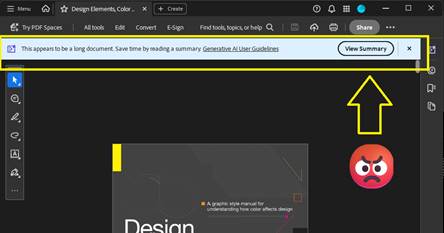
Thankfully I don’t need to close an ad like this every time I open the app for the rest of the day, but every time I open a document, I can be certain that another dialog recommending an AI summary will appear at the top of the screen. Let’s leave for another day the question of whether an AI summary is good for me, good for society, or whatever. Today I am irritated by the simple cognitive labor I have to do every time I open the app to work, to learn, or even just to read for fun. This dialog doesn’t obscure the document, but it consumes valuable real estate on my screen that I often can’t afford to give up. I have to think about it instead of what I’m reading.  

Here’s a super-cool dialog that is just big enough to be a distraction. Yay!

After I’ve closed this dialog, I’m still not done dealing with distractions. If I make the mistake of moving the cursor to the bottom of the screen, another dialog appears. Not only does this dialog require another little jolt of cognitive labor to acknowledge and clear the distraction, it creates a slight disincentive against moving the cursor while reading. Worse, this one obscures a portion of the document for a second or more after I move the mouse away from the Hot Zone.

This thing… this thing just really gets under my skin.

There’s something else about this dialog that drives me crazy. It activates a feature that is already controlled by a button at the top of the screen.

Here is the button that is supposed to activate an AI Assistant dialog like the one (but not the same one?) that automatically opens at the bottom of the screen when I move the mouse to the wrong place. It’s got fun colors!

If I wanted to use this feature, I would click the brightly-colored button at the top of the screen! This drives me crazy because the application shouldn’t just execute a command on my behalf – especially not when it has recommended the feature on startup and then reminded me of its existence again and again with popups, dialogs, and colorful buttons. Don’t treat me like a stubborn child who needs to be forced to eat his vegetables. You say you don’t like it, Adobe asks, clearly the wise adult in this exchange, but have you even tried it?

What an insult.

On this computer I pay the bills. If I want to use the damned feature I’ll damn well click the damned button.

This insult poses a philosophical challenge as well. Ask yourself: when is it OK for a machine to operate itself? The deal we’ve made with machines is simple: operators should be the ones operating them. The machine should not operate itself unless the operator has instructed it to do so, or failing to perform an operation would risk injury. When it executes a command on its own, the resulting operation should be limited in scope and duration.

Perhaps a car offers some good analogies. In my car, the headlights turn on automatically when it gets dark because I’ve turned a switch—that is, issued a command—for them to operate that way. If I don’t turn the switch, they don’t turn on. The radio doesn’t randomly change channels to introduce me to new stations (yet). It doesn’t turn on at all unless I press the button. The engine doesn’t change to Eco Mode automatically when I cross the border into a new state. The things that do operate without my explicit command, such as the automatic door locks, do so because the risks associated with error are grave. If I don’t lock the door, it may open in a crash. You can imagine the consequences. I’m willing to hand over a little piece of my autonomy to the machine here.

Does this example of remote execution, this magic AI Assistant dialog, pass that test?

In my most uncharitable moods (like the one shaping this blog post) I think about how failing to click the “Ask AI Assistant” button threatens the careers of all the managers who are responsible for driving user adoption of AI at Adobe. I suspect that Number of Impressions—that is, eyeballs on the AI Assistant feature—is a KPI they can boost by displaying this dialog at the bottom of the screen when I move the mouse down there. When I’m in these dark moods I think that’s a dirty trick to pull on me. It’s especially low down when I’ve been kind enough to allow you to reach into my bank account and automatically withdraw $19.99 every month.  

Believe it or not, we’re not done with adverts yet. After capturing the screenshots for this post, I clicked the OS window control to exit the application and close the window. To my amazement, the popup below appeared because I tried to exit without saving the document. Unlike the magic AI Assistant dialog, this could have been helpful! Alas. Rather than simply prompting me to save my changes, some manager at Adobe thought this would be another fantastic opportunity to sell me on a product feature by using dark patterns to drive my behavior. “Share for review” is bright and welcoming. Simply press Enter, it suggests, and turn on the light. And that WhatsApp logo is a big green light saying Go, Go, Go. “Save without sharing,” in contrast, is dark and foreboding, like the mouth of a cave—clearly a button for dullards and dimwits to press so they can stay in the Dark Ages.

They’ve got you coming and going. I pay for this.

Adobe isn’t alone here. Companies are taking these liberties too often. Just today, for example, Teams informed me when I started the app that there was a brand-new Copilot feature for me to try. I have to use Teams for work, so I spend a huge portion of my life—like it or not—staring at this application. I didn’t ask for this. I didn’t opt-in, and I can’t opt-out. My employer didn’t request the feature. But, nonetheless, there it is. A group of managers and devs forced me and millions of others to just live with this thing for eight or more hours per day and hundreds or thousands of dollars per year. And if we don’t care about the feature enough to click on it, they’ll find new ways to remind us that it’s there. I expect to see more popups, more nudges, brighter colors, shimmering icons, and other ruses from the big bag of user psychology tricks reminding me to Try Copilot! until the next KPI comes along that incentivizes Microsoft to arbitrarily and unilaterally change the app again and surface new features.

Adobe ain’t alone. This thing I didn’t ask for had a “helpful” little popup to announce its arrival as well.

I see this happening every day in web apps, mobile apps, desktop apps, even the operating system itself. And before you swing your boots up into the stirrups of your high horse, I know I can use Linux to avoid most of this. I know I can use open source tools. I’ve used Linux as a daily driver on my personal machines since 2007, and I was using open source apps before that. It doesn’t matter. If I want to put food on my table I have to use these products controlled by Microsoft, Adobe, Apple, Google, Esri, Autodesk, and all the other companies who do these short-sighted, authoritarian things to try to alter my behavior and shape my daily existence. I can’t escape it, and neither can you.

But still, if Adobe could chill with the ads in Acrobat, even just a little bit, that would be nice. Until then, I’ll be over here closing popup adverts and keeping my cursor at the top of the window.

Steamboat Sublime

Edit: this poem was published at The Lake, a fine online journal of poetry and reviews. Please check it out there and read all of the other amazing work!

On General Pershing Street
the crows eat Lo Mein
from styrofoam cartons
while down at the museum
of the Second World War
the Ardennes Offensive
plays on a digital loop.

The projectors over there
decode streams of numbers,
signifying suffering
in the dark forest room where
the sound of Howitzers exploding
among the artificial trees
tends to bore the children
down from the Midwest.

Tonight the Carnival Liberty
will carry those children
down the Mississippi River
churning quietly by
flaming oil derricks and
ghostly lights in the delta.

Roll, Jordan, roll
the old folks used to sing
down on the German Coast
watching dark blades churn
the oilblack current.

Black oil, the wings on the
Pershing Crows.
Rust on the wind.

Magnolia

On a trail once, I saw a tree which
should not have been, a magnolia
in the pine flats, by the influence of
some creature planted out of place.

I gave that tree a name, and when I
can’t sleep the name crosses overhead
like Radio On in the darkness static
a nebula of memory flashing to quicken me still.

Und die blumen von meine Magnolien
sind Weiß in der raum dunkel
like footlights in the gloom
shining daylight past in the room.

Like magnolias, too, we bloom in the dark
putting out flowers brown by morning and
passing ancient signals through the
rhizomous earth from which we came.

It is the same earth to which we return and
what more can we ask of the soil mysterious?
Let it be together, we might ask,
let us glow together like blooms in the hunter’s night.

What am I doing Here?

1.

Outside my window there is a shaft of sunlight streaking across the fence. The fence is dark brown, a color that hasn’t been popular since the 1970s, and the local paint store keeps a formula in the notebook just for our condo association to paint the fences and trim. They call the color “Westwood Brown,” and if we ever decide to change the color scheme here they will probably hesitate to pull the color out of the book because it is like a collector’s item now. It is a story they can tell to new employees. Even so, if you catch it when the light is just right, like right now, Westwood Brown can transport you to a different time–the Halston era, the epoch of the land yacht Coupe de Ville. It is the golden hour and the light points, like a celestial digit, straight at the spreading petals of brilliant flame-colored Bromeliad my wife planted along the fence. I think, I should take a picture of that.

I am unsure if it is me thinking about the picture, or if it is Instagram thinking it for me.

This week I quit Twitter. It’s not like I had much of a presence there, so we will be fine without each other. I had something like 150 followers, followed around 1,200 accounts, and scrolled over there occasionally when the rest of my addictive scroll-holes were drying up for the day. Lately I had been playing a simple game every time I opened the app. If the first post was someone: 1.) wailing about the hypocrisy of the other side in the culture war, 2.) flexing their success, or 3.) piling onto the controversy du jour, I would close the app and move on. I have had very little reason to scroll beyond the first screen in the past few weeks.  

I’ve quit Twitter and deleted Facebook before, but I was encouraged to close my Twitter account this time by the spate of articles that popped up this week frankly raising the question: what are we doing here? Quinta Brunson’s thoughts on minding your own damn business afford the best example, but the algorithms must have registered some little chemical twist in my pituitary because I kept running across pieces, like this profile of Twitter-person Yashar Ali, or this interview with someone who quit social media, that chip away at the foundation of social media’s necessity by questioning whether we need it or whether the people we see there are as significant as they appear. 

The cynical among you are likely to say that these are dumb questions; that of course social media people are unworthy of our attention, and of course we don’t need it. I think making this claim is a bit like playing a character, though: that of the discerning sage, you probably think, or the intelligent free-thinker standing on a stage opposite the vapid follower and the bankrupt influencer. Which of you is Malvolio and which is Toby Belch will depend upon the attitude of the viewer, however. The postures and costumes are different, but from far enough away the result is the same. They strike us now as just a couple of old assholes, rendered immortally luminous by a poetic genius of world-historical importance. On the internet, there is no poetry to illuminate them. Both characters are constricted by straitjackets of bullshit, and both of them seem terribly unhappy

That brings me in a roundabout way to the question I sat down to ask in the first place. What am I doing here? I’m pretty sure I’ve asked this question before, but I don’t want to go back and check. That would be depressing, like reading an old poetry notebook or flipping through an old diary from high school. I’ll reframe the question this time instead and try to write my way to an answer. Is what I’m doing here, whatever it is, balancing out some of that unhappiness? Is that even possible?  

2.

Lately people have been writing about how much they miss the old internet. The new internet is too vanilla, they argue, too boring and perversely commercial, like a shopping mall. I am normally inclined to agree, but the other afternoon I woke up from a nap and read about alternate reality games and obscure social media characters on Garbage Day. Perhaps it was the residual Triazolam and Nitrous Oxide leftover in my system from oral surgery that morning, but I had trouble making sense of it in the same way that I once stumbled gape-mouthed across arcane forums and exotic communities like a rube from the meandering suburbs of America Online. The old internet, with all of its nonsense, all of its randomness and quirky passion, is still with us. I’m looking at you, Malvolio, for the next line. Of course it is, you might say. It’s all just people.

But did the old internet make people happy? The internet seems always to have been a contested space, a rambling assemblage of insider communities whose best days are very recently gone. I remember my first connection, a dial-up hotline to AOL across endless air-conditioned days and nights in the summer of 2001. I was late to the party, five years behind my more affluent peers, and anxious to make up for it in sheer eagerness. I joined email lists, clicked through webrings, posted to forums. I had been led to believe, probably by bewildered news anchors or breathless magazine articles, that the web was a brand new thing. What I found instead was a bunch of conversations with no beginning and no end. It seemed like the authors of my favorite web pages had all recently stepped away from their keyboards. Communities were cantankerous places, hostile to newcomers, where old fires never seemed to burn themselves out. There was the Eternal September of 1993, for example, named for the time when all the noobs from AOL flooded Usenet and never left. At least that’s how the old Usenet admins have it. For my part, I started moderating a mailing list and stepped right into the middle of flame wars dating back years. Old-timers had to bring me up to speed on the old arguments so I would know how to intervene. New trolls arrived weekly. Maybe it was a bad list, but anyone who’s spent time moderating an online community knows the struggle. 

I think of this when I wonder why we all flocked to MySpace, and then Facebook, so rapturously. The old internet was a place made of text, and consequently a place where strangers spread their shit all over you. You couldn’t avoid it. If you wanted to communicate, you had to work at it. You had to learn the jargon, nod along with inside jokes you didn’t always find funny, assimilate opinions you couldn’t publicly examine. MySpace and Facebook were made of pictures, blissfully free of ideas that couldn’t be communicated at a glance. Facebook remains so. Your mere existence, your possession of a face, is the only cost of admission.  

3.

Neither the old internet nor the new, then, have made us any happier than we were in the time before. Rather than happiness, what we’ve gained is access to a sort of dark power bubbling in the river of instant and endless information flowing through the pipes. We use this information to construct stories, and it is through these stories that we harness the power to do work in the world. I can’t help but feel as though we’ve designed the internet to give us information which reinforces the worst stories we tell about ourselves. These are stories of growth and progress in which we appear better and smarter than anyone who lived before us. These are also stories that make us feel empowered as individuals, unique among lesser peers. Meanwhile the algorithms conditioning the flow of information enable us, in a vicious feedback loop, to look away from the stories we’d rather not tell–stories of stasis or declension, of similarity and solidarity. 

There is another force flowing in those dark waters as well: the emotive power of suggestive blank spaces. Memes are like atoms, rich in potential and eager to freely associate, but information devoid of context is like a shadow divorced from its object. We can only guess at its sources and meanings. This is precisely the type of information the internet is engineered to deliver, however. You ask Google a question and it gives you an answer. 

Google’s brand is based on authority and correctness, at least. The rest of the internet is built to keep you engaged. If content exists in a sort of Darwinian state of nature, the most successful information is that which makes you feel. Reddit and the chans are factories producing and serving up the most emotive content. You scroll TikTok or YouTube and the algorithm serves you videos according to their likelihood of keeping you engaged. Twitter and Facebook serve up bite-size nuggets of emotion on the feed. News editors engineer headlines to galvanize you to action. It is not that microblogs, articles, memes, pictures, blurbs, and short videos are incapable of rich contextualization; it is that the creators focused on context are not as successful as those focused on engagement.    

Part of what I am trying to do here is counter these tendencies. I am drawn to the stories we prefer not to tell. As a historian, for example, I am fascinated as much by continuity as by change over time. No matter the era in which they lived, informants in the archives shared their similarities with us as readily as they disclosed their differences. Our motivations echo theirs. Many of our creations fall short of theirs. Like strangers on the internet, they rub their shit all over us too. We would do well to wallow in it, though, because we cannot engineer a new world as easily as we can engineer a new user experience. Our culture is built from theirs. We live in the cities and towns they built. We speak their language, worship their gods, read their books. Rather than seeing ourselves as disruptors or innovators, we might benefit from seeing ourselves as cautious trustees of that world, therefore; as careful fiduciaries focused on moving slowly and maintaining things rather than moving fast and breaking them. 

This perspective need not be conservative. The narrative of constant growth and improvement is the guiding myth of capitalism, after all. I think building an alternative grounded in context, focused on capturing the prosaic or humanizing the proletarian (to the best of my meager ability, at least), can make us feel a little more anchored in the swift currents of a society built to pick our pockets and power over us by maintaining a constant state of instability. If this approach can make the internet a little bit of a happier place, then maybe I’m doing some good here.

4. 

I failed to mention at the beginning of this essay that I am not necessarily a reliable narrator. 

I actually don’t know whether I’m achieving any of the lofty goals I just described. Perhaps, like an artist’s statement, everything I said up there illuminates the principles organizing my work. I like the sound of that but I’m not sure it’s true. The truth is that I really just work on ideas that I like without worrying about how they fit into some schema. If I admit this, however, then my work in this essay isn’t done and it remains for me to answer: does doing this make me happy? Now I can’t hide behind a shield of analysis. This just got scary.    

Writing for me is a form of exorcism. If I go more than a few days without writing something, anything, I can feel a sort of dark pit forming somewhere inside me. I’ve come to realize that this darkness is death stalking me, as it stalks all of us, from somewhere just outside of my peripheral vision. The longer I go without writing–or, to a lesser extent, creating other things like images or music–the closer it gets, until the feeling of hopelessness is almost unbearable. This sounds like an acute illness, I understand, but each of us is striving to overcome this darkness in our own way every moment we are alive. Some of us achieve it through devotion to family. Others achieve it through friends or work, some achieve it with drugs. Writing is what works best for me. 

Every word written is written for an audience. This is obviously true for articles and essays like this one, for books, and so on, but even a journal is just a book we write for our future selves. With this in mind, a few years ago I thought: if I’m writing simply to stay alive, why not publish it? It takes so many rejection letters to get an acceptance, and I don’t have time (this line of thinking goes) to develop a whole submission and tracking process in addition to working, studying, trying to shift gears and be creative, and then somehow writing and finishing some hairbrained idea in the first place. 

The narrative of progress through technology is here to make me feel good about this. With the rise of Substack and the constant firehose of essays like “No One Will Read Your Book” or “10 Awful Truths About Publishing” or this NY Times article which found that 98% of books released last year sold fewer than 5,000 copies, there is no better time than now to rethink publishing altogether. There are currently 7,614 markets and agents listed on duotrope. Many of the “lit mags” on the web and indexed by duotrope are labors of love undertaken by one or two individuals. They went out and bought a domain and built a WordPress site, just like I’ve done here. What’s the difference? 

Ask anyone who writes and they will point out the problem right away. There are few things more pathetic than a self-publisher. Publishing my own work here helps to exorcise that darkness, but it will never feel good enough. The point of publication, especially now that we all have the resources to publish whatever we want–is that someone else thinks what you have to say is worth amplifying. Publishing your own work is like an admission of inadequacy. It feels like saying, I don’t think this is good enough to publish or, even worse, nobody else thinks this is good enough to publish. 

This is an indoctrinated opinion. Just like those stories of endless progress that troubled me a few hundred words ago, this opinion serves a social purpose. It is likely that how you see that purpose depends on your bedrock identity. Perhaps you see publication as a form of competition that elevates the best writing over the mediocre, driving everyone to greater heights of achievement along the way. Or maybe you see it as a limiting mechanism that functions–either intentionally or not–to push out voices that challenge dominant opinion. 

Since I am now in the personal and supposedly truthful part of this essay, I should say that my own view changes based on how strongly I feel about my own abilities. When I am down, probably after a rejection or two, my opinion of publishing is decidedly Jacobin: down with the editors! At other times, probably when I’ve had something published or just written something that I feel good about, I’m as sanguine about the market as Adam Smith. 

Perhaps all of my opinions are like this and the problem I am struggling to write around is that we are supposed to be consistent. Do the algorithms know I am as changeable as the wind? Do they take advantage of the distance between my variable opinions and desires and how consistent I think they are? We value being but we are all, always, merely becoming. 

This is the real strength of a blog. A book is firm, stolid like our opinions are supposed to be. A book, we might say, is being. The internet is fluid, as variable as the flood of emotions and opinions shaping our daily experience. It is a space characterized by constant becoming, by revising, rethinking. Conversations here neither begin nor end. We’re all just passing by one another, sharing ideas inscribed with light and stored as magnetic charges on a magnetic array somewhere far away. 

This website is my bridge between becoming and being.

This website is a bridge between the old web and the new.   

This website won’t make anyone happier, but it’s not for lack of trying. 

Water Oak

Quercus nigra

There is a tree in the small stand of forest where I take my lunch at work. It has grown from two woody solitudes, twisted in convergent forms like twins battling for supremacy of the same body. One of the twins has emerged triumphant since the plant took root, standing tall–as tall as a Water Oak can stand–above the other, which is bent toward its mightier sibling, rotting at the top, acceding the victory of its twin. It is a tree like other trees. It does not tower. It has no lore. It lives upon its own insistence, feeding on what sunlight it can gather from its prosaic patch of earth sandwiched between the silent waste of the government parking lot and the incessant, hissing excess of Interstate 10. Today I and the twins will commune, like yesterday, reflecting upon our own insistent will to live. Feeding in silence.

I only notice the tree because it is nearest to my picnic table. There are no charismatic grandfathers or grandmothers in my lunch-wood, no booming fauna, no roaring water. Places like this are where most Americans experience nature. In my part of the country, these places are often gray and brown, bark and mud. Dominion of the water oaks.

A water oak is like a chameleon: adaptable, unpredictable. A prolific nineteenth-century observer of trees wrote of the water oak: “There is no oak in the United States of which the foliage is so variable and so different from that of the tree, on the young stocks and on the sprouts from an old trunk or from the base of a limb that has been lopped.” It favors wetlands but can grow indifferently on compact or sandy uplands. It is semi-Evergreen in the South, taking on a showy yellow for a week or so before dropping its leaves according to its own schedule and sometimes not at all. It grows in polluted cities with poor soil and drainage as readily as it will grow in old fields or in the rich muck along the edge of wetlands. Water Oaks don’t much mind drought–contrary to their name–but don’t particularly like strong storms, which can blow away their fragile trunks. One of these likely put an end to the weaker twin of my lunch-wood’s tree. Water Oak flowers, last but not at all least, are brown like their fruit, which stains sidewalks and parking lots a deep tannic hue. In this way, then, Water Oaks connect my asphalt milieu to the impossibly murky rivers which cut their quiet way through the red clay far away from my little Southern city. Town and country, strong and weak, wet and dry: they cannot be reduced.

As they connect town and country for me, so, too, do they connect present with past. Like so many of the people I have known, Water Oaks are short and tough but prone to tragic deterioration. They die young, hollowed out by the age of 40, subject to every one of the world’s whims. Bits and pieces of the trees lie aground, bearing mute gray-and-brown testimony to past trauma. Lightning-scarred, savaged by birds and rodents, worsened and weakened by neighbors, seasons, companions, they fall and die by the age of fifty. I can’t help but think of my cousin when I imagine the tragedy of the Water Oak. The Water Oak is yours, Billy Yetman.

Commensals: Summer

I. Summer

Somewhere summer is gold, I’ve heard
but here it is gray as tired earth.

Like light mysterious to the prism,
so all it is nothing.

I pity those near the mouth of the den
embroidered with ceaseless energy.

By day by light accosted,
at night by heat exhausted.

To witness is to fall
short of empathy.

Where, then, are the fairy tales of haze gray summer,
Of dog days beneath crackling pines?

Pleiades

wood smoke redolent
of campfires at Ocean Pond

of spruce and pine pilfered
from the lumber yard where they worked

my father and
friends of my father

pleiades redolent
of amberglow stories told

of blinking night over
zipper pulls announcing silence

still, low burns the fire
warm glows the lantern, still

M.F.K. Fisher by Book Light

“Any normal man must nourish his body by means of food put into it through the mouth.”

M.F.K. Fisher, “When a Man is Small”

It is a cold winter night–cold for these parts, anyway–and I am lying in my bed, cringing my feet to escape the little insidious tendrils of icy air creeping under the blanket and reading M.F.K. Fisher by the miserly glow of a little reading light. I’ve progressed through thirty-five years of a reading life, somehow, without once encountering Fisher’s name. That all changed a few weeks ago, when an essayist I was reading mentioned her in passing. Since then I’ve seen her name again and again, as though a magical door opened from some parallel universe into this one and out stepped Fisher, master of the essay. 

When I read the sentence with which I opened this little anecdote, it was like another light, warm and simple and welcoming, began to glimmer from the opening of that door. I had to turn off the light, set the book down. I’m done. It is an extraordinary sentence. To set it down on the page and move on, as though nothing happened, must have felt like flying. It is a remarkable thing and I love it. I love it the way an artist loves a deft turn of the brush. The way a chef loves a surprising flavor. 

Perhaps one day, if I read and write hard enough, I may enjoy a glimpse through the door at a master like Fisher. Until then, I’ll try harder to stay out of the cold.