Word of the Day: Nonpareil

Today’s word of the day is appropriate, because all of you are readers nonpareil.

Nonpareil (nahn-puh-REL). Adjective. Having no equal; unrivalled, incomparable, peerless, unique.

Many of you might know this word from the candy which shares a name. We call them sprinkles, but I wish we used the Australian name–Hundreds and Thousands—because it is obviously so much better. I digress.

Sprinkles might be called nonpareils, but the word itself has a lot more to offer. It comes to us today from medieval poets, who used it to describe loves and kings, though not necessarily in that order. “[I] haue a nounparalle maystres,” The Duke of Orleans wrote in an English poem around the year 1450, for example: “The which hath hool my service & myn hert.

In another middle English poem, a French knight asks a bunch of Scottish knights about their king. One speaks up: “[I] sey for trouthe that he is Le nounpareil that euir [I] sawe or herde speke of.” Strong words.

Some time later, the word descended from the pages of poetry and made its way into the streets. In 1730, for example, you could go to the bookstore and pick up a copy of A treatise of buggs. By John Southall, maker of the nonpareil liquor for destroying buggs and nits. This isn’t a joke. You can read the book on Google Books.

Despite Mr. Southall’s best effort, nonpareil is still a wonderful word to describe things that are unequaled. Like all of you. I hope you all enjoy a weekend nonpareil.

Just watch out for “buggs.”
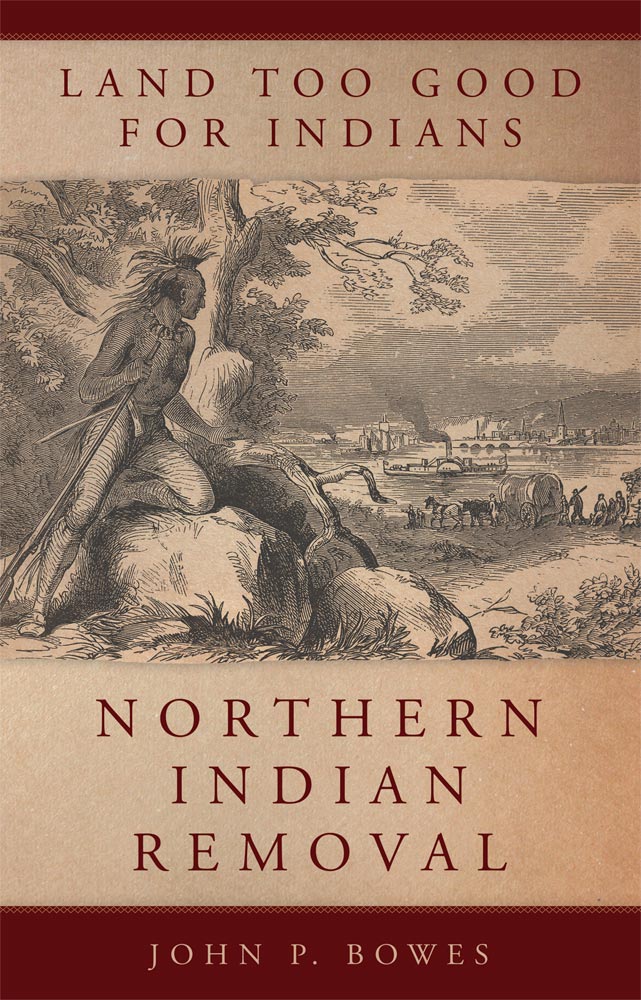
Review: Land Too Good for Indians: Northern Indian Removal.

Bowes, John P. Land Too Good for Indians: Northern Indian Removal. Norman: University of Oklahoma Press, 2016. (Publisher link)

Though settler colonialism has thoroughly re-shaped Native American historiography in the past twenty years, scholars still tend to view Indian removal as a discrete moment or era in American history–a tragic narrative beginning with the transition from away from the Civilization plan marked by the passage of the Indian Removal Act by Congress in 1830 and culminating in the Cherokee Trail of Tears nearly a decade later. In Land Too Good for Indians, John P. Bowes argues that removal has instead been a central fact in the history of the American republic, rooted in the intertwining contexts of European colonialism and Native politics that preceded its founding, and enduring to the present. To advance this argument, Bowes examines the history of removal in the Old Northwest–the vast territory stretching from Ohio to eastern Minnesota. While many other scholars in recent years have studied the history of this region’s Native peoples, Bowes is the first in decades to take up the topic of removal for its own sake. In addition to shedding new light on removal in the North, Bowes along the way demonstrates the value of this kind of regional monograph in shaping the broader historiographical currents of settler colonialism and removal in the United States. 

Bowes is sensitive to context in his definition of removal, arguing that the complicated process was shaped and mediated by the history of imperial violence in the region and the pervasive rhetoric of removal that accompanied this violence. The book’s two opening chapters explore these themes in depth. In the first, on violence, Bowes explores the imperial clashes that shaped the region before and immediately after the American Revolution, arguing that these conflicts contributed to a belief on the part of American settlers and policymakers that Indians were “savage agents of the British Empire” who could not abide peace [20]. This violence contributed to a rhetorical tradition that linked peace, propriety, and prosperity for Americans in the region with the removal of its Native peoples. American lawmakers responded to this rhetoric by crafting policies and embarking on a series of punishing wars that achieved removal–the subject of the book’s remaining chapters–while the history of violence and ongoing rhetoric of removal continue to leave deep scars on American Indians everywhere. Bowes closes the work with a chapter on the aftermath of removal and its legacy in memory, arguing that the “American era is a removal era.” 

By shifting the terrain, Bowes offers a powerful corrective to the historiography of removal. While the scholarship of settler colonialism has thoroughly unsettled historians’ understanding of early America, there is still much work to be done “on the ground” to understand how settler colonialism as a foundational American political philosophy shaped the nation’s culture and politics. Looking away from the South, where scholarship on the history of capitalism and slavery continues to unearth new layers of meaning in the region’s Native history, forces scholars to re-evaluate the many contexts that shaped Indian policy. That said, some of the scholarship from other regions may have bolstered the theoretical framework that gives this book its shape. Engaging Matthew Jennings’ work on the clashing “cultures of violence” that shattered Native political power in the early American Southeast, for example, might have supported the chapter on violence–especially as we learn more about the myriad connections that drew (and continue to draw) Native peoples together across the continent. Likewise, Ned Blackhawk’s unique treatment of violence as a unit of analysis suggests intriguing possibilities for the argument about violence that forms such an important part of this book. The rhetoric of removal, too, seems an extension–an important and valuable expansion, to be sure–of Francis Jennings’ “cant of conquest.” These minor historiographical quibbles neither blunt the argument nor detract from the contribution this book makes to the historiography of removal and American settler colonialism, however, and scholars of Native history, the early republic, or the Old Northwest will find this book a valuable addition to their bookshelves for years to come.

Firelight Composite

From inky black, pull starry future
To drape o’er young shoulders and wish it so

Now wash the garment in strange elixirs
Bell upon chime, we watch the spring days go

Shed the cloak of night in diurnal climes
To sweat o’er the troubled skein of the self

Now in the dog days to heaven you climb
Bell upon chime, place the cloak on the shelf

Shadows draw to vespers unclothed still
By the evening firelight learn fear

We lost so much time climbing autumn hills
By firelight, by sunlight, month over year

Oak leaf alights upon Earth in repose
Its airborne life but a blink to commence

To become the soil in winter gray glow
No cloak of night to warm the lapis winds

Shine like inky black
stuff of future past

Word of the Day: Recondite

Truth is the best policy, they say, and in truth: with everything happening in the world, I forgot to think about any more Words-of-the-Day last week. Sorry about that.

Part of the problem is that it’s hard to think of words quite recondite enough to share. Let’s remedy that this week with a word you’ll be proud to show off.

Recondite. (REK-un-dyte).Adjective. little known or understood; abstruse, obscure; profound.

This $2 word comes from the Latin word reconditus, which means the same thing; but if you look a little deeper, the root is actually condere, which can be translated as: “to put or bring together,” “to put up, store,” or “to conceal.” (1)

It’s that last one, that element of concealment, that makes recondite words so popular for words-of-the-day columns and so annoying to everyone who doesn’t know what they mean. Just look at this list of Merriam-Webster’s Words-of-the-Day from last month. Even Microsoft Word is a little chapfallen by this list. Spellcheck does not recognize the word rectitudinous and dutifully places a little red squiggly line underneath. Talk about recondite!

Merriam-Webster’s Word of the Day entries for part of March 2020

The word first came to English-speakers through an astronomer, John Bainbridge (2), waxing philosophic about the Great Comet of 1618:

“I hope this new Messenger from Heauen,” he wrote, “doth bring happie tidings of some munificent and liberall Patron…by whose gracious bountie the most recondite mysteries of this abstruse and diuine science shall at length be manifested.”

The Great Comet of 1618

That’s nice, but I think I prefer the words of Robert Louis Stevenson, who wrote:

“Humanly speaking, it is a more important matter to play the fiddle, even badly, than to write huge works upon recondite subjects.”

Have a great week! Don’t be afraid to share your suggestions for words—recondite or not—and I’ll credit you when I write them up.

(1) One of the standard Latin textbooks, by the way, teaches students that Latin was basically sung. So that’s ♫Con-de-re, like an opera singer.

(2) Bainbridge described himself as “Doctor of Physicke, and louer of the mathematicks.”

Verses on a Plague Night Walk

When the sodium lights first come on

Those are the moments 

Those moments of departed daylight

Departed vision 

Those adolescent moments of endless

Possibility

.

Each footstep a promise to the future

Each breath an assurance of its promise to me

.

Tonight we walked the twenty-something streets 

In those adolescent moments

Senses awakening to the edge of night

Inhaling understanding as we each day grow

Footsteps to tomorrow 

Word of the Day: Commensal

Today’s Word-of-the-Day is close to our hearts at DEP, I think, because it’s such an important part of the ecosystems we work so hard to protect. Today’s word is commensal.

There are two meanings to commensal, but I want to start with the one we’re most likely to use here.

Commensal. Biology. Applied to animals or plants which live as tenants of others (distinguished from parasitic).

It’s easiest to understand the concept if we apply an –ism to the end. Commensalism is a relationship in which one party benefits while the other is unaffected. It’s different from parasitism, in which one animal benefits at the expense of another; and it’s different from mutualism, in which both parties benefit.

So why is it important to our work at DEP? In two words: Gopher Tortoises.

I’ll let FWC tell the story using their website on the topic. There’s also a great fact sheet there and a neat flickr gallery of photos.

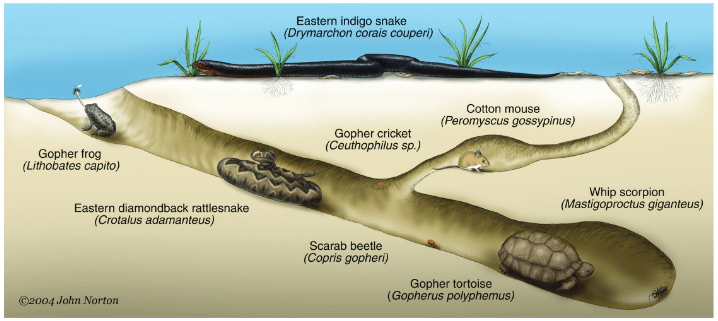
“The gopher tortoise’s presence is important to more than 350 species that benefit from the burrows gopher tortoises dig. Because gopher tortoises alter their environment in a way that benefits other species, they are recognized as a keystone species. Animals that obtain food, refuge, and other benefits from the burrows are known as gopher tortoise commensal species. A healthy and widespread gopher tortoise population is necessary for commensal species populations to exist.”

Some of these commensal species include: burrowing owls, indigo snakes, rattlesnakes, mice, and a host of insects. There’s a lot going on in those burrows!

Commensals in Gopher Tortoise Burrows

I didn’t know this before I started writing about commensals this afternoon, but this meaning comes from an earlier definition of commensal.

Commensal. Adjective. Eating at, or pertaining to, the same table.

People used the word this way for over 500 years before the biologists took it over. The first reference in written English comes from a middle-English text called the Testament of Love, in which one of the characters asks another, “O where hast thou bee so long commensal?”

Perhaps that’s what I’ll ask one of the Gopher Tortoise commensals the next time I see one in the woods.

Are you familiar with any other commensals? Does anyone have anything to share about Gopher Tortoises, the 350 species who live with them, or any other Florida commensals?

Thanks for reading and have a great week!

Minute Wild: Ants at Lake Talquin

Recorded at Lake Talquin State Forest, March 29, 2020. It was exceptionally hot and difficult to see the screen down on the ground for this little scene. I moved the camera halfway through (before this scene starts) and didn’t notice until I got back off of the trail later that the hole was out-of-focus. What a disappointment! I nearly hiked back to this spot to try again, but on second thought, I began to like this shot. Individual ants take “center stage” here. Instead of thinking about the ants as part of an abstract collective, the viewer is encouraged to “know” the ants who venture into focus. This sheds new light on the individuals at work here and casts their little society in a different shade.

Word of the Day: Portmanteau

I’ve written a couple of these posts for work, but thought that others might like to read them, too.

Good morning!

Let’s try something different today to bring everyone a little closer together. Let’s talk about words.

With all the talk recently about telework, I’ve been thinking about the word portmanteau, which is today’s Word-of-the-Day.

What is a portmanteau? As my friend Jay would say: “I’m glad you asked.”

Portmanteau (pôrtˈmantō): Noun. A word formed by blending sounds from two or more distinct words and combining their meanings. Also, more generally: a term or phrase which encompasses two or more meanings.

If you had brunch recently, you took part in a portmanteau (of the words breakfast and lunch, of course). If you’ve stayed in a motel, you stayed in a motor + hotel. Do you watch Netflix? That means you probably like Internet + flicks. How about Velcro? This one’s a little obscure, but every time you tear open Velcro, you’re actually using a portmanteau of the words velours (which is French for velvet) + crochet. Who knew?

So when and where did we start using the word portmanteau, which is actually a type of suitcase, to refer to new words made by jamming old words together?

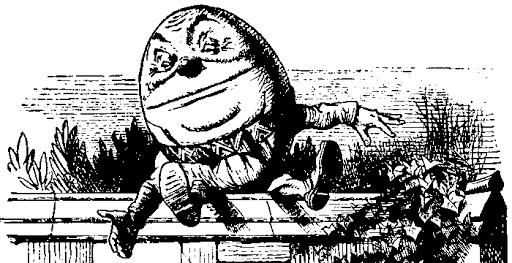
According to the Oxford English Dictionary, Lewis Carroll gave us the word in the wonderfully weird little book Through the Looking-Glass, when Alice (whom you probably know from her trip to Wonderland)asks Humpty-Dumpty to explain the meaning of a poem. Here’s the first verse:

‘Twas brillig, and the slithy toves
Did gyre and gimble in the wabe:
All mimsy were the borogoves,
And the mome raths outgrabe.

Like me, Alice is puzzled by this nonsense. Thankfully, Humpty-Dumpty is able to explain part of it. “Well, ‘slithy‘ means ‘lithe and slimy’,” he explains: “’Lithe’ is the same as ‘active’. You see it’s like a portmanteau–there are two meanings packed up into one word.”

And with that, Lewis Carroll invented a new word. How about you? Can you think of any portmanteaus?

Through the Looking-Glass - Chapter 6
Humpty on his wall