Thunder

Thunder here among the pines and red hills is the song of summer. Listen long enough and you will hear its song in different keys throughout the day. Thunder at 7:00 in the morning sings a gentle song of relief, of decisions you need not make, heat you need not endure. On a weekday morning this song is colored faintly with regret. It is a lullaby the armchair by the window hums softly to itself as you clamber through the door and leave for work. Thunder at noon is puckish, a cymbal crash to punctuate your lunch hour or send you scurrying to the pavilion at the beach clutching your shoes and towels. At day’s end here thunder sings the loudest, conducting a fanfare for the setting sun diva as it dips below the closed-curtain horizon. 

At night thunder sings the sweetest song. A song of space, of longing, and distance. A song of life.   

Flash Fiction: Spanish Moss

From Shade: Selections from the Shade Tobacco Region Oral History Project

Off in the woods there was a palace I saw it with princes and prelates and fools up under the swingin moss dancin their old jigs in them fancy getups like in the old movies what used to come on TV on Sunday. I saw one he was jinglin them little teeny bells like a song at Christmastime just a prancin around back in there like you know what and I thought that was funny but it hurt my head too. My dogs they didn’t hardly know what to think about it all Rex he looked at me like what is all this and I said I reckon I don’t know but we best be gettin out a here. And that’s what we did too but I sure wish we had stuck around to see what they was doin back there and what they was gonna do next because I don’t reckon we will ever see anything quite like it again long as we walk this earth. I been back in there since and they wasnt there no more and that made me a little scared and a little sad too I aint too proud to say. Theres things in this world we dont know nothin about and we aint got no business knowin it neither.

Magnolia

On a trail once, I saw a tree which
should not have been, a magnolia
in the pine flats, by the influence of
some creature planted out of place.

I gave that tree a name, and when I
can’t sleep the name crosses overhead
like Radio On in the darkness static
a nebula of memory flashing to quicken me still.

Und die blumen von meine Magnolien
sind Weiß in der raum dunkel
like footlights in the gloom
shining daylight past in the room.

Like magnolias, too, we bloom in the dark
putting out flowers brown by morning and
passing ancient signals through the
rhizomous earth from which we came.

It is the same earth to which we return and
what more can we ask of the soil mysterious?
Let it be together, we might ask,
let us glow together like blooms in the hunter’s night.

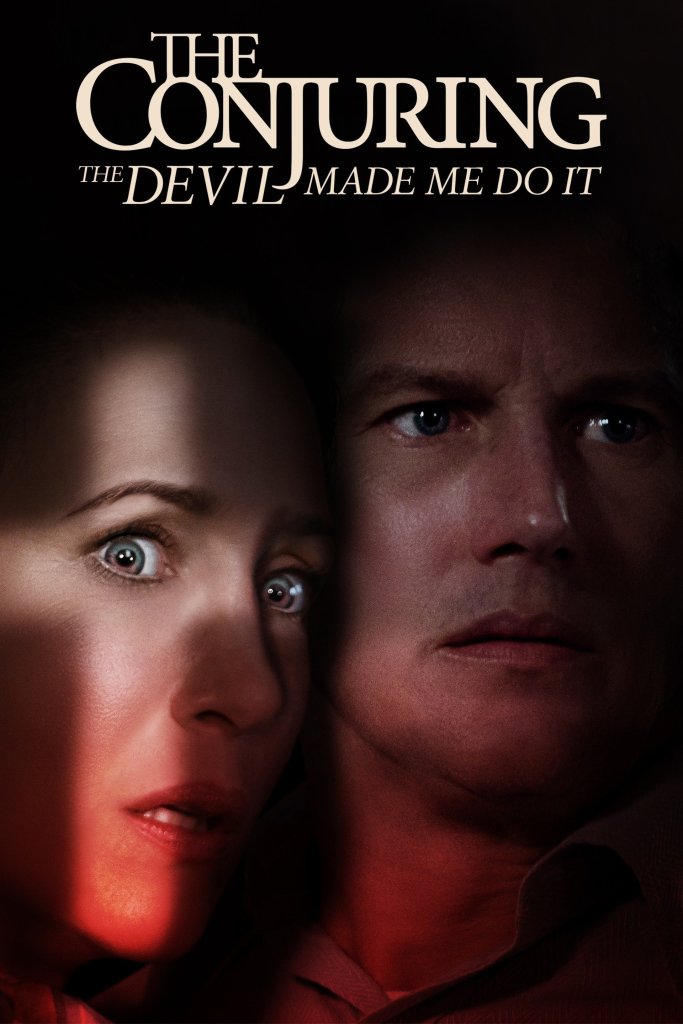
Review: The Conjuring: The Devil Made Me Do It

There is a period of ten minutes or so at the beginning of a film when it can be anything. We have some idea of what to expect from trailers, posters, and other hype, but we are ready for the film to surprise us, to subvert our expectations and carry us into a world we did not expect to discover. That ten minute window is rich with opportunity for the filmmaker, and it is vitally important to the success of the film that follows.  

In the first few minutes of The Conjuring: The Devil Made Me Do It, Director Michael Chaves sets up a possession film. If the ritualized prayers and weird body contortions in the first scene aren’t enough, the ham-fisted homage to the famous poster scene from William Friedkin’s masterpiece of the genre, the priest standing in the accursed light of evil outside of the Regan’s house in The Exorcist, should clue us in. A few minutes in, therefore, I was prepared for a good possession and an exorcism.  

Homage, much?

Imagine my surprise when the story shifted gears, grinding awkwardly like the clutch in an old diesel truck from what seemed like a trite but entertaining exorcism feature to a haunted murder mystery. Imagine the complete whiplash, then, when the gears ground again, and the film turned into a kill-the-witch cat-and-mouse chase. A film is traditionally structured in three acts. The Devil Made Me Do It is three different films. With some investment in the story, any one of the three separate acts might have stood alone. When you stand them one atop the other, though, like children in a trench coat sneaking into an R-rated movie, the whole thing falls down.  

The Devil Made Me Do It takes its title from a briefly infamous Connecticut manslaughter trial in the 1980s in which a young man named Arne Johnson claimed that a demon who had taken possession of his soul compelled him to stab his landlord with a pocketknife. Johnson’s case would have garnered little more attention than a few “isn’t that weird” news reports and a couple of law review journal articles if not for the intervention of self-proclaimed demonologist Ed Warren and his wife, spirit medium Lorraine Warren, in 1981. The “case files” of the Warrens, a New England couple who rose to fame in the latter half of the last century by cashing in on Americans’ growing fascination with the paranormal through a series of expertly marketed “investigations” resulting in numerous books and publicity events in the 1970s and 1980s, provide the basis for the films in The Conjuring series. The paranormal interpretation of the Amityville murders remains the most (in)famous of the couple’s investigations, but the success of The Conjuring franchise has certainly replenished the coffers of their estate for generations to come. 

The story The Devil Made Me Do It tells is about as complicated and neurotic as you might expect a tale of demonic possession, crafted by master hucksters to defend a man from murder charges in pursuit of their own fame, to be. There are spoilers ahead, so skip a couple paragraphs if you think, for some inexplicable reason, that you might want to subject yourself to this film. I recommend reading ahead and then spending your time watching a better movie, but you do you.  

In the first scene, we meet the Glatzel family and their possessed son, David. The Warrens are there—as charming and down-to-earth as the very capable Vera Farmiga and Patrick Wilson can render them—and so is Arne, David’s sister’s extremely friendly boyfriend. David and Arne share a moment of tenderness while waiting on a priest to arrive for an exorcism and, when the exorcism doesn’t go as planned, Arne invites the demon inhabiting his girlfriend’s brother to go ahead and enter his body instead. Things start to get weird for Arne after that, until he has a freakout that would have thoroughly amused Burroughs or Hunter Thompson and murders his drunk and stupid landlord while Blondie’s “Call Me” (1980) plays on the stereo for some reason. Thus ends the possession film in Act 1.  

In Act 2, the haunted mystery, the Warrens need to build a case proving that Arne’s act was a consequence of demonic possession rather than a freak brawl with a lame soundtrack. Sure enough, guided by Lorraine Warren’s extremely reliable and specific connection with the spirit realm, they find a witch’s totem underneath the Glatzel house. Makes sense, right? The Glatzel kid was possessed, the demon jumped to Arne, bing bang boom, the landlord is dead. Seeking a pattern of similar occult influence in other crimes, therefore, the Warrens reach out to police throughout New England. The search leads eventually to a skeptical cop working an inexplicable murder and disappearance in Massachusetts and a former priest giving the world his best impression of a thousand-yard stare after investigating a satanic cult in Annabelle, a prior instalment in The Conjuring universe. After the Warrens solve the case for the cop—drawing, again, on Lorraine Warrens amazingly detailed second sight—the priest reveals that his own daughter is the witch causing all the trouble. How convenient! Thus ends the haunted murder mystery film in Act 2.  

In Act 3, the Warrens must kill the witch to save Arne. After a conventional labyrinth chase in the occult dungeons beneath the priest’s home, the Warrens destroy the witch’s altar. This breaks her magical connection to Arne, which pisses off the demon to whom she had promised Arne’s soul. The demon kills the witch, Arne is relieved of his demonic tormentor, and the Warrens have another little toy to put in their collection beside the Annabelle doll and the painting of Valak the Defiler. Arne gets a light prison sentence, but it’s OK because he’s just relieved to be free of the demon, and everyone lives happily ever after.  

Writer and filmmaker Jon Boorstin provides an excellent framework in his book, The Hollywood Eye, to explain how and why movies work. This notion—that Hollywood filmmakers, perhaps in distinction from those working in other milieus, are focused on what works rather than what is beautiful or moving or artistic—is important, Boorstin argues, because it is the font from which meaning and aesthetic value and all that other stuff flows. This is because, according to Boorstin, viewers watch a film with two “eyes” which must be simultaneously pleased for the film to capture and maintain their attention. Only when they are suitably rapt will they be responsive to the film as a work of art. 

The first “eye” is the “voyeur’s” eye, focused on realism. This is the little voice in your head that says, “that would never happen,” or, “shouldn’t they have run out of bullets a long time ago?” Next there is the “vicarious” eye, focused on feeling. This is the part of you that is carried away by the story, the part that falls in love with the characters or causes you to bite your nails at the suspenseful parts. Boorstin says that these basically correspond to brain and heart, and I can think of no reason to dispute him. 

There are things this film does well. Michael Chaves builds on the world of The Conjuring with interesting views of sweeping New England vistas. This pleases the “voyeur” eye. The cast is well put-together. The stars share good chemistry, and, at times, their talent breaks through a scene just enough to please the “vicarious” eye. There are enough such moments to say that this a functional bit of filmmaking. It progresses like a Toyota Corolla from point A to point B. It makes you jump a few times. It has a couple of good monsters and, I don’t know, you don’t see the boom mics in the shots. If you spent money on a theater ticket or forked out for an HBO Max subscription to see it, you would be hard-pressed to point to a particular moment where it went off the rails. 

But let’s be honest. You would be hard-pressed to find that moment because the whole film is a god-damned train wreck. The Devil Made Me Do It just doesn’t work. Its three acts do not cohere. Its characters are only developed far enough to fit in the panels of the comic book tie-in that is sure to follow. Here are some examples. It was unclear whether the demon or the witch was the villain. As a result, both of them were shallow, shallow, shallow. Defeating them felt more like a chore than a quest. The skeptical detective in Act 2: why does he exist? (More on that below). And who is the protagonist? I suppose it is the Warrens, but then who is Arne Johnson? I didn’t care about Arne Johnson. Captain Howdy in the original Exorcist film has more screen presence than Arne Johnson in this story, and Captain Howdy only appears on screen for three frames. Was Arne Johnson a hero? A victim? A villain? Who knows? In any event, it didn’t matter to me whether the Warrens saved him or not. Nothing mattered, in fact, because the story was awful. The fat, naked ghoul in Act 2 will make a cool collectible action figure, I guess. Sorry for the spoiler.  

One more thought before I slam the door on this one. I don’t know what Ed and Lorraine Warren were like in real life, but the characters Ed and Lorraine Warren in The Conjuring universe grow more insufferable with each new installment in the series. They’re always right; sanctimoniously pure; perfectly in love with each other. There’s nowhere for them to go, no way for them to grow. Perhaps this untouchability was a condition of the contract with the Warrens’ estate—a $2 billion deal for New Line so far—but it sets them apart from the characters written in the round. The villains in these movies are not the monsters and demons, who knock down like ninepens in the end, but the straights. The skeptics and normies who choose not to believe in the paranormal must be set straight by the Warrens, and there’s a mighty horde of us. We’re the baddies, the fools, wondering what in the world is going on in these movies. They’re not for us. That’s OK. 

The Mountain of Military Knowledge

I got this link in a Vice newsletter today: “Air Force Video Explains What a Penis Is.” 

Image from the U.S. Air Force via Vice.

Ha. Nice, Vice. That’s a funny one. It practically clicks itself. 

When I was through laughing, though, I started to wonder. If you surfaced all the information and knowledge the United States military has amassed, described it, and made it accessible, how big would the resulting library be? Would it rival the Library of Congress? What if you included the literal mountains full of classified information? 

Doctors in fatigues offering up a straight-faced explanation of the penis makes for a funny video, sure, but think about the context of that video. That penis video–a remarkably well done bit of public health information, I’m not too cool to admit–was likely produced as part of an overall health information strategy that included other videos designed to meet specific training goals for Air Force personnel. Someone had to draw and render that 3D phallus. Someone wrote the text, someone storyboarded the video, someone cast the doctors. Someone set up the studio. Someone made arrangements for the doctors to come and record their parts. Someone filmed the segments. They did multiple takes. Someone else–probably more than one someone–edited the video. Someone else posted it on the web. On and on it goes, every day, and that’s just videos. The Army and Navy probably have their own versions of the same thing, and each of them is just one example of hundreds of thousands of pamphlets, manuals, SOPs, videos, audio recordings, books, specifications, and other resources the military produced in just a single year. Multiply that by seventy-five years and you would have the Alexandria multiplex of knowledge accumulation and dissemination the modern American military has undertaken since the end of World War II. 


That’s not ephemeral information, like emails and phone logs, but strategic media created for the express purpose of knowledge transfer and managed according to long-term retention and preservation policies. Where is all of it? Vice mentions DVIDS, the “Defense Visual Information Distribution Service,” but that’s just visual information. The various service “doctrine” websites are another source, and of course the National Archives and Library of Congress have millions of items. Much of this knowledge is accessible, but it is extremely decentralized. What would we do with it all if it were described and catalogued? What if it was semantically linked? Would we just make fun of it, or would we make use of it?

What am I doing Here?

1.

Outside my window there is a shaft of sunlight streaking across the fence. The fence is dark brown, a color that hasn’t been popular since the 1970s, and the local paint store keeps a formula in the notebook just for our condo association to paint the fences and trim. They call the color “Westwood Brown,” and if we ever decide to change the color scheme here they will probably hesitate to pull the color out of the book because it is like a collector’s item now. It is a story they can tell to new employees. Even so, if you catch it when the light is just right, like right now, Westwood Brown can transport you to a different time–the Halston era, the epoch of the land yacht Coupe de Ville. It is the golden hour and the light points, like a celestial digit, straight at the spreading petals of brilliant flame-colored Bromeliad my wife planted along the fence. I think, I should take a picture of that.

I am unsure if it is me thinking about the picture, or if it is Instagram thinking it for me.

This week I quit Twitter. It’s not like I had much of a presence there, so we will be fine without each other. I had something like 150 followers, followed around 1,200 accounts, and scrolled over there occasionally when the rest of my addictive scroll-holes were drying up for the day. Lately I had been playing a simple game every time I opened the app. If the first post was someone: 1.) wailing about the hypocrisy of the other side in the culture war, 2.) flexing their success, or 3.) piling onto the controversy du jour, I would close the app and move on. I have had very little reason to scroll beyond the first screen in the past few weeks.  

I’ve quit Twitter and deleted Facebook before, but I was encouraged to close my Twitter account this time by the spate of articles that popped up this week frankly raising the question: what are we doing here? Quinta Brunson’s thoughts on minding your own damn business afford the best example, but the algorithms must have registered some little chemical twist in my pituitary because I kept running across pieces, like this profile of Twitter-person Yashar Ali, or this interview with someone who quit social media, that chip away at the foundation of social media’s necessity by questioning whether we need it or whether the people we see there are as significant as they appear. 

The cynical among you are likely to say that these are dumb questions; that of course social media people are unworthy of our attention, and of course we don’t need it. I think making this claim is a bit like playing a character, though: that of the discerning sage, you probably think, or the intelligent free-thinker standing on a stage opposite the vapid follower and the bankrupt influencer. Which of you is Malvolio and which is Toby Belch will depend upon the attitude of the viewer, however. The postures and costumes are different, but from far enough away the result is the same. They strike us now as just a couple of old assholes, rendered immortally luminous by a poetic genius of world-historical importance. On the internet, there is no poetry to illuminate them. Both characters are constricted by straitjackets of bullshit, and both of them seem terribly unhappy

That brings me in a roundabout way to the question I sat down to ask in the first place. What am I doing here? I’m pretty sure I’ve asked this question before, but I don’t want to go back and check. That would be depressing, like reading an old poetry notebook or flipping through an old diary from high school. I’ll reframe the question this time instead and try to write my way to an answer. Is what I’m doing here, whatever it is, balancing out some of that unhappiness? Is that even possible?  

2.

Lately people have been writing about how much they miss the old internet. The new internet is too vanilla, they argue, too boring and perversely commercial, like a shopping mall. I am normally inclined to agree, but the other afternoon I woke up from a nap and read about alternate reality games and obscure social media characters on Garbage Day. Perhaps it was the residual Triazolam and Nitrous Oxide leftover in my system from oral surgery that morning, but I had trouble making sense of it in the same way that I once stumbled gape-mouthed across arcane forums and exotic communities like a rube from the meandering suburbs of America Online. The old internet, with all of its nonsense, all of its randomness and quirky passion, is still with us. I’m looking at you, Malvolio, for the next line. Of course it is, you might say. It’s all just people.

But did the old internet make people happy? The internet seems always to have been a contested space, a rambling assemblage of insider communities whose best days are very recently gone. I remember my first connection, a dial-up hotline to AOL across endless air-conditioned days and nights in the summer of 2001. I was late to the party, five years behind my more affluent peers, and anxious to make up for it in sheer eagerness. I joined email lists, clicked through webrings, posted to forums. I had been led to believe, probably by bewildered news anchors or breathless magazine articles, that the web was a brand new thing. What I found instead was a bunch of conversations with no beginning and no end. It seemed like the authors of my favorite web pages had all recently stepped away from their keyboards. Communities were cantankerous places, hostile to newcomers, where old fires never seemed to burn themselves out. There was the Eternal September of 1993, for example, named for the time when all the noobs from AOL flooded Usenet and never left. At least that’s how the old Usenet admins have it. For my part, I started moderating a mailing list and stepped right into the middle of flame wars dating back years. Old-timers had to bring me up to speed on the old arguments so I would know how to intervene. New trolls arrived weekly. Maybe it was a bad list, but anyone who’s spent time moderating an online community knows the struggle. 

I think of this when I wonder why we all flocked to MySpace, and then Facebook, so rapturously. The old internet was a place made of text, and consequently a place where strangers spread their shit all over you. You couldn’t avoid it. If you wanted to communicate, you had to work at it. You had to learn the jargon, nod along with inside jokes you didn’t always find funny, assimilate opinions you couldn’t publicly examine. MySpace and Facebook were made of pictures, blissfully free of ideas that couldn’t be communicated at a glance. Facebook remains so. Your mere existence, your possession of a face, is the only cost of admission.  

3.

Neither the old internet nor the new, then, have made us any happier than we were in the time before. Rather than happiness, what we’ve gained is access to a sort of dark power bubbling in the river of instant and endless information flowing through the pipes. We use this information to construct stories, and it is through these stories that we harness the power to do work in the world. I can’t help but feel as though we’ve designed the internet to give us information which reinforces the worst stories we tell about ourselves. These are stories of growth and progress in which we appear better and smarter than anyone who lived before us. These are also stories that make us feel empowered as individuals, unique among lesser peers. Meanwhile the algorithms conditioning the flow of information enable us, in a vicious feedback loop, to look away from the stories we’d rather not tell–stories of stasis or declension, of similarity and solidarity. 

There is another force flowing in those dark waters as well: the emotive power of suggestive blank spaces. Memes are like atoms, rich in potential and eager to freely associate, but information devoid of context is like a shadow divorced from its object. We can only guess at its sources and meanings. This is precisely the type of information the internet is engineered to deliver, however. You ask Google a question and it gives you an answer. 

Google’s brand is based on authority and correctness, at least. The rest of the internet is built to keep you engaged. If content exists in a sort of Darwinian state of nature, the most successful information is that which makes you feel. Reddit and the chans are factories producing and serving up the most emotive content. You scroll TikTok or YouTube and the algorithm serves you videos according to their likelihood of keeping you engaged. Twitter and Facebook serve up bite-size nuggets of emotion on the feed. News editors engineer headlines to galvanize you to action. It is not that microblogs, articles, memes, pictures, blurbs, and short videos are incapable of rich contextualization; it is that the creators focused on context are not as successful as those focused on engagement.    

Part of what I am trying to do here is counter these tendencies. I am drawn to the stories we prefer not to tell. As a historian, for example, I am fascinated as much by continuity as by change over time. No matter the era in which they lived, informants in the archives shared their similarities with us as readily as they disclosed their differences. Our motivations echo theirs. Many of our creations fall short of theirs. Like strangers on the internet, they rub their shit all over us too. We would do well to wallow in it, though, because we cannot engineer a new world as easily as we can engineer a new user experience. Our culture is built from theirs. We live in the cities and towns they built. We speak their language, worship their gods, read their books. Rather than seeing ourselves as disruptors or innovators, we might benefit from seeing ourselves as cautious trustees of that world, therefore; as careful fiduciaries focused on moving slowly and maintaining things rather than moving fast and breaking them. 

This perspective need not be conservative. The narrative of constant growth and improvement is the guiding myth of capitalism, after all. I think building an alternative grounded in context, focused on capturing the prosaic or humanizing the proletarian (to the best of my meager ability, at least), can make us feel a little more anchored in the swift currents of a society built to pick our pockets and power over us by maintaining a constant state of instability. If this approach can make the internet a little bit of a happier place, then maybe I’m doing some good here.

4. 

I failed to mention at the beginning of this essay that I am not necessarily a reliable narrator. 

I actually don’t know whether I’m achieving any of the lofty goals I just described. Perhaps, like an artist’s statement, everything I said up there illuminates the principles organizing my work. I like the sound of that but I’m not sure it’s true. The truth is that I really just work on ideas that I like without worrying about how they fit into some schema. If I admit this, however, then my work in this essay isn’t done and it remains for me to answer: does doing this make me happy? Now I can’t hide behind a shield of analysis. This just got scary.    

Writing for me is a form of exorcism. If I go more than a few days without writing something, anything, I can feel a sort of dark pit forming somewhere inside me. I’ve come to realize that this darkness is death stalking me, as it stalks all of us, from somewhere just outside of my peripheral vision. The longer I go without writing–or, to a lesser extent, creating other things like images or music–the closer it gets, until the feeling of hopelessness is almost unbearable. This sounds like an acute illness, I understand, but each of us is striving to overcome this darkness in our own way every moment we are alive. Some of us achieve it through devotion to family. Others achieve it through friends or work, some achieve it with drugs. Writing is what works best for me. 

Every word written is written for an audience. This is obviously true for articles and essays like this one, for books, and so on, but even a journal is just a book we write for our future selves. With this in mind, a few years ago I thought: if I’m writing simply to stay alive, why not publish it? It takes so many rejection letters to get an acceptance, and I don’t have time (this line of thinking goes) to develop a whole submission and tracking process in addition to working, studying, trying to shift gears and be creative, and then somehow writing and finishing some hairbrained idea in the first place. 

The narrative of progress through technology is here to make me feel good about this. With the rise of Substack and the constant firehose of essays like “No One Will Read Your Book” or “10 Awful Truths About Publishing” or this NY Times article which found that 98% of books released last year sold fewer than 5,000 copies, there is no better time than now to rethink publishing altogether. There are currently 7,614 markets and agents listed on duotrope. Many of the “lit mags” on the web and indexed by duotrope are labors of love undertaken by one or two individuals. They went out and bought a domain and built a WordPress site, just like I’ve done here. What’s the difference? 

Ask anyone who writes and they will point out the problem right away. There are few things more pathetic than a self-publisher. Publishing my own work here helps to exorcise that darkness, but it will never feel good enough. The point of publication, especially now that we all have the resources to publish whatever we want–is that someone else thinks what you have to say is worth amplifying. Publishing your own work is like an admission of inadequacy. It feels like saying, I don’t think this is good enough to publish or, even worse, nobody else thinks this is good enough to publish. 

This is an indoctrinated opinion. Just like those stories of endless progress that troubled me a few hundred words ago, this opinion serves a social purpose. It is likely that how you see that purpose depends on your bedrock identity. Perhaps you see publication as a form of competition that elevates the best writing over the mediocre, driving everyone to greater heights of achievement along the way. Or maybe you see it as a limiting mechanism that functions–either intentionally or not–to push out voices that challenge dominant opinion. 

Since I am now in the personal and supposedly truthful part of this essay, I should say that my own view changes based on how strongly I feel about my own abilities. When I am down, probably after a rejection or two, my opinion of publishing is decidedly Jacobin: down with the editors! At other times, probably when I’ve had something published or just written something that I feel good about, I’m as sanguine about the market as Adam Smith. 

Perhaps all of my opinions are like this and the problem I am struggling to write around is that we are supposed to be consistent. Do the algorithms know I am as changeable as the wind? Do they take advantage of the distance between my variable opinions and desires and how consistent I think they are? We value being but we are all, always, merely becoming. 

This is the real strength of a blog. A book is firm, stolid like our opinions are supposed to be. A book, we might say, is being. The internet is fluid, as variable as the flood of emotions and opinions shaping our daily experience. It is a space characterized by constant becoming, by revising, rethinking. Conversations here neither begin nor end. We’re all just passing by one another, sharing ideas inscribed with light and stored as magnetic charges on a magnetic array somewhere far away. 

This website is my bridge between becoming and being.

This website is a bridge between the old web and the new.   

This website won’t make anyone happier, but it’s not for lack of trying. 

Magical Spaces

Across the driveway opposite my bedroom window there is a little field. The little field is more of a yard than a field. It is less than a hundred feet wide, maybe two hundred feet long. It drops a few feet down from the entrance driveway and parking lot, like a little emerald bowl carved out of the earth to compensate for the concrete piled up next to it. Still, the field rises above the busy road on the other side. It is an engineered space.

It is also, I have found, a magical space.

The little field is shaded almost completely by stately pine trees emerging from the bowl. I like to take my dog, Penny, over there for walks. She finds little things in the grass to chase and smell. Sometimes she is overwhelmed by some aroma there, driven to flop over and roll around, covering herself in its wonder. There are patches of grass she enjoys eating. I call this “salad time” and we do it almost every day.

At the back side of the field, right up against the fence separating us from the high school next door, there is a tree unlike the others. Where the pines tower, telegraphing their power to absorb the sun’s energy by shading the ground far below, this tree huddles. Its branches swirl and cascade, creating a sort of greencast temple underneath the spreading boughs. I like to pause there on our walks and bask in this little space. This tree, a mulberry in a pine field, is the wellspring of the field’s magic.

There is magic everywhere you go. I don’t mean abracadabra magic, rabbits from hats, wand-waving, magical beasts. I mean magic as an expression of the mysterious power that certain spaces can exercise over us. You know it when you see it. We are drawn to these spaces. Perhaps it is an echo of the space’s past. Our neighborhood used to be a dairy, for example, and the little field calls out to this past in stark contrast with the lumber, concrete, and steel of the parking lots and buildings surrounding it. Or perhaps the magical space is a zone of quiet in an otherwise hectic environment. It could be a nook, a void, a hiding place, a lively spot in a drab surround. It could be anything, but it must be powerful to pull us so.

As often as not, the magic that a space works on us has as much to do with what’s happening in our own minds while we’re there as it does with the power the space possesses of itself. Behind my workplace, for example, there was once a little picnic area cleared out of the squat hardwood margin between the interstate and the parking lot. They ruined it some time ago by dropping a big wooden gazebo back there, but it was a nice place for awhile to read a book and eat a sandwich while the cars and trucks roared by on the other side of trees. This was a magical space for me, but now that it is gone the magic persists in my memory as an enchantment of time and place rather than harmonic space. It was magical because I lived with significant feelings there.

I started my job at the end of my graduate coursework. It was a time when most of my colleagues began turning their attention from seminars to teaching and conferences in preparation for the workforce. I will spare you the “quit lit” picaresque–which is an insufferably self-absorbed genre that exists out there on the wild internet–but in order to explain the magic of the lunch clearing I need to explain that I felt like there wasn’t much future in academia. Living here was as good as living anywhere else, I thought, and if I got a job instead of starting to teach I would still be free to write and do all of the big thinking that I went to grad school to do in the first place. But it still felt like giving up on the dream. I remember making my way to the clearing some time in my second week on the job and thinking, this isn’t so bad. I remember the autumn afternoon, watching the long shadows playing across the building through the trees while completely re-imagining who I was and who I could be. Sitting at one of the picnic tables there I got a text message from my friend which read, “Is it soul-crushing?”

“No, actually,” I replied, “it’s not bad at all.”

I would return to the clearing again and again, day after day. I read books there: Pilgrim at Tinker Creek was one. I wrote there: poetry, essays, emails. I wrote about a Water Oak tree living next to the bench where I sat to read and think. I wrote an ode to my wife sitting beneath the tree’s branches. Occupying this magical space helped me escape the workday. It charged my creativity and gave me peace. It helped me adapt to a period of profound change.

Think of a magical space like a power-up in a video game. Being there may recharge your batteries or allow you to focus. It may give you a moment of peace or an hour. What it is and what it means will vary as widely as the people who occupy the space and the feelings shaping their experience from moment to moment. On this blog I intend to share examples. Perhaps, by doing so, I can better explain myself.

Review: The Hitch-Hiker (1953) and the Dark Underside of the Postwar Road

There was a prolonged moment after World War II when the road symbolized for Americans ultimate freedom. These were the years of interstate highways, land yachts, Jack Kerouac and William Burroughs, teenage hot rodders, drive-in movies and drive-up restaurants. Empowered by all things automotive, the story goes, Americans were footloose and wild. As a result they lived through hard drinking years, fast living, devil may care years. So it goes. From Happy Days to the good-old days long gone in the animated film Cars, we’ve idealized the period to the point of caricature.

Underneath all of this there lurked a menacing darkness. Killers roamed the highways. Cons, pimps, and addicts thrived in the automotive underground. Post-traumatic former GIs, reliving the horrors of Guadalcanal or the Bulge, struggled to hold it together. Women and minorities took the brunt of it. Woe betided those who happened to be both. Automotive freedom ran like a wine dark current beneath this moment, empowering some as thoroughly as it shackled and destroyed others.

A modest but brilliant noir picture emerged from this ambivalent milieu: Ida Lupino’s chilling feature, The Hitch-Hiker. Released in 1953, it is important that this is the only classic noir directed by a woman. It is not the only entrée in the genre to call the free-wheeling postwar world to account, but Lupino’s gaze, executed by cinematographer Nicholas Musuraca and carried out by deft performances on the part of the film’s three stars, is attuned to cruelty and power in a way that her male counterparts did not grasp in their cynicism or machismo.

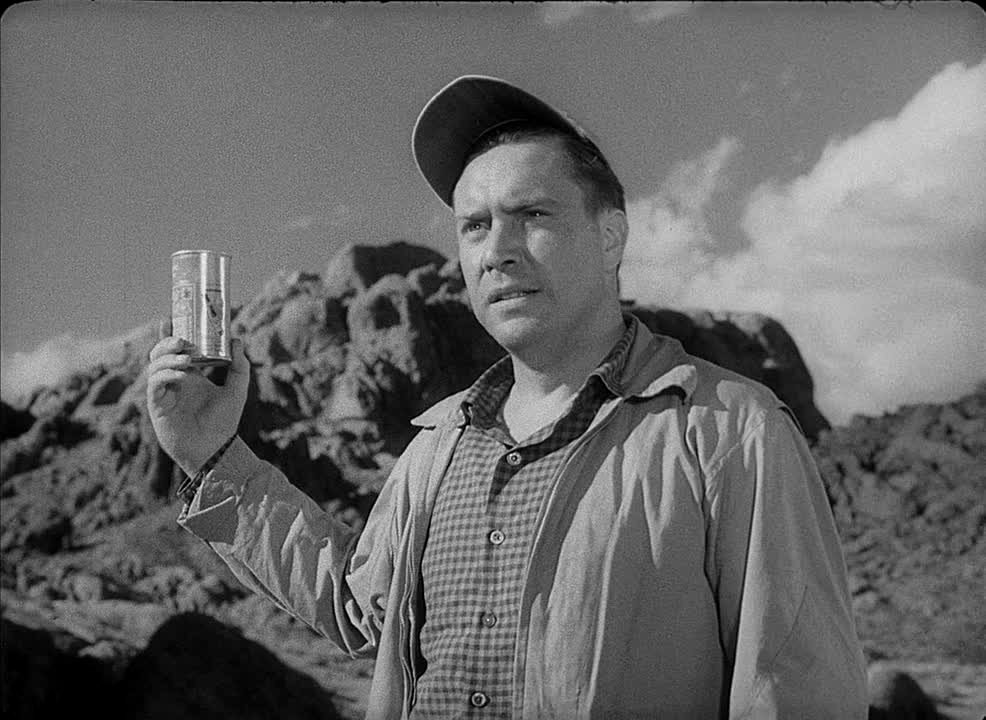
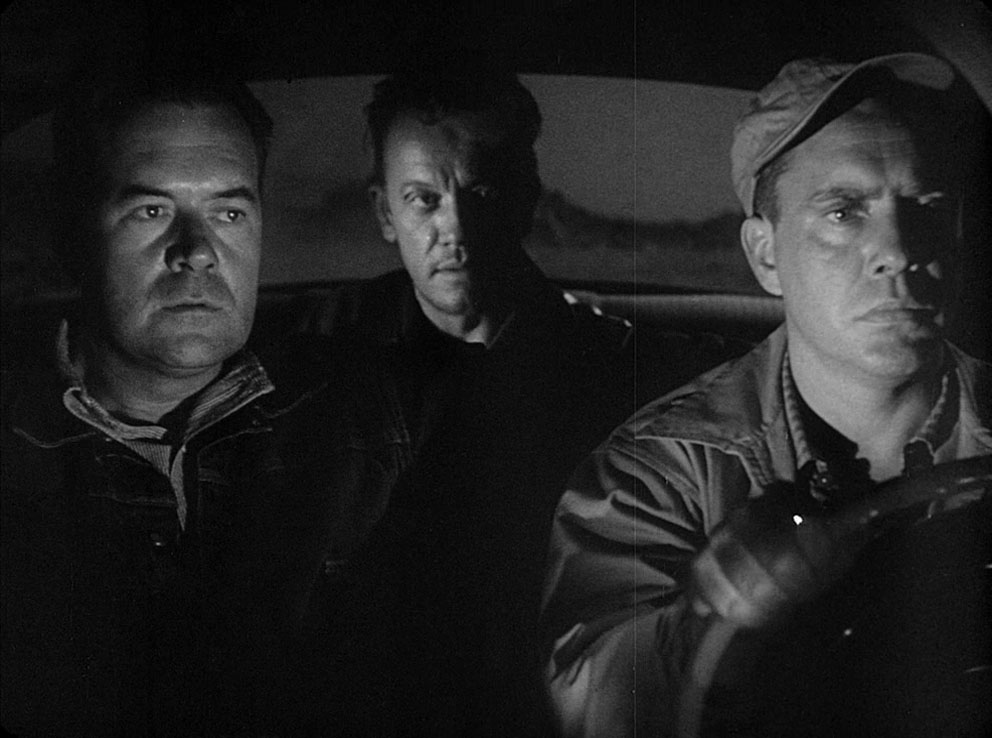
The premise of the film is straightforward. It was based on the killing spree of Billy Cook, a drifter and small-time hood with a deformed eye who gained notoriety for a 22-day rampage that left six people dead on the road from Missouri to California. In the film, Cook is represented by the character Emmett Myers, ably performed by a dead-eyed William Talman in his best role before moving to the small screen on Perry Mason. We meet Myers mid-spree. His M.O. is to hitch a ride, kill the driver, and steal the car, along with the driver’s wallet, before moving onto the next victim. After another grisly killing, Myers sticks out his thumb and hitches a ride with fishermen Roy Collins, played by Edmond O’Brien, and Gilbert Bowen, played by Frank Lovejoy. These two are old friends enjoying a taste of freedom from their domestic lives on a weekend outing to the Gulf of California when they pick up Myers, who proceeds to lead them at gunpoint on a wild odyssey into Mexico, where he plans to kill them and board a ferry to freedom across the Gulf of California. A taut thriller ensues, driven by stark contrasts, interesting inversions, and powerful frustrations, until Myers runs hard into the arms of justice and the fishermen are delivered from their terrible captivity.

Lupino manages to achieve much in the film’s meagre 71 minute runtime. Most striking to me are the contrasts, both visual and atmospheric, that serve the story. The setting alternates from the hotbox enclosure of Collins’ and Bowen’s car to the wide-open desert spaces through which it is passing. Collins and Bowen are seated in the light up front; Myers is shrouded in darkness in the backseat. Myers is blind in one eye and sharp as a hawk in the other. These contrasts are amplified by inversions, however. Collins is a mechanic and driver. He possesses the most power, therefore, in the most enclosed space. Bowen is the only character who can speak Spanish. Myers holds a gun, then, but Bowen has the power of knowledge when they need to resupply in one of the sleepy Mexican hamlets along the way. Ultimately, the dynamic that emerges between the three characters is a sort of inverted buddy feature. I often found myself wondering whether Bowen and Collins would remain friends when the ordeal was over, or if they would go their separate ways.

The Hitch-Hiker was a B picture for a reason, however. Its weaknesses are plain. There are holes in the plot big enough to drive the fishermen’s Plymouth through. The opportunities for the captives to overpower Myers and run away are seemingly endless, for example. The plot does nothing with the interesting inversions of power represented by the captives’ advantages in mechanical and linguistic knowledge, either. When Bowen speaks with Mexican characters in the film—all of whom are represented in the round, an unexpected breath of fresh air for the time—the opportunities are as tantalizing as his failure to capitalize on them is frustrating. The outcome is predictable, and the film’s short runtime does not allow Lupino to introduce many curves in the road on the way there.

Despite these flaws, The Hitch-Hiker is a must-see noir thriller. Uncluttered and raw, beautifully shot and intelligently optimistic in the shadow of the dark real-world events that shaped its story, the film captures the ambivalence of a moment in American history rich with opportunity but scarred by violence and despair. Imagine watching it in the bench seat up front of an old Chrysler parked in a darkened lot, soundtrack blaring through a speaker hung on the window. After the movie you drop off the speaker on the way out and drive home laughing about your date’s white knuckles when they clutched your knee at the suspenseful parts. You round a bend in the road, straining to see in the weak headlight beams what might be in the dark pavement ahead, and there is a lonesome man in a dark jacket on the side of the road, thumb stuck out, pointing your way. You keep driving.