No award or esteem could ever
match for pleasure
the pure electric joy I share
with my dog when we
notice each other
in the same room
Category: Writing
“disfruta la magia”
Notes toward a personal essay about the murder of trade unionists in Colombia by soft drink bottlers and about how the political is the personal: “disfruta la magia”
To believe a thing is made from people is to forgive. It’s the things that make the people here: the things made of people there.
I was born in the russet flush of autumn, 1985, in an evergreen place. My growth in the intervening years has been a gut-wrenching display of limbs beating upon membranes of things. That’s not how it feels, of course,
Being alive.
To be in the Round is to Be. Each of us a Rebel. Each of us a Gifted Student. Each of us a Birth of the Cool. Each of us a King of the Lizards.
I became a data point in the carbon rush of 1996, in a climate-controlled room. My reduction in the exaflops since that shining moment has been a substantial work of engineering prowess. That’s not how it feels, of course,
Being golden.
Ink beneath the gloss.
Acceptable loss.
Consummation to Consumption.

Flash Fiction: “Crazy on You”
“No matter how good you are, there will always be someone better.” Michael didn’t remember these words when he heard the song on the radio. He remembered another of his father’s expressions instead: the wordless joy on his face when he watched his son play the bass all those years ago. Dad would bring home CDs and tapes during the week while Michael stayed with mom across town. “I’ve got something I want you to play for me when we get home,” he would say on the golden hour drive over on Friday afternoon. “Can you play this one?”
Michael almost always could play them. He could fake his way through anything his dad wanted, jamming along to the hits of the sixties and seventies on a big amplifier he carried up and down the stairs. Lit by the warm glow of the kitchen shining into the living room of his Dad’s upstairs apartment, he felt unstoppable, ripping through Santana, Pink Floyd, Spirit, Motown, his father nearly crying from joy at the silken effortlessness of his fingers on the fretboard.
Michael was scrolling over Twitter in the Drive-Thru line at McDonald’s when the song, Heart’s “Crazy on You,” came on the radio. He had heard the song a hundred times before, but this time the bass line caught his ear. The flat, compressed warmth of the tone. The almost indiscernible space between one note and the next. The irrepressible motion beneath the melody. The gesture toward counterpoint. He was surprised this song wasn’t one of his Friday night songs all those years ago, and shocked by the feelings it brought to the surface.
This was ridiculous. Heart never made him feel anything at all. It wasn’t supposed to. He wasn’t sure who was supposed to feel things when they listened to Heart, but it wasn’t him. But there it was anyway. He was unsettled and saddened, stirred to a smoldering anger in some deep register he couldn’t quite understand.
Maybe it was loss. Michael had played a few shows after high school, but it never worked out. Bands fell apart. Rent had to be paid. Moving away, going to New York or Nashville, took more than he could save. The movies about starving artists don’t tell you that it takes money to live like a pauper in a new place. By the time he learned how to take care of himself, though, it was too late.
Listening now, he could hear so much in “Crazy on You” that he would have missed then. Striving to outdo the performer, he would have added flurry upon flair–runs, ghost notes, slaps, sweeps–smirking over the fretboard, but he wouldn’t have heard the music at all. Maybe now he could do it right, he thought, because responsibility both gives and takes. The steady tug of necessity drove him away from music a few years after the living room concerts, yes, but didn’t it give him the humility to step back, to listen? It was a shame, he thought, to waste talent on the young.
But would he ever stand before an audience as joyously rapt as his dad had been so many years ago?

Muir’s Notebooks: Thinking and Working in the Age of Distraction
Not long after the guns of the Civil War fell cold in the 1860s, John Muir opened a notebook and inscribed his name on the frontispiece. “John Muir, Earth-Planet, Universe,” he wrote, situating himself as firmly as any of us may hope to do so. And then he started walking, a thousand miles or so, to the Gulf of Mexico. After setting out on the first of September 1867 on the “wildest, leafiest, and least trodden way I could find,” Muir’s excitement was palpable when he reached Florida six weeks later. “To-day, at last, I reached Florida,” he wrote in his journal on October 15th, “the so-called ‘Land of Flowers’ that I had so long waited for, wondering if after all my longing and prayers would be in vain, and I should die without a glimpse of the flowery Canaan. But here it is, at the distance of a few yards!”

Muir undoubtedly walked a long way from Indianapolis to Georgia, but he cheated his way into Florida, booking overnight passage on a steamboat from Savannah to Fernandina. Perhaps that’s why he felt so down and out after an easy half-day and night of conversation and loafing aboard the steamer Sylvan Shore. “In visiting Florida in dreams,” he wrote, “I always came suddenly on a close forest of trees, every one in flower, and bent-down and entangled to network by luxuriant, bright-blooming vines, and over all a flood of bright sunlight. But such was not the gate by which I entered the promised land.” What he found, instead, was a tangle of marsh and swamp. A hopelessly flat vista of marsh broken only with “groves here and there, green and unflowered.” Dropped unceremoniously on this inauspicious shore, without even breakfast to ease his way into the new world, Muir was overwhelmed. The peninsula was “so watery and vine-tied,” he reported, “that pathless wanderings are not easily possible in any direction.” He made his way south from the gloomy coast down the railroad tracks, “gazing into the mysterious forest, Nature’s Own.” Everything was new. “It is impossible,” he wrote of the forest along the tracks, “the dimmest picture of plant grandeur so redundant, unfathomable.” Sometimes I feel the same way, though I’ve lived here longer than Muir had been alive when he walked down the lonely rail line trying to make sense of the place.
I picked up Muir’s book recounting the journey a hundred and fifty years later because part of that very long walk took place in Florida, and I am filling up my own notebooks here on Earth-Planet, Universe with the starry-eyed hope that another book about Florida may one day emerge from their pages. Unlike Muir, though, I can draw on an infinite library of books, videos, field guides, and brochures to reduce the unfathomable grandeur of Muir’s nineteenth century gaze to the qualified certainty of my twenty-first century gaze. On a different shelf in my office, for example, I can pull down the Guide to the Natural Communities of Florida. I can leaf through the 81 varieties of land cover the authors have identified in the state until I find the one that Muir was likely to have found along his lonely railroad track: Mesic Hammock. “The shrubby understory may be dense or open, tall or short,” the Guide reports, “and is typically composed of a mix of saw palmetto (Serenoa repens), American beautyberry (Callicarpa americana), American holly (Ilex opaca),” and so on. Maybe I can pull down the field guide to plants and trees, then; or, perhaps, just type their names into the Google search bar on my phone and find out just about anything we know about these thorny, prickly plants with just a few taps.

The sort of deep botanical knowledge Google offers to any armchair naturalist today is what Muir hoped to gain as he explored the little-traveled paths of the South. He set out to find it by tramping through the vines, turning over the ground cover, taking notes, making impressions of leaves and flowers. With only hardbound botanical guides to aid his memory—paperback books then only existed as pamphlets and dime novels, not scientific guides—we can imagine the kind of notes that Muir would need to take to remember it all. Most of all, he had to know how to look, how to take in enough information about a plant shaded by drooping beautyberry branches or hidden beneath the cutting blades of a saw palmetto a few feet off of the trail to describe it later or look it up if he didn’t know what it was. Muir did not have the luxury of a camera in his pocket, connected to an electric warren of machines making inferences from the collective learning of scientists and thousands of amateur naturalists to identify the plant instantly. Muir had to live with it for a while, turning it over and over in his mind until he could write it down. He had to bring some knowledge to the field with him, to know the important parts to remember. Muir had to work for it.
I’ve used apps to identify plants, and they are wonderful. You snap a picture of a flower, or a whorl of leaves, press submit, and like magic a selection of possible candidates appears. It only takes a moment more of reading and looking to positively identify the plant before your eyes. There is no need to walk the laborious path down a dichotomous key—a series of this-or-that questions people use to identify plants and trees in the field—or stumble through the obscure chapters of a specialized field guide. If a naturalist today can download identifying data to their phone, and if they bring a battery backup or two into the field, the old field guide is as obsolete as the buggy whip. Problem solved, right?
The internet, and by extension our whole lives now, thrives on this promise of problems solved. The old “fixed that for you” meme sums up the mindset, but you have to go a step beyond the meme’s use in the culture wars (the internet’s stock-in-trade, after all) to get there. If you don’t know it, here’s the culture war setup. Somebody posts an opinion you don’t like on the internet. You strike words from the post, like this, and replace them with other words that you do like. Then you post the altered text in the comments of the original under the simple heading, “FTFY.” For example, if you wrote a tweet that said, “I love Twix!,” some wag might respond: “FTFY: I love Twix Reese’s!” Though your interlocutor would be wrong—Twix is undoubtedly the superior candy—unfortunately the stakes are often much higher. For a while, FTFY was the perfect clap-back to a Trump tweet or a Reddit post. Like all things on the internet, however, FTFY’s popularity is fading away by sheer dint of use. Here’s an example I found on Google in case you are reading this after the meme has completely disappeared.

FTFY is a successful meme because it works on two levels. The first is merely discursive: here is an alternative point of view. If you go back and read one of the breathless essays, from before 4chan and Trump, on the democratic promise of the internet, you’ll see a lot of this. The internet is a place for people to express their opinions, and isn’t that good? Mark Zuckerberg still relies on this discursive level to justify Facebook. “Giving everyone a voice empowers the powerless,” he told a room full of people at Georgetown University last year, who, for some reason, did not burst into uproarious laughter, “and pushes society to be better over time.” If this were the end of communication—I speak, you listen; you speak, I listen—then Zuckerberg would be right and FTFY would be innocuous. The second level of meaning is why anyone uses the meme in the first place, though.
The second level is philosophical: here is a self-evidently correct point of view which shows that you are wrong and I am right. Someone using FTFY intends to point at differences of opinion and erase them at the same time. This creates a sort of nervous thrill in the reader, who revels in the shame of the erased whether they agree with them or not. It has no effect on the author beyond alienation, but the point is not to persuade anyway. It is to profit, in the social and psychological sense, by signaling one’s virtue in exchange for internet points. Rinse and repeat.
Facebook, Reddit, Twitter, and others turn shitposters’ play points into real dollars and power through the intentionally-obscured work of software algorithms. Thanks to this perverse alchemy, which converts mouse movements and button-presses into trillion-dollar fortunes, social media excels at delivering us to these impasses of opinion, where we can only point and gasp at hypocrisy for the benefit of those who agree with us. We call this free speech, but it feels like something else, like a sad video game we play on our phones in bed until we fall asleep and the screen slowly goes black. FTFY.
Software’s been Fixing That For You since the 1950s. It started off slowly, the awkward preserve of reclusive engineers, but–I don’t have to tell you this, you already know–grew in scale and intensity like a wild avalanche until now, when it holds the power, depending on which expert is holding forth, to either destroy life on the planet or usher in a new era free of death, pain, and inequity. This bestows upon software the elemental power of nuclear fission. Until recently, we’ve accepted it without nearly as much hand-wringing. Is it too late?
The world-eating logic that propels software’s growth is “efficiency.” This is the Fix in FTFY. In his recent book, Coders, Clive Thompson describes the “primal urge to kill inefficiency” that drives software developers. “Nearly every [coder]” he interviewed for the book, Thompson writes, “found deep, almost soulful pleasure in taking something inefficient and ratcheting it up a notch.” I understand this urge. At work I have spent the same hours I would have spent downloading and renaming files writing a script to download and rename them instead. I’ve coded macros to make it easier to populate fields on contract templates instead of confronting the banality of existence by editing Microsoft Word documents manually. As a result of this urge, coders and capitalists argue, nearly everything we do is more efficient today as a result of software than it was ten years ago. As 5G transmitters make their way to cell towers around the world, the same argument goes, nearly everything we do tomorrow will be more efficient than it is today. We accept this, the way we accept new clothes or new toys.

We shun or diminish the things that software displaces. Landline phones are not merely obsolete, for example. They are laughably so. The checkbook register my teachers labored for me to understand in school simply vanished some time around 2005. I left $2,000 worth of CDs sitting next to a dumpster when I moved away from my hometown in 2008 because I had ripped them all to my computer and had an iPod. (I would later deeply regret this decision). Typewriters are a cute hobby for rich actors, rather than tools so vital that Hunter S. Thompson carted his IBM Selectric II from hotel to hotel on benders for forty years. Rejecting these things feels as much like a social gesture as a personal one. Who wants to be seen writing a check at the store? Who wants to talk on a landline phone?
Shunning inefficiency strengthens our commitment to software. This brings me back to Muir’s notebook. Muir had to see, to remember, to write once in his notebook and then write again to turn those notes into something useful. Seeing and remembering, rather than taking a picture: inefficient. Looking things up in a book when he returned from the field: inefficient. Taking notes on paper: inefficient. And yet I find when I go out into the woods with my phone, tablet, or computer and do what Muir did I see very little and remember even less. I write nothing; and nothing useful, beyond a beautiful afternoon and a vague green memory, comes of it.
This is mostly my fault. I could use these powerful tools, I guess, to cash in on efficiency and make something even better. But I don’t. Instead, I get distracted. I pull out my phone to take a picture and find that I have an email. I scroll Twitter for a moment, then Reddit, until I am drawn completely into the digital worlds on my screen, shifting from one screen to the next until I manage, like a drunk driver swerving back into his lane, to pull my eyes away. There is a moment of disorientation as I confront the world once again. I have to struggle to regain the revery that drove me to reach for the phone in the first place. This part is not completely my fault. The dopamine-driven design language that drives us to distraction is well known. If I manage to overcome this pattern somehow and actually take the picture, it goes to Google Photos, one of several thousand pictures in the database that I will never seriously think about again. When I take notebooks into the woods, with pen and pencil and guide book, I do remember. I see and think and make things that feel useful.
More than merely remembering what I’ve seen, working without computer vision helps me see and learn more than I did before I put pencil to paper. Because I am a historian, always looking backward, my mind turns once again to old books and ideas. I am reminded of the nineteenth-century art critic, writer, and all-around polymath John Ruskin. Ruskin understood the power of intentional sight–the practiced vision aided by the trained eye of an artist–as a key to deeper understanding. “Let two persons go out for a walk,” he wrote in one thought experiment; “the one a good sketcher, the other having no taste of the kind.” Though walking down the same “green lane,” he continued, the two would see it completely differently. The non-sketcher would “see a lane and trees; he will perceive the trees to be green, though he will think nothing about it; he will see that the sun shines, and that it has a cheerful effect, but not that the trees make the lane shady and cool….”
What of the sketcher? “His eye is accustomed to search into the cause of beauty and penetrate the minutest parts of loveliness,” Ruskin explained. “He looks up and observes how the showery and subdivided sunshine comes sprinkled down among the gleaming leaves overhead,” for example. There would be “a hundred varied colors, the old and gnarled wood…covered with the brightness; … the jewel brightness of the emerald moss; …the variegated and fantastic lichens,” and so on. This, I argue, is the vision of the unaided eye in the twenty-first century. Unencumbered by the machines that reduce our experience to arrays of data, we can see it in new and more meaningful ways.

More than a renowned art critic, Ruskin was an influential social reformer who believed that adult education, especially education in art, could relieve some of the alienation and misery suffered by workers who spent the majority of their lives operating machines. Workers in Ruskin’s era struggled for the 40-hour work week, deploying the strike, the ballot, and the bomb for the right to enjoy more of their own time. Twenty years after his death, workers throughout the industrialized world seized the time to pursue the sort of self-improvement that Ruskin longed for them to enjoy. Because we can only believe in what Milan Kundera called the “Grand March” of history–that things are better today than they were yesterday, ever onward–we forget the flush of literacy, creativity, and prosperity that blossomed with the passage of the eight-hour workday. Some thirty years later, my grandfather still enjoyed the sort of self-actuated existence Ruskin advocated.
Pop managed a water filter warehouse in Jacksonville, Florida for thirty years after recovering from a gruesome leg injury he sustained in North Africa in 1944. At night, when my dad was a child, Pop took a radio repair correspondence course. He never finished high school but devoured books nonetheless, especially interested in anything he could get on Nazism. He had a doorstop copy of Shirer’s Rise and Fall of the Third Reich on his living room chair. He took subscriptions to magazines, Popular Mechanics alongside the Saturday Evening Post–nothing highbrow but dog-eared anyway–and read the newspaper religiously. There wasn’t much television to watch. Father and son built models together. They went fishing.
It was not a golden time by any means. Pop was a brooding, difficult man. He kept a bottle of gin hidden in the yard. He nursed grudges and pouted over a spare dinner of Great Northern beans. He dealt silently with a gnawing pain from the war in North Africa, it seems, until he couldn’t hold it in, dressing up in his army uniform one time in the depths of a quietly furious drunk and threatening to leave the family. I don’t imagine he read his books and magazines when the black dog drove him to the bottle, but I hope he could take comfort in ideas nonetheless. My dad does. He chased away the lumber yard blues on Sunday night watching Nature on PBS and reading Kerouac on the side of the couch illuminated by the warm light from the kitchen. He executed masterful oil paintings on the kitchen table, weeknight after weeknight, amassing a room full of work that would make the neighbors gasp with delight at the jewel box in the back bedroom of the unassuming apartment upstairs. He passed some of this down to me, in turn, though I will never have the talent or the patience he poured into his work. I hope Pop gave that to us.
Pop was not alone in his evening pursuits, but it is hard to imagine a similar man pursuing the same interests today. In 2018 the Washington Post, interpreting survey results from the Bureau of Labor Statistics, reported that the share of Americans who read for pleasure had reached an all-time low, falling more than 30 percent since 2004. The share of adults who had not read a single book in a given year nearly tripled between 1978 and 2014. It is tempting to blame the internet and smartphones for this decline, but it began in the 1980s, according to the Post. Screens account for this change. Television, firstly and mostly, but computers, too, and now phones and tablets. I have stared at a screen for ten hours today. There is still at least two hours of screen time left before I will lovingly set my phone in its cradle by the bed and fall asleep. I am not wringing my hands over the death of books. Ours is a highly-literate era, awash in information. Drowning in text. I am wringing my hands over what seems like the dearth of deep thought, the kind of careful thinking that comes from reading without distraction, from looking without mediation, from quiet.
After a week tramping across the flat pine woods and swamps of North Florida, John Muir found himself in Cedar Key, a sleepy village on the coast which feels almost as remote today as it must have felt in the 1860s. “For nineteen years my vision was bounded by forests,” he wrote, “but to-day, emerging from a multitude of tropical plants, I beheld the Gulf of Mexico stretching away unbounded, except by the sky.” Then as now, however, Cedar Key was the end of the road. With no boats in the harbor and apparently little desire to move on to points further down the peninsula–and vanishingly few they would have been–Muir decided to take a job at a local sawmill and save money for passage on a timber ship bound for Galveston which was due to arrive in a couple weeks. He worked a day in the mill, but “the next day… felt a strange dullness and headache while I was botanizing along the coast.” Nearly overcome with exhaustion and an overwhelming desire to eat a lemon, he stumbled back to the mill, passing out a few times along the way, where he collapsed into a malarial fever. “I had night sweats,” he wrote, “and my legs became like… clay on account of dropsy.” Uncertain whether he would even stay in town when he arrived, Muir instead spent three months convalescing in the sawmill keeper’s house at the end of the world in Cedar Key.

Once he was strong enough to leave the house, the young naturalist made his faltering way down to the shore. “During my long stay here as a convalescent,” he recalled in the memoir, “I used to lie on my back for whole days beneath the ample arms of… great trees, listening to the winds and the birds.” I have spent long days and nights in the hospital. It is nearly impossible to imagine even a half-day in a recovery room without the option of scrolling the internet, watching TV, playing a video game. I suppose, therefore, that I am thankful for software. It fixed boredom for me.
But still, Muir’s description of Cedar Key is warm, reminiscent. It is easy to imagine that these fever days spent listening to the waves and thinking about plants and birds and life beneath the spreading Live Oak boughs on the desolate gulf coast of Florida contributed in a significant way to who he was about to become. Just a few months later, Muir was in California whooping with delight in the Yosemite Valley. It was there that he became Yosemite’s Muir, the preservationist sage of the Sierra Club and father of modern environmentalism. But perhaps we should rename a little stretch of the quiet wooded shore in Cedar Key the Muir Woods, too. The time Muir spent there in forced meditation seems to have shaped the man, if only slightly, as the forces of wind and water in their slight but constant way shaped El Capitan. There was nothing to fix.
Sixteen Pines
Sixteen pines mark my quarantine transect
this little quadrangle a world of worlds
of being and becoming
of platonic forms shaping
future dream etudes where I
spin in Fibonacci circles to see it all
and always fail
These sixteen pines a Myrmidon crew
serving petulant songbirds dashing
from light to shadow
Their songs the hymns of Ithaca
the hymns I have always known
Well, such is the aviary
these sixteen pines
a mighty dialectic
Firelight Composite
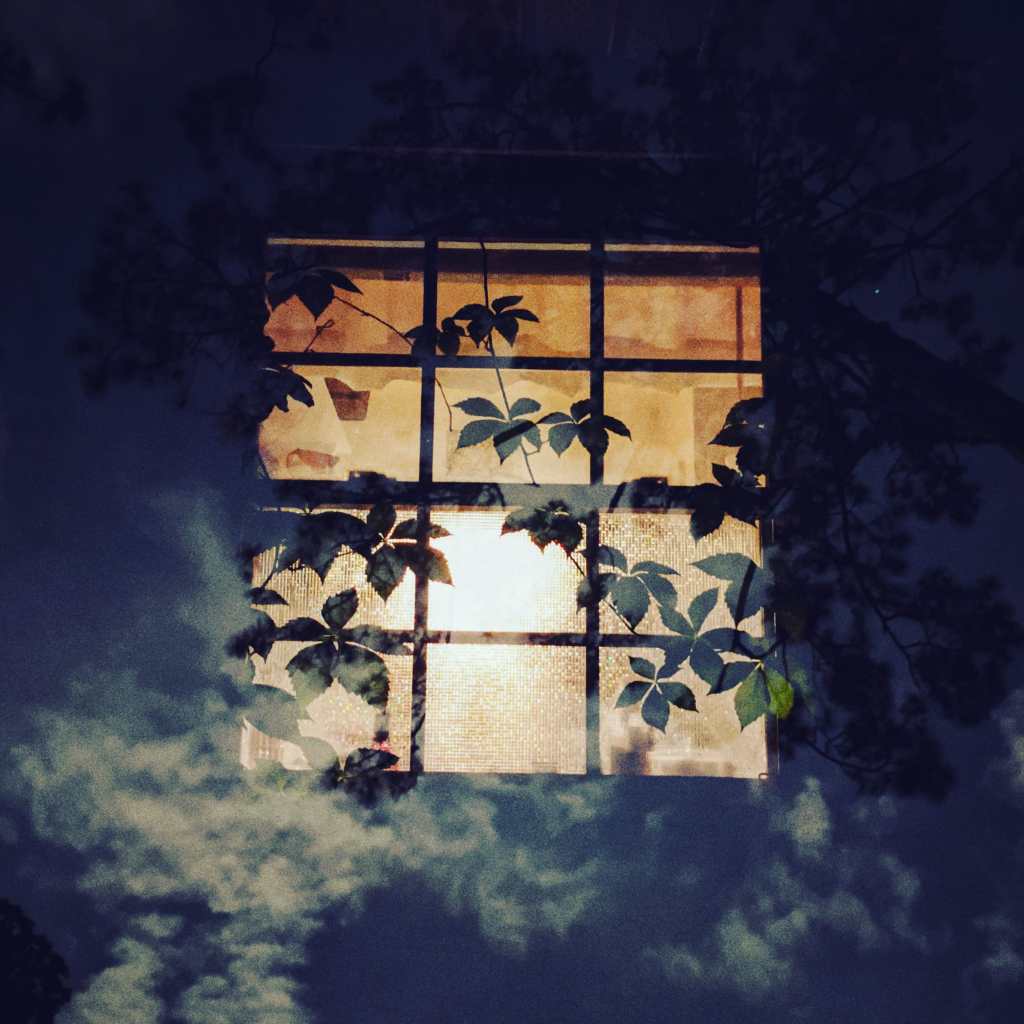
From inky black, pull starry future
To drape o’er young shoulders and wish it so
Now wash the garment in strange elixirs
Bell upon chime, we watch the spring days go
Shed the cloak of night in diurnal climes
To sweat o’er the troubled skein of the self
Now in the dog days to heaven you climb
Bell upon chime, place the cloak on the shelf
Shadows draw to vespers unclothed still
By the evening firelight learn fear
We lost so much time climbing autumn hills
By firelight, by sunlight, month over year
Oak leaf alights upon Earth in repose
Its airborne life but a blink to commence
To become the soil in winter gray glow
No cloak of night to warm the lapis winds
Shine like inky black
stuff of future past
Verses on a Plague Night Walk
When the sodium lights first come on
Those are the moments
Those moments of departed daylight
Departed vision
Those adolescent moments of endless
Possibility
.
Each footstep a promise to the future
Each breath an assurance of its promise to me
.
Tonight we walked the twenty-something streets
In those adolescent moments
Senses awakening to the edge of night
Inhaling understanding as we each day grow
Footsteps to tomorrow
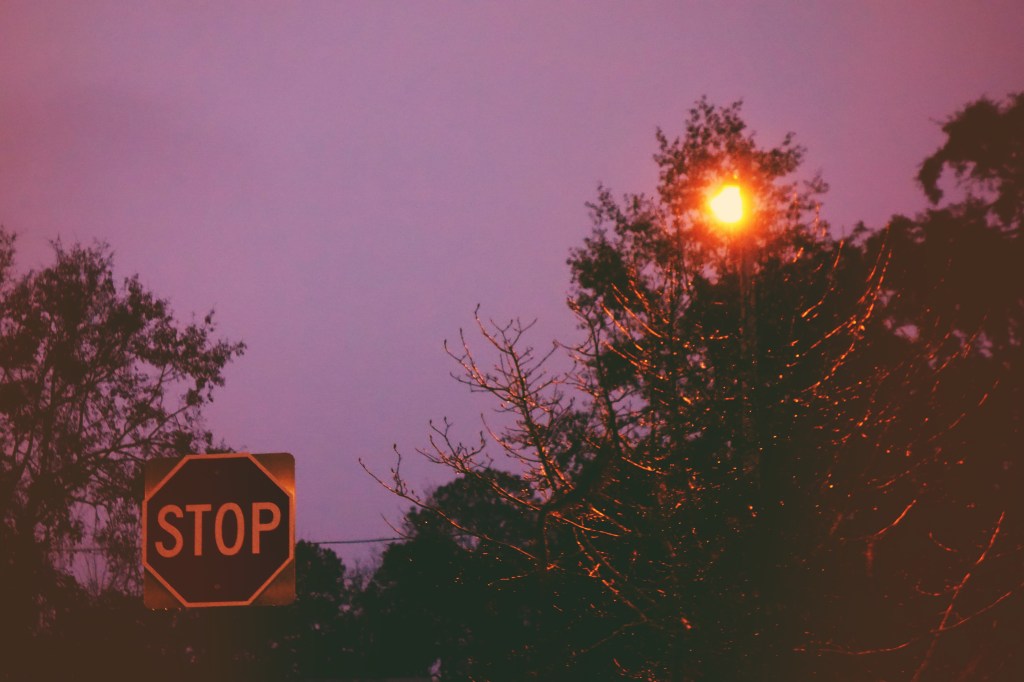
Imayo for March 18
Laurel leaves falling in spring — they strike the ground delicately and finally
Sun’s transit across the drawn windows — it traced a lonely analemma until today
Until today things were as they were — the world our grandparents built spinning its human orbit
Tomorrow we shall build anew — raking the endless leaves in the warm spring sun

Chicago in the Rear-View
Well, it’s all over now save for the thinking. Of course, what is anything but thinking? Walking, eating, even breathing, are just thinking in motion. Travel is no different. The sights, sounds, smells, and feelings we seek by traveling are, at bottom, just another way of thinking through the world. The trip I’ve been thinking about for the last four months is finally over and I’m still unpacking it all, but I’m interested today in how we come to think about places in the first place.
If you played Sim City 2000, you might remember a little easter egg in the game. Here’s how it worked: build a library in your city, click on the building to view details, and then click the button marked “Ruminate.” The game would then open a window containing an essay on cities by Neil Gaiman. I suggest playing the game on DosBox and reading the essay in context, but you can read the short piece here if you don’t have the time. I first read Gaiman’s essay when I was about ten years old, and I’m convinced that it shaped the way I think about cities from the very beginning, because Sim City was the first tool I ever used to think about what a city is, how it works–and Gaiman’s essay tied it all together. Software can move you like that.

“Cities are not people,” Gaiman writes, “but, like people, cities have their own personalities.” When I think of Chicago I imagine a vast, brown machine straddling Lake Michigan, churning incessantly. A pulsating, breathing hybrid being made from people and steel and brick and concrete. On my second night in the city, now 950 miles away, I called it a “grand steamroller of a city… an unstoppable machine looming over the Great Lake,” and at the end of the trip I felt the same way. Of course I’m not alone in this characterization. Carl Sandburg famously described the “City of the Big Shoulders,” the “Hog Butcher for the World,/ Tool Maker, Stacker of Wheat,/ Player with Railroads and the Nation’s Freight Handler.” Anthony Bourdain called Chicago a “completely non-neurotic, ever-moving, big hearted but cold blooded machine with millions of moving parts… that will…roll over you without remorse.” Following Sandburg, we are inclined to see these millions of people, living like anywhere else, as some sort of thing, some lovable but impersonal monster chewing up corn and spitting out steel. Why? Maybe we give each other this idea of what a place is, and we travel to reinforce it. Maybe we travel because of it. Or, maybe Gaiman was right. Maybe Chicago really is a sprawling machine made of people.

On my first day in the city I was riding the Red Line train south into the Loop and it struck me as odd that all of this should be happening just a few thousand feet away from the cold, quiet depths of wild Lake Michigan. While the train raged through a tunnel, an image popped into my head of a Smallmouth Bass, ensconced in silence and ever-so-still, suspended in the water just a few hundred yards away from this roaring, clanging madness. In my imagination, a single little bubble escapes the fish’s slowly opening mouth. It meanders to the surface, where it contributes an immeasurably tiny voice to the symphony of noise swirling in the air around the city. It is amazing that these two things–electric locomotive and smallmouth bass–should exist in such proximity to one another, and it raises the question: is the fish part of the machine, too? Tennyson argued in his way that nature is “red in tooth and claw,” but in this place the traveler cannot help but feel that the order is reversed. The city is wild; the lake civilized. It’s all a matter of perspective, yes, but the frigid calm of the lake’s depths seems to offer a poignant counter-argument to the City for living in this part of the world. The fish does not move unless it must. The people living in the city are always moving, bundled against the killing cold. Maybe this is why the city seems like a thing unnatural: it moves when it should be still.

The cold is unmistakable. The wind, infamous. It gets dark at 4:30 in the afternoon during this time of year. When I was there it was foggy and wet, muddy from the first snowfall. As the sun slid beneath the horizon and the long, cold night closed in, I thought too about how miserable Chicago must have been for the people who lived there hundreds of years ago. “Cities exist in location,” Gaiman says, “and they exist in time. Cities accumulate their personalities as time goes by.” Huddled against the cold, counting the days until the spring, Chicago’s early people–Native progenitors and European usurpers alike–must have cultivated a biting sense of humor and a firm work ethic to survive here. Joking to blunt the sharp edges of the cold and shorten winter’s long nights, then working feverishly in the warmer months to survive the cold again. The first Europeans came to know Chicago as a place to cross the river: once, twice, three times you could portage the Rivière Chicagou on this 1733 map. The city, as Gaiman suggests accumulates its character across time and space. You stamp your feet when you’re cold. In Chicago, you cross the river. Over time, millions of people found their way to the portage. They stamp their feet to stay warm. They cross the river. They do it over and over again until they start to look like millions of moving parts and the city takes on a life of its own.
Images like these are the things we use to understand cities. I’m no closer to understanding Chicago today than when I boarded the plane to visit, but neither was Sandburg when he wrote:
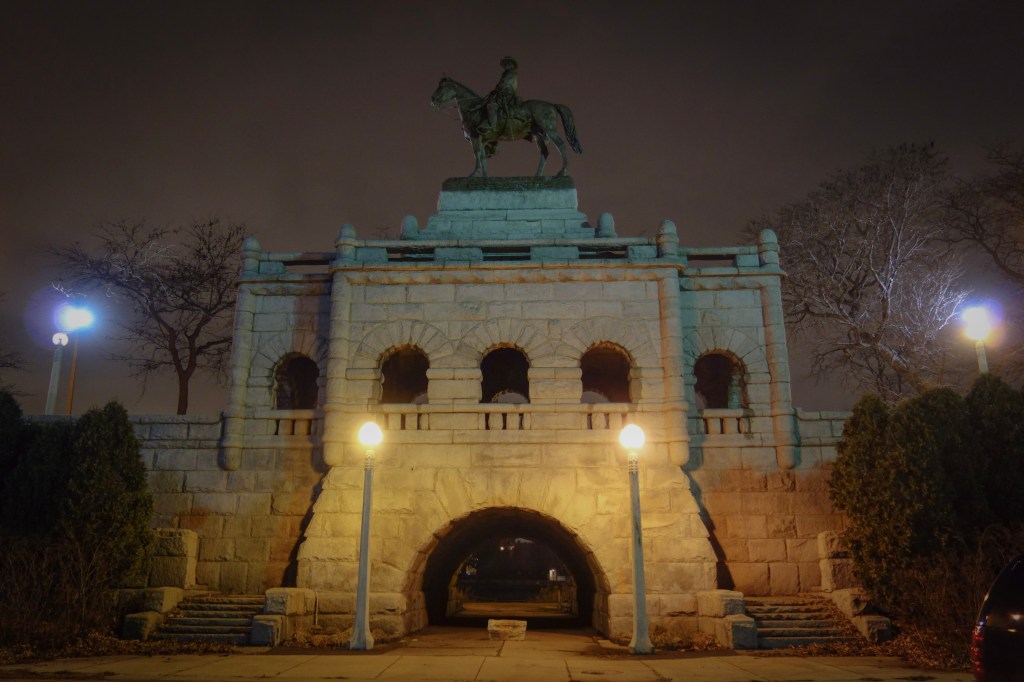
“The bronze General Grant riding a bronze horse in Lincoln Park
Shrivels in the sun by day when the motor cars whirr by in long processions going somewhere to
keep appointment for dinner and matineés and buying and selling”
The city is what we project upon it. It is then what we project upon the projections. Add image upon image, time upon place, and the palimpsest can take on a life of its own, like Sandburg’s General Grant in the remainder of the canto:
“Though in the dusk and nightfall when high waves are piling
On the slabs of the promenade along the lake shore near by
I have seen the general dare the combers come closer
And make to ride his bronze horse out into the hoofs and guns of the storm.”
Chicago, I will miss you.
Happy Thanksgiving, Grand Marshal Andrew Jackson
King Mob on the Meridian claiming
this land is ours
in the affirmative mode which animates even
the Communists here
the three-pounds of flax
who wax zen on the temple mounds of the erased
Shuck oysters and weave the
folksonomy of despair from threads golden like
the ever yellow afterglow over the bay below
you sing of this place like you own it, you
like you could own Cassiopeia and
Wite-Out the inky spaces in between
 C.B. Crenshaw