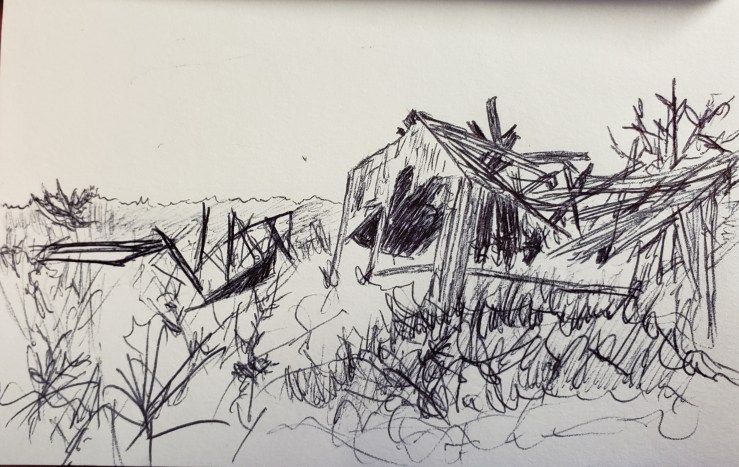
Untitled, Thursday Night

I smell my dad’s house sometimes
While sweeping, maybe,
Like some particle of the psychic past stirred by our labor in common. He swept, too.

A man who didn’t believe in vacuum cleaners,
he believed in me; and somewhere I register that in an olfactory way. The same way you hear voices when you drift off to sleep. Voices from other rooms and other times. He told me he heard his mother that way, her voice clear as a navy bell in the night.

How will I hear my own?
Her house had a smell that was mine too,
My Monday to Friday smell from the metes and bounds.
Hoover in the closet an oblique sort of foreboding.

Sweep first, then mop the floor. Drive across town, then vacuum some more.

Problem 1,364,872 with Facebook and Data

So, full disclosure: I’ve deleted my Facebook account twice in the past 6 years. Last month I came back again after about six months away with a shamefaced grin. It made me sad to think about all of the people I know sharing their lives with one another, without me. If I’m unwilling to let those connections go, then I can’t opt out of Facebook.

But today I was reading this fantastic reporting in the New York Times about the company’s response to its many crises, and what troubled me is not necessarily that it knows everything about me–which it does–but that the best way to monetize that information is to zero in on the weaknesses: the points of ignorance, credulity, impulse, and reaction. It’s a vast database of personal pressure points the platform presses all day long.

Google has the same information, Apple has a lot of it, Samsung now owns a lot of my pressure points, and all of the apps, trackers, and aggregators on my phone, iPad, computers, and web browsers that don’t come from those companies know a lot about me. There’s no way to opt out and no clear way forward for any of us. Is there some combination of open source and paid platforms, along with encryption and data security practices that will save us?

Jill Lepore and Publishing “Big” History

Many of the historians on Twitter have been dunking on Jill Lepore’s interview in the Chronicle of Higher Education since it was published. I posted a thread on Twitter about this earlier and decided to post it here, too. Twitter is so ephemeral, and this is something I’d like to think more about.

Working outside of the university, I’m not as ready to jump on the Bash Jill Lepore bandwagon as many #twitterstorians seem to be. Can we get past the Twitter hot take and engage her interview on its own terms?

Everyone’s arguments about historians engaging the public sphere through op-eds and teaching are valid, but they seem to ignore the context of the interview, which is mostly about publishing. In this context, Lepore is right. “Big” history books, the kind of Hofstadter syntheses Lepore is talking about, don’t have the cachet they once did. I think this is a good thing for scholars, but probably bad for civic culture.

It’s good for scholars because it means we’ve truly eschewed the sort of grand narratives that were en vogue at midcentury in favor of the complexity and ambiguity that followed from the late-sixties critiques aimed at this vogue. It’s probably bad for civic culture, though, for all of the reasons that Lepore mentions–especially the decline of the “fact.” When everything is too complex to sum up with a simple answer, like a math problem or popular science anecdote, it’s much harder to convince people to pay attention to the answer. What many readers seem to hear is that truth is relative to the observer, which doesn’t align with anyone’s moral compass. I think what readers often encounter, too, is a thicket of academic platitudes–like “the ways in which” or “to be sure.”

I think Professor Lepore is right on the money, therefore, to argue that scholars need to introduce complexity to the public with style. Thankfully, many are doing that in the past few years. The number of trade books I see on the general history shelves at Barnes & Noble penned by academic historians is growing. And it is exciting! Moving away somewhat from Lepore’s interview and down to the ground level here in flyover country, I think a bigger challenge faces all of us: how do we get these books on the shelf at Walmart or Target or the drug store?

Moving away somewhat from Lepore’s interview and down to the ground level here in flyover country, I think a bigger challenge faces all of us: how do we get these books on the shelf at Walmart or Target or the drug store? This is where they are most needed, because this is where the majority of intelligent but casual readers browse books. These are people, I believe, who are hungry for serious scholarship and complexity if the read is worth their time. Publishers and scholars should be reaching out past the booksellers to the big boxes serving the places without Barnes & Noble. Perhaps this will help restore historians to the town square.

Brief Visions of New York

Sorry, I’ve been neglecting this in favor of Instagram–bad me! Here are a group of photos from my trip to New York City over the long weekend. I’m working on an essay about the trip and have some film to develop as well. This was my first excursion using the Sony RX-100, and I have to say it: I LOVE this camera!

While we’re on the subject of instagram, I would be extremely grateful if you had a look at my page there @cbcrens. If you like what you see there, please follow. I’ll most likely follow you back.