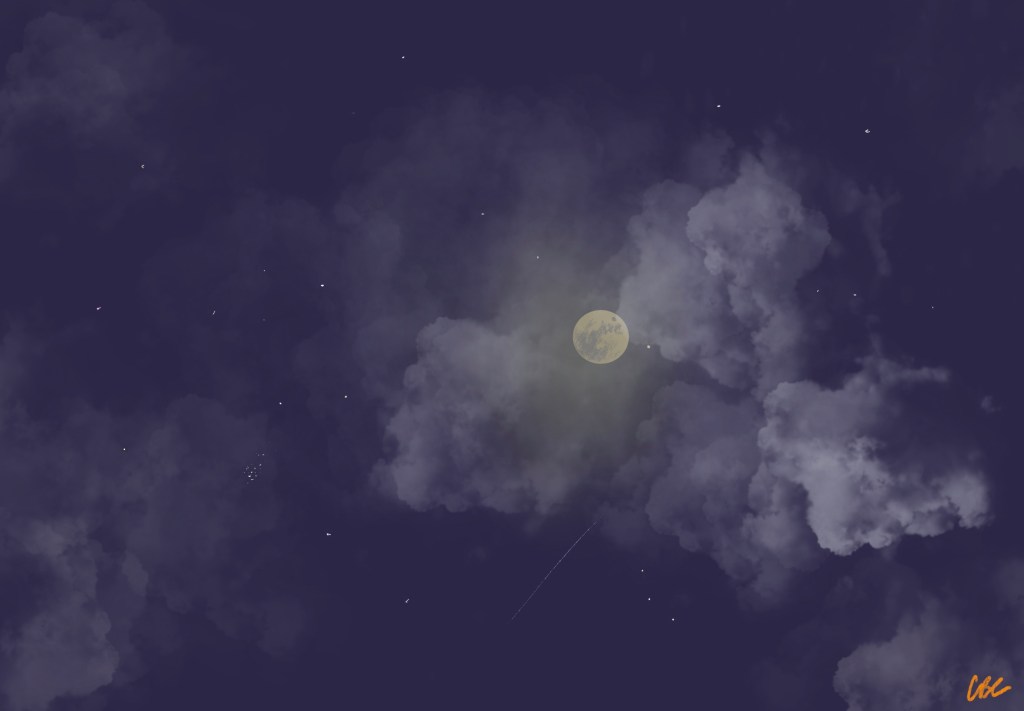
When I was young and sleepless I imagined opening the window and taking flight like one of the Lost Boys twinkle-dusting into the night chill.
Slowly ascending over the flat roof, I would embrace the oak outside the window on its own terms, finally, and turn to face The great sodium lamp world.
And then southward I would plot a course, Wind sweeping away my terrestrial cares As, above the elementary school, rising, I might rejoice for a moment at the majesty of time.
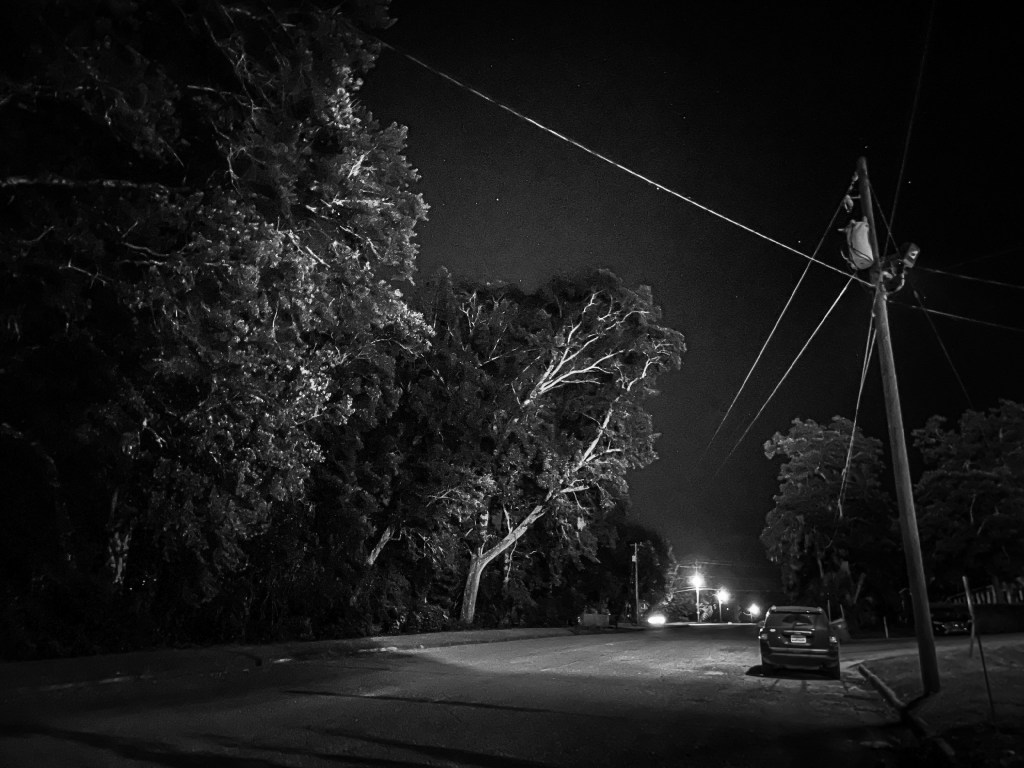
This is part of a series of posts exploring video games as spaces players inhabit. If you’re wondering what this is all about, I tried to explain myself here.
Cosmopolitan Liberty: Dodgeball Nationalism
“Any text is constructed as a mosaic of quotations; any text is the absorption and transformation of another.” — Julia Kristeva, “Word, Dialogue and Novel”
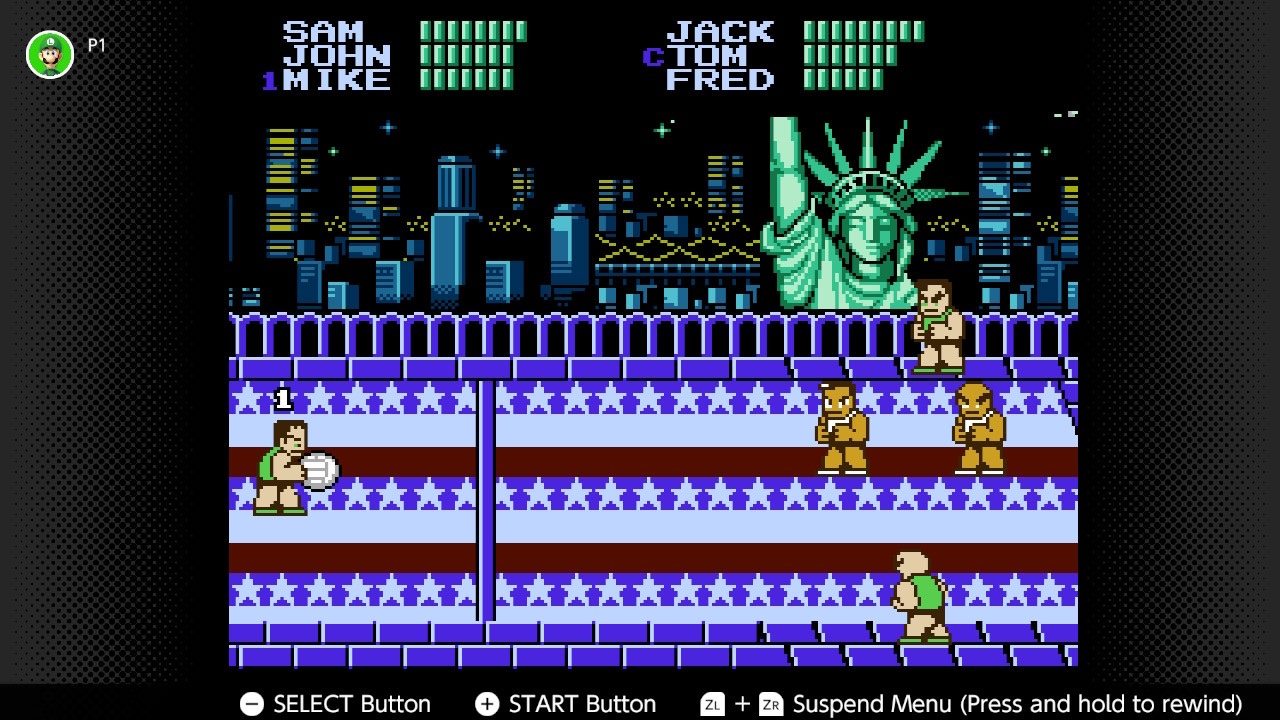
Super Dodge Ball is an NES game in which the player takes control of an American dodgeball team and competes against other national teams on a journey around the world.* There is an English team–replace New York and the Statue of Liberty in the screenshot with London and the Tower Bridge–an Indian team, an Icelandic team, a Kenyan team, Team Japan, and, finally, a boss battle with Team USSR. You should watch the playthrough here if you want to see the game in action. Nintendo thought highly enough of the game to include it with the NES games on Nintendo Switch Online, which is where the screenshot comes from.
Odds are, if you played this game in 1989, you were familiar with Rocky IV, which debuted in 1985, and Top Gun, which came out a couple years later. You might have watched the 1988 Olympics, which were relatively drama-free following the political scrimmages surrounding the 1980 and 1984 games, but still drew huge audiences to a spectacle of nationalist competition. Maybe, inspired by the World Cup in 1990, you pulled the game down from the shelf to play through it again. That is something I would have done, substituting dodgeball for soccer to reenact the thrill of the television event. Maybe the looming Kremlin in the game’s final showdown flashed across your mind when the Berlin Wall came down and the USSR along with it. Super Dodge Ball probably sat on your shelf when the United States invaded Iraq for the first time in 1991.
Rocky IV, Top Gun, the Olympics, the World Cup, Super Dodge Ball (and other games like it), the fall of the Soviet Union, Operation Desert Storm. These things appear disconnected, but they were woven together in an intricate pattern, disparate phenomena contributing to a noumenon of nationalist triumph in the eye of the American beholder.

Is this the moon? No, just Iceland. Screenshot from Youtube.
Set against world-historical events like wars and political collapse, cultural products like films and video games seem to speak with an infinitesimally small voice in the historical record. We should reconsider this point of view. Because these events take place out there in real time and space, the vast majority of people experience them passively. Movies, games, recorded music, and other cultural products occupy personal time and space. We experience them actively and use them to think through events.
For most Americans, the Soviet Union collapsed on the news. Americans who played Super Dodge Ball contributed to this collapse in their minds when they played the game. Along the way, they internalized certain ideas about difference, about strength, agility, and development. Many of these ideas were expressed spatially. Players have inhabited these spaces for more than thirty years.
Thunder here among the pines and red hills is the song of summer. Listen long enough and you will hear its song in different keys throughout the day. Thunder at 7:00 in the morning sings a gentle song of relief, of decisions you need not make, heat you need not endure. On a weekday morning this song is colored faintly with regret. It is a lullaby the armchair by the window hums softly to itself as you clamber through the door and leave for work. Thunder at noon is puckish, a cymbal crash to punctuate your lunch hour or send you scurrying to the pavilion at the beach clutching your shoes and towels. At day’s end here thunder sings the loudest, conducting a fanfare for the setting sun diva as it dips below the closed-curtain horizon.
At night thunder sings the sweetest song. A song of space, of longing, and distance. A song of life.
From Shade: Selections from the Shade Tobacco Region Oral History Project
Off in the woods there was a palace I saw it with princes and prelates and fools up under the swingin moss dancin their old jigs in them fancy getups like in the old movies what used to come on TV on Sunday. I saw one he was jinglin them little teeny bells like a song at Christmastime just a prancin around back in there like you know what and I thought that was funny but it hurt my head too. My dogs they didn’t hardly know what to think about it all Rex he looked at me like what is all this and I said I reckon I don’t know but we best be gettin out a here. And that’s what we did too but I sure wish we had stuck around to see what they was doin back there and what they was gonna do next because I don’t reckon we will ever see anything quite like it again long as we walk this earth. I been back in there since and they wasnt there no more and that made me a little scared and a little sad too I aint too proud to say. Theres things in this world we dont know nothin about and we aint got no business knowin it neither.
On a trail once, I saw a tree which should not have been, a magnolia in the pine flats, by the influence of some creature planted out of place.
I gave that tree a name, and when I can’t sleep the name crosses overhead like Radio On in the darkness static a nebula of memory flashing to quicken me still.
Und die blumen von meine Magnolien sind Weiß in der raum dunkel like footlights in the gloom shining daylight past in the room.
Like magnolias, too, we bloom in the dark putting out flowers brown by morning and passing ancient signals through the rhizomous earth from which we came.
It is the same earth to which we return and what more can we ask of the soil mysterious? Let it be together, we might ask, let us glow together like blooms in the hunter’s night.
There is a period of ten minutes or so at the beginning of a film when it can be anything. We have some idea of what to expect from trailers, posters, and other hype, but we are ready for the film to surprise us, to subvert our expectations and carry us into a world we did not expect to discover. That ten minute window is rich with opportunity for the filmmaker, and it is vitally important to the success of the film that follows.
In the first few minutes of The Conjuring: The Devil Made Me Do It, Director Michael Chaves sets up a possession film. If the ritualized prayers and weird body contortions in the first scene aren’t enough, the ham-fisted homage to the famous poster scene from William Friedkin’s masterpiece of the genre, the priest standing in the accursed light of evil outside of the Regan’s house in The Exorcist, should clue us in. A few minutes in, therefore, I was prepared for a good possession and an exorcism.
Homage, much?
Imagine my surprise when the story shifted gears, grinding awkwardly like the clutch in an old diesel truck from what seemed like a trite but entertaining exorcism feature to a haunted murder mystery. Imagine the complete whiplash, then,when the gears ground again, and the film turned into a kill-the-witch cat-and-mouse chase. A film is traditionally structured in three acts. The Devil Made Me Do It is three different films. With some investment in the story, any one of the three separate acts might have stood alone. When you stand them one atop the other, though, like children in a trench coat sneaking into an R-rated movie, the whole thing falls down.
The Devil Made Me Do It takes its title from a briefly infamous Connecticut manslaughter trial in the 1980s in which a young man named Arne Johnson claimed that a demon who had taken possession of his soul compelled him to stab his landlord with a pocketknife. Johnson’s case would have garnered little more attention than a few “isn’t that weird” news reports and a couple of law review journal articles if not for the intervention of self-proclaimed demonologist Ed Warren and his wife, spirit medium Lorraine Warren, in 1981. The “case files” of the Warrens, a New England couple who rose to fame in the latter half of the last century by cashing in on Americans’ growing fascination with the paranormal through a series of expertly marketed “investigations” resulting in numerous books and publicity events in the 1970s and 1980s, provide the basis for the films in The Conjuring series. The paranormal interpretation of the Amityville murders remains the most (in)famous of the couple’s investigations, but the success of The Conjuring franchise has certainly replenished the coffers of their estate for generations to come.
The story The Devil Made Me Do It tells is about as complicated and neurotic as you might expect a tale of demonic possession, crafted by master hucksters to defend a man from murder charges in pursuit of their own fame, to be. There are spoilers ahead, so skip a couple paragraphs if you think, for some inexplicable reason, that you might want to subject yourself to this film. I recommend reading ahead and then spending your time watching a better movie, but you do you.
In the first scene, we meet the Glatzel family and their possessed son, David. The Warrens are there—as charming and down-to-earth as the very capable Vera Farmiga and Patrick Wilson can render them—and so is Arne, David’s sister’s extremely friendly boyfriend. David and Arne share a moment of tenderness while waiting on a priest to arrive for an exorcism and, when the exorcism doesn’t go as planned, Arne invites the demon inhabiting his girlfriend’s brother to go ahead and enter his body instead. Things start to get weird for Arne after that, until he has a freakout that would have thoroughly amused Burroughs or Hunter Thompson and murders his drunk and stupid landlord while Blondie’s “Call Me” (1980) plays on the stereo for some reason. Thus ends the possession film in Act 1.
In Act 2, the haunted mystery, the Warrens need to build a case proving that Arne’s act was a consequence of demonic possession rather than a freak brawl with a lame soundtrack. Sure enough, guided by Lorraine Warren’s extremely reliable and specific connection with the spirit realm, they find a witch’s totem underneath the Glatzel house. Makes sense, right? The Glatzel kid was possessed, the demon jumped to Arne, bing bang boom, the landlord is dead. Seeking a pattern of similar occult influence in other crimes, therefore, the Warrens reach out to police throughout New England. The search leads eventually to a skeptical cop working an inexplicable murder and disappearance in Massachusetts and a former priest giving the world his best impression of a thousand-yard stare after investigating a satanic cult in Annabelle, a prior instalment in The Conjuring universe. After the Warrens solve the case for the cop—drawing, again, on Lorraine Warrens amazingly detailed second sight—the priest reveals that his own daughter is the witch causing all the trouble. How convenient! Thus ends the haunted murder mystery film in Act 2.
In Act 3, the Warrens must kill the witch to save Arne. After a conventional labyrinth chase in the occult dungeons beneath the priest’s home, the Warrens destroy the witch’s altar. This breaks her magical connection to Arne, which pisses off the demon to whom she had promised Arne’s soul. The demon kills the witch, Arne is relieved of his demonic tormentor, and the Warrens have another little toy to put in their collection beside the Annabelle doll and the painting of Valak the Defiler. Arne gets a light prison sentence, but it’s OK because he’s just relieved to be free of the demon, and everyone lives happily ever after.
Writer and filmmaker Jon Boorstin provides an excellent framework in his book, The Hollywood Eye, to explain how and why movies work. This notion—that Hollywood filmmakers, perhaps in distinction from those working in other milieus, are focused on what works rather than what is beautiful or moving or artistic—is important, Boorstin argues, because it is the font from which meaning and aesthetic value and all that other stuff flows. This is because, according to Boorstin, viewers watch a film with two “eyes” which must be simultaneously pleased for the film to capture and maintain their attention. Only when they are suitably rapt will they be responsive to the film as a work of art.
The first “eye” is the “voyeur’s” eye, focused on realism. This is the little voice in your head that says, “that would never happen,” or, “shouldn’t they have run out of bullets a long time ago?” Next there is the “vicarious” eye, focused on feeling. This is the part of you that is carried away by the story, the part that falls in love with the characters or causes you to bite your nails at the suspenseful parts. Boorstin says that these basically correspond to brain and heart, and I can think of no reason to dispute him.
There are things this film does well. Michael Chaves builds on the world of TheConjuring with interesting views of sweeping New England vistas. This pleases the “voyeur” eye. The cast is well put-together. The stars share good chemistry, and, at times, their talent breaks through a scene just enough to please the “vicarious” eye. There are enough such moments to say that this a functional bit of filmmaking. It progresses like a Toyota Corolla from point A to point B. It makes you jump a few times. It has a couple of good monsters and, I don’t know, you don’t see the boom mics in the shots. If you spent money on a theater ticket or forked out for an HBO Max subscription to see it, you would be hard-pressed to point to a particular moment where it went off the rails.
But let’s be honest. You would be hard-pressed to find that moment because the whole film is a god-damned train wreck. The Devil Made Me Do It just doesn’t work. Its three acts do not cohere. Its characters are only developed far enough to fit in the panels of the comic book tie-in that is sure to follow. Here are some examples. It was unclear whether the demon or the witch was the villain. As a result, both of them were shallow, shallow, shallow. Defeating them felt more like a chore than a quest. The skeptical detective in Act 2: why does he exist? (More on that below). And who is the protagonist? I suppose it is the Warrens, but then who is Arne Johnson? I didn’t care about Arne Johnson. Captain Howdy in the original Exorcist film has more screen presence than Arne Johnson in this story, and Captain Howdy only appears on screen for three frames. Was Arne Johnson a hero? A victim? A villain? Who knows? In any event, it didn’t matter to me whether the Warrens saved him or not. Nothing mattered, in fact, because the story was awful. The fat, naked ghoul in Act 2 will make a cool collectible action figure, I guess. Sorry for the spoiler.
One more thought before I slam the door on this one. I don’t know what Ed and Lorraine Warren were like in real life, but the characters Ed and Lorraine Warren in The Conjuring universe grow more insufferable with each new installment in the series. They’re always right; sanctimoniously pure; perfectly in love with each other. There’s nowhere for them to go, no way for them to grow. Perhaps this untouchability was a condition of the contract with the Warrens’ estate—a $2 billion deal for New Line so far—but it sets them apart from the characters written in the round. The villains in these movies are not the monsters and demons, who knock down like ninepens in the end, but the straights. The skeptics and normies who choose not to believe in the paranormal must be set straight by the Warrens, and there’s a mighty horde of us. We’re the baddies, the fools, wondering what in the world is going on in these movies. They’re not for us. That’s OK.
Ha. Nice, Vice. That’s a funny one. It practically clicks itself.
When I was through laughing, though, I started to wonder. If you surfaced all the information and knowledge the United States military has amassed, described it, and made it accessible, how big would the resulting library be? Would it rival the Library of Congress? What if you included the literal mountains full of classified information?
Doctors in fatigues offering up a straight-faced explanation of the penis makes for a funny video, sure, but think about the context of that video. That penis video–a remarkably well done bit of public health information, I’m not too cool to admit–was likely produced as part of an overall health information strategy that included other videos designed to meet specific training goals for Air Force personnel. Someone had to draw and render that 3D phallus. Someone wrote the text, someone storyboarded the video, someone cast the doctors. Someone set up the studio. Someone made arrangements for the doctors to come and record their parts. Someone filmed the segments. They did multiple takes. Someone else–probably more than one someone–edited the video. Someone else posted it on the web. On and on it goes, every day, and that’s just videos. The Army and Navy probably have their own versions of the same thing, and each of them is just one example of hundreds of thousandsof pamphlets, manuals, SOPs, videos, audio recordings, books, specifications, and other resources the military produced in just asingle year. Multiply that by seventy-five years and you would have the Alexandria multiplex of knowledge accumulation and dissemination the modern American military has undertaken since the end of World War II.
That’s not ephemeral information, like emails and phone logs, but strategic media created for the express purpose of knowledge transfer and managed according to long-term retention and preservation policies. Where is all of it? Vice mentions DVIDS, the “Defense Visual Information Distribution Service,” but that’s just visual information. The various service “doctrine” websites are another source, and of course the National Archives and Library of Congress have millions of items. Much of this knowledge is accessible, but it is extremely decentralized. What would we do with it all if it were described and catalogued? What if it was semantically linked? Would we just make fun of it, or would we make use of it?