Syllabus: January 29th

A list of interesting things new and old that I’ve read or experienced this week. I do not endorse or even necessarily agree with anything on the other side of these links.

Articles

Broderick, Ryan. “Happy Birthday, Guy Fieri,” at Garbage Day. — Because after I had read or heard about eighty GameStop and wallstreetbets explainers this week I was thrilled to read: “It is both terrifying and liberating to look clear-eyed into the meaningless void at the heart of modern life and accept it for what it is.” This looks like a decent mailing list, actually.


Cho, Adrian. “The cloak-and-dagger tale behind this year’s most anticipated result in particle physics,” at Mel. — If the wild intro that uses the R.E.M. song about the beating of Dan Rather in 1986 as a way to start an article about particle physics doesn’t grab you, perhaps the science will. Bonus: fans of Bruno Latour and the anthropology of science will definitely nerd out on the breathless description of laboratory heroics.


Grimm, David. “Ice age Siberian hunters may have domesticated dogs 23,000 years ago,” at Science. — Fuck it, I like dogs and I wanted to include this one.


Klee, Miles. “Everything you Never Wanted to Know about the ‘Sigma Male.'” — Machines turn inputs into outputs. The internet is a machine that transforms time into ever more toxic forms of masculinity.

Video

Pahokee. Directed by Ivete Lucas and Patrick Bresnan. 2020. A beautiful documentary on four high school students in the titular town, a small (by South Florida standards) farming community down on Lake Okeechobee. The link goes to Kanopy. If you have a library card you can probably watch the film for free and then choose a few more to watch gratis, too.


Vast of Night. Directed by Andrew Patterson. 2020. — Look, this isn’t Spielberg, but it captures a little tiny bit of the magic from Close Encounters while imparting its own awareness of space, pace, and light. It’s a memorable film on Amazon Prime.

Music

If you like the ’90s you will probably enjoy this playlist of songs from a 1996 compilation called This Is… Trip Hop. I found this CD at Goodwill and love it.

Art

Florida landscapes by Eleanor Blair at Signature Art Gallery in Tallahassee.

Aryo Toh Djojo’s “Transmission” @ Wilding Cran Gallery.

Books

Clarke, Susanna. Piranesi. New York: Bloomsbury, 2020.


Cheryl Dumesnil, Showtime at the Ministry of Lost Causes. University of Pittsburgh Press, 2016.

Other

If you were struck by the ineffable urge this week to point your phone out into the cold, lonely void and project an image of Bernie Sanders sitting in a chair somewhere out there, you might like this Sitting Bernie AR Meme. Use your phone and press “AR” to enjoy yourself for a few seconds.


I was inspired by Nicely Small, a curated list of small businesses in Vancouver created by the design firm Engine Digital. Tallahassee needs something like this.

Field Work: Panorama Mode

I finally developed some film that I’ve been sitting on for almost a year. The two panoramic shots at the top of the page are my favorite from this little excursion, but I’ve attached a few more shots from the roll as well at the bottom of the page. I love this little Nikon Point and Shoot for these quick Ilford snapshots, and it lives in my travel bag alongside a Sony Rx-100 for quick, no-fuss shooting opportunities.

Taken just before sunset on the last day of 2019, in a field alongside US-331 outside of Paxton, Florida, I feel that these shots capture the cold quiet of the field in winter. In retrospect, they seem now to say a little more.

And in color..

The rural panhandle is full of these haunted landscapes. I remember watching Cold Mountain years ago and thinking about how the filmmakers had to travel to Romania to find an alpine landscape that would convince viewers the films was set in the 1860s. You can travel back roads in rural Walton County through landscapes that have not changed since the Great Depression. Time is a little more evident in these photographs, but not much. If I squint, I can still see the mule working the rows. at the edge of the field yonder. I can breathe the quiet rhythm of the plow, the sun, the wind.

Not far up the road there is a garish sign alongside which shouts, “Visit the Beaches of South Walton!” If you like the outlet mall, that’s fine. Most of the time I’d rather grab the Nikon and drive the back roads, though, searching for the past.

Discount Movie Review: Thoughtless Violence in Hell’s Kitchen

                Legend has it that Miami Vice was born when the President of NBC, whom I (unfairly and probably incorrectly) like to imagine deep in the throes of a head-spinning fugue state around 11:30 in the morning on day 3 of a coke binge in the summer of 1984, scrawled the words “MTV Cops” on a sheet of paper and pitched it to a producer. We can imagine a similar scenario playing out in 2016 or 2017. Some producer on a flight from Los Angeles to Shenzhen to make a superhero movie pitch jolts awake from a psychedelic jet lag dream, fumbles for his iPhone, head lightly spinning from a single Lime-a-Rita before the flight, and scrawls “The Departed with women” in the Notes app. The Kitchen is born, and I sit down to watch it on a Tuesday night many months later in a suburban multiplex on the edge of the woods in North Florida.

                It’s hard to talk about The Kitchen. I think all of us gathered in the multiplex on Discount Tuesday this week were extremely aware of the trail this movie is trying to blaze. The stars are badasses, alright? They don’t take any shit. They dominate every man in the film—with the exception of fathers and Italians—and we all love that. If you’ve ever thought to yourself, “this gangster movie is good, but what if the wiseguys were women?” then this is probably the movie for you. I loved that part of it. But if you value good films or human life, it probably isn’t the movie for you. Let’s talk about that.

                First, life and death. Like Stuber, which I talked about on Discount Tuesday a few weeks ago, The Kitchen kills with impunity. People die in this movie and nobody really cares. Heads are blown open; dead people are dragged on the sidewalk; bodies are dismembered and dumped in the Hudson River. Spoiler alert: Haddish and McCarthy sniffle for a moment when they kill their husbands, but the audience is discouraged from joining in these brief moments of quiet. Watching these badass women rampage is just too fun, I guess, for the filmmaker or the audience to go and turn the killers and the victims into humans. That would require empathy, right, and who wants to bother with that on Discount Tuesday in the summertime?

                The Kitchen’s failures as an example of filmmaking art follow, in part, from all of this sexy dehumanization. If films are meant to shed some light on the human experience, death should do something. Take the gangster movies that this movie clearly wants to emulate. In The Godfather, benefiting from death makes Michael Corleone into a monster. Each killing in the film’s pivotal seizure-of-power sequence severs him from his humanity and isolates him from his family until, finally, a closing door figuratively seals him within his own personal hell. In Casino, death is a grotesque ritual which so scars the fantasy landscape that the killers operate in the depths of the desert. Death is a reminder of the cruel masters back east, and a consequence of flying too high. Goodfellas treats death like a cruel joke, but the audience clearly understands that Ray Liotta’s character is both hero and heavy. He’s a ghoul.

                You may be wondering: what if all of the people who die in The Kitchen are bad guys? Does that make it OK, like Inglourious Basterds or revenge movies? It might, except The Kitchen isn’t about revenge or redemption, and the bad guys aren’t Adolph Hitler and Joseph Goebbels. The “heroes” in this film kill the “villains” in order to become the villains. With the exception of one rapist—killed by a male savior/mentor instead of one of the badass women, it’s worth pointing out, as though some villains are still too formidable for women to handle—we don’t know anything about the small-time gangsters who die in this film except that they’re standing in the way of the “heroes” racing to reach rock bottom. There is a moment near the end of the film—in the nadir of the “dark night of the soul” every screenwriting manual will instruct budding artistes to include in the script—when Melissa McCarthy says that she’s built something too great to give up. I was left wondering: does she mean the criminal enterprise the hero-villains built from theft, rackets, blood, and graft; or just the relationships they made along the way?

                It’s impossible to watch this movie without thinking about its moral and historical counterpoint: J.C. Chandor’s 2014 masterwork, A Most Violent Year. That film takes place just three years later and engages the late-seventies underworld this movie glorifies. It has everything this movie has: crooks, a gritty, desaturated New York cityscape, gangsters, a badass woman, even Hasidim. But instead of cruel, half-baked stereotypes, these are real people, living in a real place. Instead of racing to the bottom like the soulless heroines of The Kitchen, Oscar Isaac and Jessica Chastain struggle to do the right thing in a world that rewards badness. If Donald Trump is the Bizarro Obama, an inverse agent whose entire political program is built on undoing his predecessor’s legacy, The Kitchen is the Bizarro Violent Year. Its nihilism betrays the talents of the performers and craftspeople who brought it to life.

Straight Outta Compton and the Historian’s Dilemma

“Instead of sharing an experience the spectator must come to grips with things.” – Bertolt Brecht
Straight_Outta_Compton_poster

What is it that historians do?

On the one hand, they must tell The Truth. This means reading, watching, listening to, tasting, smelling, or touching every bit of evidence they can find, weighing them against each other, and then putting it all together into a faithful account of the past. Which is pretty much what they do. But on the other hand, because they are humans, living in this noisy and contentious world, historians always have some axe to grind. History means something, they maintain. And besides killing readers with boredom, history without meaning would be useless. It would just be a list of things that happened. Everything that ever happened. So historians have to make the past mean something, too. This means throwing some evidence out, maybe pointing at other evidence that might not seem important and saying, “there it is! The Truth!” Figuring out what to keep and what to ignore is a real dilemma. Nobody will agree. This, in short, is the historian’s dilemma: making choices without appearing to make choices. Making claims about today by appearing to make claims about the past.

This is contentious stuff. Most academic historians have long taken postmodern subjectivity for granted, attempting in turn to do the least harm by pulling into their work as much evidence as possible, from as many opposing voices as possible. Their readers, however, are impatient with both the problem and the solution. Most readers tend to see the past as immutable—as a story just waiting to be uncovered—and the documents required to tell that immutable story as mostly self-evident. Rather than complications of interpretation, readers see challenges of comprehension and accessibility. Knowing where to find documents and how to translate their archaic prose is challenging enough, they claim. With this arcane knowledge, historians should have no problem interpreting what they find and telling The Truth. Efforts on the part of academic historians to incorporate alternative sources, to include an abundance of notes, or to challenge their readers with theory are routinely derided. Amazon reviewers often savage academic books for being too detailed, too unsure—too boring—while school boards argue that they are too interesting, too provocative or heterodox for students. What is a historian to do?

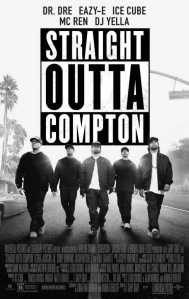
It is clear that Director F. Gary Gray and the producers of Straight Outta Compton faced the historian’s dilemma. Compton is a film obsessed with its own history, as though viewers are listening to a deep conversation between Dr. Dre, Ice Cube, and their own reflections in the bathroom mirror about where they’ve been and how they got there. Gray offers is an exceptional rendering of those conversations, replete with outstanding performances from a fairly green cast—anchored by Paul Giamatti—and a workmanlike attention to detail.

Too bad it doesn’t have much to say.

Let me tell you a story. Once upon a time—the late 1980s, a time increasingly shrouded in pre-Golden Age mystique—it was rough in the Los Angeles ghetto. A group of young black men were making their way through the hard times, honing their talents (or courting an early grave) in obscurity despite the efforts of the police state to break their will or end their life. One day, the group of young men decided to do something about their obscurity and formed a rap group. It wasn’t very difficult to record a hit single, but it was even easier to find a manager who could sell their talents to a record label after they did. They were immediately successful. A bunch of rock-star stuff happened, the group of young men got into a fight, and then the rap group split up. Two of them were immediately successful after the breakup; one wasn’t. A bunch of other stuff happened. The now-unsuccessful one ended his relationship with the agent and then, right before staging a comeback with the still-successful young men who used to be part of his rap group, succumbed to AIDS. The other young men cry and reflect.

That’s pretty much it. One does not get an honest sense of the struggle involved when obscure young black men build a career out of sheer talent and provocation from the very heart of the American nightworld. Police violence, for example—such a prominent part of the film’s first two acts and in the real-life NWA’s meteoric rise to fame—simply disappears in the third act. Gone. Manager Jerry Heller’s treachery is only vaguely outlined. Less vague, perhaps, are the hints of cultural and social tension between the fairly affluent Heller and the rappers he represents, but not much. Dr. Dre and Ice Cube’s success is not vague at all, however. Both easily sidestep the belligerent malfeasance of entertainment capital: Ice Cube by obliterating obstacles with a baseball bat, Dre by rolling over them with a steam-powered Suge Knight. Eazy-E alone struggles with the system. One-by-one, the fragments of late twentieth-century failure pile on E’s shoulders: friendships broken by bounced checks, a heartbreaking series of moves back toward the underclass, and, finally, the cruel denouement offered by HIV and AIDS. These are Eazy-E’s problems, though, and don’t belong to his friends or the viewer. None but E are complicit in his fall from grace.*

These are tragically missed opportunities. Unfortunately, Straight Outta Compton takes the easy way out of the historian’s dilemma: mere narrative; evidence without meaning. The narrative itself is solid and entertaining, absolutely, but the whole is dissatisfying. By refusing to answer or even pose deeper questions of meaning, the filmmakers leave it up to viewers to formulate their own questions and answers. Is this just another touchstone of American consensus, another tired affirmation that we, too, can be successful if we are talented and hard-working enough to overcome adversity? Perhaps. Or is there something else here, some covert meaning in the filmmakers’ refusal to pose these questions? Maybe that too. Eazy-E is a remarkably tragic figure, after all.

But then again, maybe not. Ultimately, one must ask: what is the argument? I don’t know. Straight Outta Compton doesn’t have the answers.

* And maybe Jerry Heller, but, again, the details are hazy.

Dope and the Location of Culture

Dope Poster

“A boundary is not that at which something stops but, as the Greeks recognized, the boundary is that from which something begins its presencing.” – Martin Heidegger, “Building, Dwelling, Thinking”

A month after its release, there’s a particular scene from Dope that still sticks out in my mind. It’s when Shameik Moore’s character Malcolm Adekanbi—a charismatic protagonist, I’ll just say here at the outset—is frantically driving to meet a Harvard alumnus as part of his college application. He’s driving away from an impossibly, hilariously complicated situation to one that is even more outrageous and complicated. Along the way, he sees someone completely unexpected, however, in a completely unexpected situation. The camera pans to his face. Dumbfounded, he asks aloud: “what the fuck?” The audience asks it with him before he (and they) are inexorably carried onward, further into a story rich with anomalous characters and ridiculous situations. The scene I remember is a fleeting moment, unnecessary to the story, but that question—Malcolm’s bewildering and fleeting encounter with the wholly new and unexpected—captures Dope’s cultural meanings more than any other could.

First, the film itself. Dope is a bildungsroman for the twenty-first century. Protagonist Malcolm Adekanbi is a product of Ira Berlin’s fourth great migration—a Nigerian-American geek living in a rough section of Los Angeles—where he and his friends Jib and Diggy share a love of early-nineties hip-hop and play robopunk songs in their band, Awreeoh, while they finish their senior year of high school. Malcolm is ambitious. He plans to attend Harvard University, on one hand, and his college application frames the narrative. Much of the story takes place at school and in classrooms. But Malcolm wants to be “dope” on the other hand. An encounter with drug dealers and street violence offers Malcolm an inside look at his neighborhood and his own strength. Stuck with a backpack full of molly, death threats and the danger of arrest hanging over his head, and looming standardized tests, Malcolm (and Director Rick Famuyiwa) must resolve the tension between his ambitions in order to survive. Famuyiwa resolves them in style. Dope is engaging, warm, outrageously funny, beautifully rendered, and vibrant.

While I’d like to take credit for reading Heidegger closely and taking detailed notes, the quote that opens this review is the epigraph of postcolonial scholar Homi Bhabha’s 1994 book The Location of Culture. In The Location of Culture, Bhabha argues that the re-iteration and repeated translation of hegemonic cultures associated with colonialism—or “globalization,” if that term is more palatable—leads to the formation of new cultural identities in the “interstices” between opposing social or cultural forces. Because they can only translate the received hegemonic wisdom of nation, race, gender, and so on for themselves, minorities and oppressed populations create “hybrid” identities that transcend these simple categories. Globalization and hybridity go hand-in-hand. Forced to puzzle over entirely new identities and situations, colonizer and colonized alike must both sometimes throw their hands in the air and ask, like Malcolm Adekanbi, “what the fuck?”

Dope is about hybridity. Malcolm crosses the boundaries between “geek” and “dope”; between generations, marrying his love of nineties hip-hop to his skill with the tools of twenty-first century cunning, like bitcoin, digital money laundering, and the dark web; between poor and affluent; between East Coast and West Coast; between African and African American. Without entirely new categories, it is impossible to pin Malcolm down and label his identity.

Malcolm’s friends and enemies demonstrate the futility of creating new labels. Drug dealer and gang member Dom quizzes his street counterparts on logical fallacies; Malcolm’s lesbian friend, partner-in-crime, and bandmate Diggy crosses the boundaries between genders; friend Jib—who claims to be 14% African—and stoner hacker Will—emphatically not African but unapologetically crass in his use of the N-word—cross the boundaries between races. Even Malcolm’s band, Awreeoh, crosses the boundaries between punk rock and hip-hop with a subtle nod toward race. Situations, too, cross the boundaries of class and morality: upper-class acquaintances struggle in vain for street cred; Malcolm is sympathetic and good, but he sells drugs to earn his way into the Ivy League. Hybridity abounds.

And it is wonderful.

Dope crosses boundaries without turning the mirror on itself and preening for attention. Its characters navigate a world of ambiguous definitions and unsteady moorings without sinking beneath the onerous weight of racial awareness and class-consciousness. Their awareness feels more real, more like a tool to adapt to the world as well as shape it to their own ends, rather than the self-destructive rebellion or acrobatic accommodation a previous generation of storytellers demanded from their characters. Famuyiwa—perhaps uniquely positioned to comment on hybridity by his location within the Nigerian diaspora—captures the fracturing of the twentieth-century’s colonial order better than any filmmaker in recent memory. If millennials exist, this is surely their film.

Insidious: Chapter 3 and the Wage of Postmodern Capital

images

Open with a reluctant medium, an unsuccessful reading.

These first five minutes or so of Insidious: Chapter 3 sum up the remaining ninety-two minutes with depressing clarity. Sure, Leigh Whannell and Blumhouse have manufactured a suitably dark aesthetic, an occasionally unsettling package of jump scares and visceral death fetishes, a nightmarish and demonic villain, and an angelic white protagonist, but the parts are greater than the whole.

Neither individual parts nor whole package, to be clear, are very substantial.

The story takes place a few years before the initial installment in the Insidious series, some time in the late-mid 2000s, when teenager Quinn Brenner opens a door to the dark reaches of “The Further”–readers familiar with the rest of the Insidious series will recognize this dreary world of underpowered handheld lamps and hideously re-embodied voices–by visiting spirit medium Elise Rainier in order to make contact with her departed mother, Lilith. After the reading goes wrong, Quinn ignores Rainier’s frank advice to avoid talking to dead people and makes a connection with a respirator-wearing demonic presence–an angry old miner with black lung, perhaps?–through the air vents of her family’s hipster-proletariat apartment building while trying to reach her mother. This initiates a classic haunting sequence–what screenwriters call “fun and games”: bumps in the night escalate rapidly to full-on bodily violation and spirit possession. Skeptics must turn believers and seek the assistance of psychic intermediaries. Elise Rainier returns, thus, and overcomes her own demons to lead the final confrontation with evil. But–surprise!–the battle is far from over at the end. The Lambert haunting from the first movies hangs over the ending and clears the air once again for a fourth instalment in the series.

Storylines float to the surface and sink away again, barely acknowledged. Main character Quinn’s teenage friendships, fledgling romantic interest, and acting ambitions form an important leg of the story in the beginning of the film, for example: they are almost completely forgotten by its conclusion. The “Man Who Can’t Breathe” haunts a seemingly empty building. His backstory–a former resident of the building turned soul-devouring denizen of “the further”–is left undeveloped. The fact that he is old and was obviously disabled at death is enough, apparently, to explain his paranormal anxiety. Quinn’s troubled relationship with her father is unconvincingly resolved; her brother is a foil, at best; her friends are forced caricatures.

There is little here for viewers interested in questions of race, gender, class, and age–Insidious is a rather retrograde product on the whole in these areas, in fact–but the cinematography is effective in a workmanlike way, and the movie will keep your attention for the entire 97 minute runtime. Which is nice, I guess.

This, then, is the wage of postmodern capital: a wholly predictable haunted house, a ham-fisted and cynical rumination on mortality mediated by basic cable spiritualism, and an open door for the next commodity in the series to enter the pop culture milieu. Insidious: Chapter 3 is effectively ineffective. It is maximally profitable with a minimal investment on the part of its producers. They’ve risked no cultural capital, placed nothing more than money on the line. Viewers–myself included–have so far responded by paying them back the money and then investing our own cultural capital in the film. This insidious arbitrage is the truly horrifying part of the entire experience.

The producers of the Insidious series are not alone. Neither are they cynical magnates laughing and rubbing their hands together as they steal from bovine audiences. They are logical actors at work in a global system that glorifies the most gruesome forms of self-interest. Hollywood is driven by profit, after all, and motivated by an army of willing promoters among the public to profit from the easy sell of franchises today more than ever before. They can’t help themselves.

We can’t help ourselves. Brand relationships broadcast through social media are an easy and powerful forge of identity claims. If I’m the kind of person who likes Insidious in a public way, whether you agree with my preference or not I hope that you’ll form an opinion of me that is favorable to my social strategy. Bundles of preferences are movable pieces in a game of identity claims that, powered by the internet, forms the very fabric of postmodern existence. Preferences can be easily and quickly located on the left-right spectrum of the culture wars; rapidly deployed to build or dismantle relationships with other people; worn; shouted aloud; photographed. We are what we like.

Hollywood franchises like Insidious are vitally important pieces in this game. Simple preferences–for the color green, say, or for long walks on the beach–are easily overshadowed by the cultural complexity of brand relationships. More than merely personal decisions, preferences for brands involve negotiating bundles of meaning. Apple computers, for instance, are symbols that stand in for images, videos, songs, other people you’ve known who have owned them, and conversations you’ve had or overheard–in addition to objects that do things and with which you may spend a great deal of time in interaction. These symbols do thirty years’ worth of cultural work daily. So, too, The Avengers, Jurassic Park, and so on. So, too, Insidious.

Viewed alone, Insidious: Chapter 3 is mostly hollow. It is merely visceral. As part of a franchise, it is completely empty. It is little more than a single level in a vertical marketing video game. The “Man Who Can’t Breathe” is just a minor boss in a dungeon, a bump on the road to progressively “harder” bosses in even more deeper dungeons. Where does the game end? Who will be the final villain? Will the whole finale be one long jump scare planned and carried out by the Dark Angel Beelzebub to put this “insidious” horror film brand in a shallow grave once and for all? One can hope.