No matter what you do, odds are that a significant amount of your time doing it is spent answering emails. That is certainly true for me. Email is a unifying thread across my professional and creative life. It directs the course of my days at work and my nights playing music and making art. As a result, it is the first thing I check in the morning, the most important part of my workday during the week, and one of the last things I look at before I go to sleep at night. Everyone I know is in the same situation.
A literal mountain of emails. Image produced by Microsoft Copilot.
It’s too bad, then, that email is all wrong. Though email is such an important part of my day, none of the email tools I’ve tried offer any of the things that I need to respond thoughtfully and keep myself organized. Email web apps limit you to accounts provided by that host or require you to do a bunch of weird setup to look at other accounts. That’s before looking at any of the tools these providers offer. Thunderbird is stuck trying to emulate the way Outlook worked in 2007. Outlook—the default, required client for most users—offers notes, tasks, folders, reminders, rules, and integrations to other Office software, but at the end of the day every email that flows into the application looks and feels the same, and every important tool exists somewhere else on the reader’s machine. It’s up to the reader to categorize, prioritize, leverage the right tools, and follow-up on their messages. Most readers are OK with that responsibility, but the sheer volume of email we have to deal with everyday can make it difficult to faithfully execute this responsibility.
Here are the main problems as I see them:
Every email in every client looks and feels the same by default
“Reading” is the objective. For many users, when an email is “read,” it is filed away for further action in the same pile with things that don’t need action. Important items can fall through the cracks unless the user deploys some secondary processing method. These methods vary widely by user but may include flags, folders, tasks, changing the status back to unread, or (more likely, I suspect) some combination of everything the interface offers in a desperate bid to stay on top of it all.
Every item must be read in order to be processed. See above.
All of the most important tools—word processors, spreadsheets, web searches, IM clients, checklists, and so on—exist somewhere else. There is no connection between an email which triggered a process and the tools needed to complete it.
This is also true in the archival sense. Often an email and its attachments are the only evidence of work done. These are only the most superficial products of deeper processes which are documented on both local and remote file systems.
Lately I’ve been thinking about a different kind of email tool. I’d like to have an app where I can build process templates and drag emails to “anchors” for those processes. Dragging an email to the app would create an action item, and the process anchor would follow rules to provide the specific tools needed to complete the item.
Let’s say you have a standard process you typically need to support from email. For example, for several years my job looked like this:
Receive an email with an assignment
Create a folder on a filesystem on the enterprise network
Populate this folder with certain templates
Collect information from the internet and other emails
Use this information to complete the templates in the folder
Submit a link to the folder to a reviewer
Revise items based on the reviewer’s comments
Send approved items to a customer
Archive work products in an online repository
In my platonic email app, I would drag the assignment email to a process anchor in the app. This process anchor would increment an action item counter and then follow a rule to create the folder, populate it with templates, provide a list of links to the places where I need to gather information, give me the ability to open the template documents and work them right from the application, automatically send a message to the approver when I’m ready, automatically email the customer, and then pop a link to the repository upload (or, in an even more perfect world, use an API to upload the work products). After completing the process, the action item counter would decrement.
Each action item associated to the anchor would have its own workspace, which would include other tools like a notepad and calculator. Similar anchors would exist for other processes configured by the user, surfacing different tools and following different processes set in advance. These processes would be configured with natural language rules, like Monday.com automations.
Anyway, I doubt I’ll ever have the time to build this tool, but I’m always looking for it. In the meantime, maybe just writing out the ways that I think email is wrong will help me be more thoughtful about how to make it right with the tools I already have.
Computers should be bicycles for the mind, but with email we are trudging through confusion.
This is part of a series of posts exploring video games as spaces players inhabit. If you’re wondering what this is all about, I try to explain myself here.
1: Bric-a-Brac
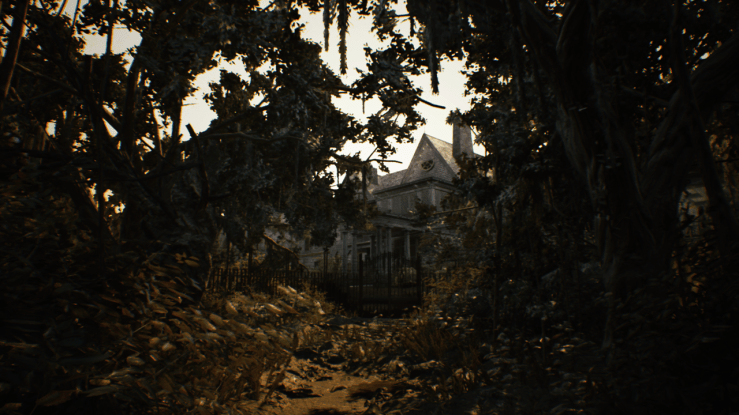
The house sprawls.
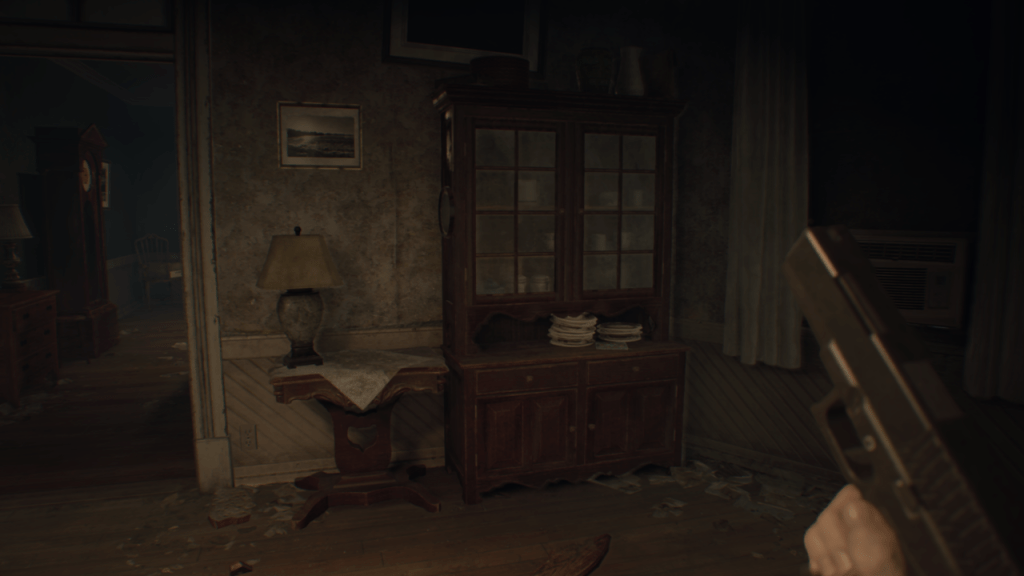
It is a labyrinth of jarring juxtapositions, a complex of rooms and ruins, corridors, bedrooms, workrooms, bathrooms, parlors, outbuildings. It is liberally decorated and lavishly electrified in decay. Its intact rooms remain gracefully furnished. Some of them might even be comfortable, perhaps, if you opened a window on a crisp spring morning. Some time ago this would have been a fine home, a stolid structure meant to house a family in comfort and grace.
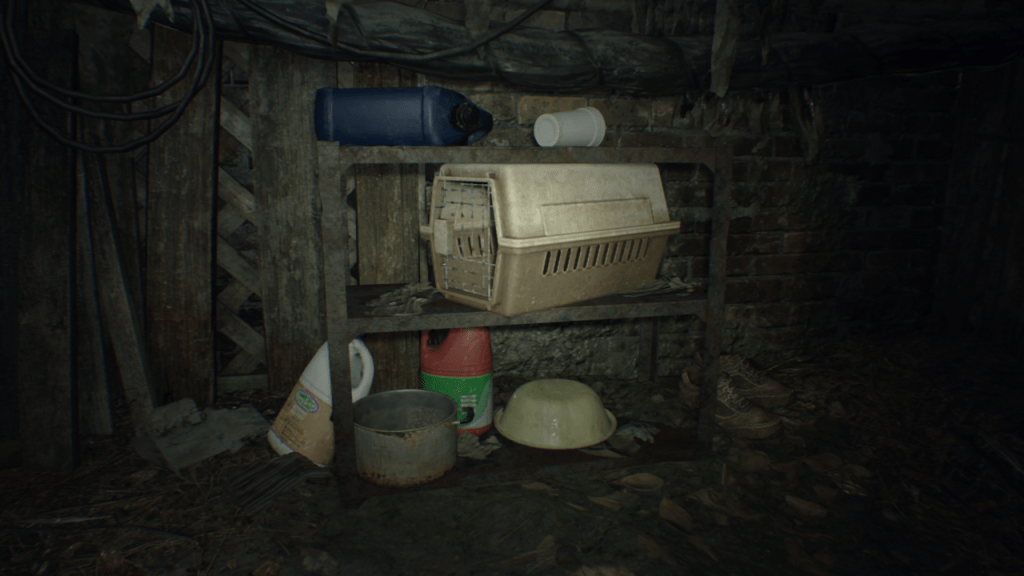
There is a sort of disease spreading through the home, however, undermining its health and style. There are hundreds, thousands of objects inhabiting the space: books, papers, shelves, paintings, tools, plates, photographs, video cassettes, suitcases, more. It is a dizzying, terrifying mess that bestows upon the game a sort of misleading material cadence: calm in the ordered spaces shattered by violence, chaos in the ruins while the heart slows from conflict.
The disease haunting the house is the American disease, a malady of excess. The inhabitants of this house demand forever more: more house, sprawling through endless outbuildings and passages; more bric-a-brac on the tables and curios; more prints on the walls; more rotting meat in the refrigerator; more life on the bones. They are without regard of the cost, keen only to revel in the excess. “Heck of a thing, ain’t it?” the house’s first monster, Jack Baker, asks you when he appears again in some new corner of the vast residence. “Sure as shit beats the hell out of dying.”
Resident Evil: Biohazard wouldn’t be much of a game if the house did not sprawl, creeping across the miasmatic landscape like an invasive organism, but the player should ask: if architecture influences how we think and feel by shaping the ways that we experience space, what does the house do to us while we are here?
2: Postcards to the Soul
A house, Gaston Bachelard reminds us, is something we imagine into being. The walls, nails, doors, and windows exist in some configuration resembling a house for a little while, but in our imagination these objects take on a new configuration that surpasses the mere existence of the building. Intimate spaces, in particular, like bedrooms, attics, drawers, and so on, bring to mind images that we generate somewhere prior to thought. These images are postcards of the soul.
What postcards does this home send to the soul?
3: Eastman Johnson on the Walls
If we consider the fine art still hanging somehow on the walls of this sprawling charnel house, the postcards here have been inscribed by the sickly hand of a diseased presence, an even more insidious manifestation of America’s original sin than the piles of stuff everywhere. One of these, Eastman Johnson’s A Ride for Liberty, narrates the dark tale.
The painting confronts us again and again.
Consider this place in its surroundings. The Baker House is situated in fictional Dulvey Parish, Louisiana, a watery place on the coast separated from the rest of the state by a dark bayou. This is delta land; sugar country. The Baker House is a plantation home, glowering over what was once one of the most hellish landscapes in North America. The Baker House’s Resident Evil is the immutable ghost of slavery. It cannot be silenced, here. The chains rattle through the night.
In 1853, a northern transplant to the Louisiana sugar country described the typical plantation. “The stately residence rises” he wrote, “out from among groves” of citrus, magnolias, and live oaks. The walk leading to the home was shaded by “shrubbery of evergreen jessamines, and perpetually blooming flowers.” Behind the house, he continued, “in strange confusion, is a crowd of out-houses; useful as kitchens, store-rooms, baths, with a school-house, and perhaps a chapel.”1 Past as well as present, plantation homes lured visitors through a complicated mixture of fantasy and reality, of wealth real and imagined. They loom large still in the American imagination.
In the Baker House, the pretense of gentility that plantation homes package and sell to visitors—the live oaks and “evergreen jessamines,” the opulent antiques and mint julep porches—has been stripped and subverted. Instead of a wedding venue, the property is a tomb writhing with decay. Instead of a preservationist’s dream, the house is a crumbling wreck, more House of Usher than Tara. In this sense, the home’s dark, unspoken memory is cut closer to the joints of history than tourist plantations. It is difficult to imagine a more poignant monument to the unresolved legacy of enslavement in the United States. In another sense, however, the makers of this house in this game insist upon obscurity. They chose this setting for a reason. Rather than write a story about slavery, they evoke the dark stain through a painting which recurs throughout the house: Eastman Johnson’s A Ride for Liberty.
It is said that history rhymes, and that is true of ARide for Liberty hanging on the walls of the Baler House. The artwork, which Johnson claimed to have painted after witnessing an enslaved family in Virginia emancipate themselves from bondage as the Union army approached in 1863, is well-known today. Art historians class the painting in the top three or four most influential works by the painter. It graces the cover of American history textbooks, flashes on the screen of documentaries. You may be surprised to learn, therefore, that this apparent treasure of the nineteenth century never hung in a gallery. Johnson chose never to display it.
Johnson’s reasons for holding the painting back are unknown, but its departure from the refined brush work and chiaroscuro for which he was known suggests that hanging the work may have been somewhat off-brand in his time. Johnson was primarily a portrait painter. It may also be true that there was little appetite in the market after the Civil War for anything dealing with the subject of slavery. We will probably never know why Johnson kept the painting to himself, but we do know that he executed two copies of the work in addition to the original. Its significance for the artist may have been greater than its appeal to the marketplace. Over time, the painting in its quiet way has come to symbolize emancipation. Perhaps it symbolized the same for Johnson. Perhaps it thrilled him from time to time to recall that morning in 1863, the hope and joy of freedom.
A Ride for Liberty plays a subtle role in the Baker House as well, but its presence is jarring, rather than uplifting. Elevated to the iconographic heights of the American myth, the work has taken on an almost devotional significance. It reminds the player, on one hand, that salvation will not come riding over the hill. On the other hand, salvation from what? Objects made of code, rendered polygons, scripted sequences? A Ride for Liberty draws the player out of the game, out into the deepest horrors of history. The house is a museum, therefore. It challenges the player; jars them; instructs them.
This is the plantation tour turned upside down. The player is encouraged to fear monsters and scientific abominations, but the monstrous human past of the place they inhabit here towers over any antagonist the game’s developers could imagine. “Gothic tales dwell on fear of the past’s resurgence in the present,” Emily Alder writes in the foreword to a recent story collection. “Repressed memories,” Alder continues, “personal crimes, family secrets, and cultural anxieties take form as ghosts, monsters, or shadowy doubles.”2
Human bondage is the Resident Evil of the United States of America, and it is the wellspring from which this work of gothic horror flows.
4. The Republic of Nostalgia
Houses do not emerge from the minds of their builders already haunted. They are haunted by the weight of their pasts. The ghost of consumption haunts the Baker House. The screaming spirits of slavery haunt the landscape upon which it is situated. The moaning specter of nostalgia, finally, haunts its quiet places.
On a shelf upstairs there is a football helmet. On the shelf beside it there is simply a picture of a football, framed. The football, set against the crumbling household and the past and present evils within and without, is a synecdoche for innocence. Other nostalgic symbols abound. Old books and framed photographs clutter desktops and walls. Old-fashioned floral wallpaper reminds the player of their grandmother’s home. Tape recorders where players may save their game physically embody memory, transforming ethereal digital information to analog. The player may imagine dropping the tape in her pocket and carrying it from recorder to recorder
“The nostalgic,” Svetlana Boym writes, “desires to obliterate history and turn it into private or collective mythology, to revisit time like space, refusing to surrender to the irreversibility of time that plagues the human condition.” Like the historians plastering Eastman Johnson’s overlooked Civil War painting on the cover of the American history textbook to symbolize the march of freedom, nostalgia converts the inert stuff of history to the fabric of myth.
Nostalgia at the Baker House forms the crux of a dialectic. As an aesthetic it contrasts the dark present with the bright past, leisure with terror. As a narrative device, it compels the player to link the “good old days” these nostalgic objects recall with the history of bondage permeating the house and landscape.
5. Tourists
After wandering the corridors for hours rifling through the cabinets, running from the monsters, puzzling over old photographs, and playing haunted video tapes, it is little wonder that metaphors of travel, such as postcards and plantation tours, spring to mind so readily. We are tourists here. The mansion is an inverted attraction.
Read against the grain and you will find all the things here that tourists seek. First there is the allure of history. The old home, the fine oil paintings and sculptures, the endless curios: these make up a sort of museum, drawing players through a historical narrative told by objects on display. The narrative here, as in many museums, is about family. Like all families too, this one is wrapped protectively around its darkest places. Unlike the typical family narrative, however, this museum draws your eyes those dark places rather than away from them.
There is also the valorization of work. The well-appointed garage and the morgue-like laboratory in the basement offer players an idea of the work that is done here. Like the winery tour or blacksmith shop, we are fascinated by contact with work. We imagine the satisfaction of the worker twisting the wrench or hammering the boards which shaped the world around us. Inhabiting the world shaped by that work distances us from our own work. Here the work is strangely collaborative, though. The player works for hours on end to overcome the work of their antagonists. This is a different sort of distance from that established by the winery tour, but the effect is the same.
Tourism draws visitors with the promise of limitless consumption. Like the outlet malls and gift shops surrounding Disney World, overflowing with merchandise, consumption here is doubly encoded. It is evident, first, in the maximalist sprawl of rooms and bric-a-brac. These spread before the player/tourist like a promising vista of leisure: numerous doors to open, each full of treasures to behold. Consumption is also encoded in the endless confusion of stuff the player may acquire. Downloadable content promises greater success, a more interesting experience, the continuation of the story.
Tourism scholarship points to the ways tourists congregate at the scenes of trauma, gathering in throngs at Gettysburg, Buchenwald, Hiroshima. Like other gothic tales set in haunted houses, evil castles, and graveyards, Resident Evil: Biohazard draws strength from this fascination with the dead. The subtle invocation of human bondage at the game’s centerpiece setting offers players a form of veiledcommunion with the vicious past.
Slavery is the American Gothic. Resident Evil: Biohazard is one of its postmodern texts.
Grabbed some shots last night of Pat from Subpotent’s other band, Durty Suns, playing at The Bark. I chose these to upload out of about 40 shots so I wouldn’t kill my hosting limit.
We all know Facebook is gathering data on users, but this is surveillance on a truly chilling scale. From the article:
Using a panel of 709 volunteers who shared archives of their Facebook data, Consumer Reports found that a total of 186,892 companies sent data about them to the social network. On average, each participant in the study had their data sent to Facebook by 2,230 companies. That number varied significantly, with some panelists’ data listing over 7,000 companies providing their data.
Even the most fevered conspiracy nuts of the last century could not have conceived of surveillance on this scale.
Facebook and other Meta properties are required in my creative work, but it is long past the time for artists to seriously consider alternatives.
Call it a passion project. The past few days in my spare time at work I’ve been recovering data from twenty-five and thirty-year old floppy disks. The files on these old disks—CAD drawings, meeting minutes, reports, and other construction-related documents structured in 1.44 MB or smaller bundles—are interminably boring, but there is something intellectually thrilling in the process of accessing and reviewing them. I’ve been thinking of this as an archival thrill, similar in the little raised neurons it tickles to the feeling I get when chasing leads in old newspapers or digging through a box of original documents in search of names, clues, faces. Entire careers have come and gone since these files were copied to the magnetic circles in their little plastic cases. Whole computing paradigms have risen and fallen in that time, and, with them, our own sense of technical superiority to the people who authored these files. Still, the same meticulous attention to detail is evident in the files, the same sense of their own sophistication on the part of the authors, the same workaday problems we are solving today.
Working the files, I noticed two more things:
The sound of a physical device reading data is special, and it can be deeply satisfying. I had forgotten the audible experience of computing—the whining, clicking, tapping, and whirring which used to characterize the entire experience. All of this is gone now, replaced by the sterile sound of fans, maybe, like wind blowing over a dried lakebed. There are audible affordances in physical media. When the sound stops, for example, the transfer is finished. When the button clicks on a cassette tape, the experience is complete.
The old files on these disks are authored with maximum efficiency in mind. With only a few hundred KBs to work with, designers had to get creative in ways we don’t today. There are a lot of pointillistic graphics, tiny GIFS, plaintext, line drawings; none of the giant, full-resolution graphics we include everywhere today.
One of the disks contains a full website, preserved like a museum piece from 1999. Clicking around those old pages got me thinking about the archival thrill of the old internet.
Consider the way that the most prominent metaphors of the web have shifted over time.
It used to be that people would surf information on the internet, riding a flow state wave across documents and domains in pursuit of greater knowledge, entertaining tidbits, or occult truths previously hidden in books, microfilm, periodicals, letters, and other texts. The oceanic internet held out the sort of thrill you feel when wandering among the stacks of a vast library or perusing the Sufi bookstalls of old Timbuktu. It was an archival thrill, tinged with participatory mystique, abounding with secrets.
In the heady days of the early web, to surf was to thrill in the freedom of information itself.
When Google arrived on the scene and began its ongoing project of organizing the information on the web, feeding took the place of surfing. This act, like every triumph of industrial capital, relied first upon the extraction of surplus value from the laborers who produced the commodity—i.e., the authors of the information. That is a subject for another day. More to my point in today’s rumination, however, Google’s revolutionary commodification of the web also took advantage of the customer’s innate narcissism. You have specific and important information needs, Google says with its design language, which this text bar can satisfy.
Google delivered on this promise by surfing the web on behalf of searchers. To deploy another (very stretched) oceanic metaphor, Google turned surfers into consumers of tuna fish. Each search serves up a little can of tuna. Enter a term in the box and out pops a little tin; pop the can and get what you need, increasingly on the first page; and then get on with Your Busy Life.
The YourBusy Life warrant is the play on narcissism. You don’t have time to surf, it says, because you are important.Have this can of tuna instead.
I love tuna. I search every day. Google was so successful, however, that the web wrapped itself around the tuna-dispensing search box. By the mid-2000s, users no longer used search primarily as an entry point to the waves but, rather, as a sort of information vending machine serving up content from Google’s trusted searches.
Beginning around 2008, feeding completely overtook surfing as the dominant user metaphor of the web. As Infinite-scroll apps on smartphones took the place of websites, the purveyors of these apps took it upon themselves to predict what users would like to know, see, or do. To this end, the most talented software engineers in the world have spent more than two decades now building algorithms designed to settle users in a stationary location and serve them little morsels of information on an infinite conveyor belt. Cans of tuna became Kibbles and Bytes, piece by piece, scrolling past.
The participatory mystique, or archival thrill, as I have called it, has been almost completely displaced by this dull feedlot experience. I know that the old experience of the web exists alongside the new, that I could go surfing right now if the urge carried me away, but I lament that so many of the people who could be building more and better websites are building cans of tuna for the Google vending machine on the web or Kibbles and Bytes for the apps.
I am currently seated on a dark, gray-green “Cuddler Sectional” sofa in a quiet warehouse. A single fan is whirring somewhere in the corner over by the rollup door leading to a chaotically disarranged backroom full of giant boxes and stacked mattresses shrouded in opaque plastic wrap. A sign on the wall overhead shouts “FREE LAYAWAY” in blood-red block letters. Another proclaims, “SAME DAY DELIVERY.”
Somewhere I have learned that red is an action color, meant to provoke; but what happens here, mostly, is that people wait. I am waiting on this gray couch, for example. The printout taped to the couch in a plastic sleeve neat my head tells me the color is “Aspen Gray,” but no such color exists in nature. Across from me, an elderly woman is waiting in a black leather recliner. On a sofa several rows behind me another woman waits, staring forlornly at her phone. People wander around,
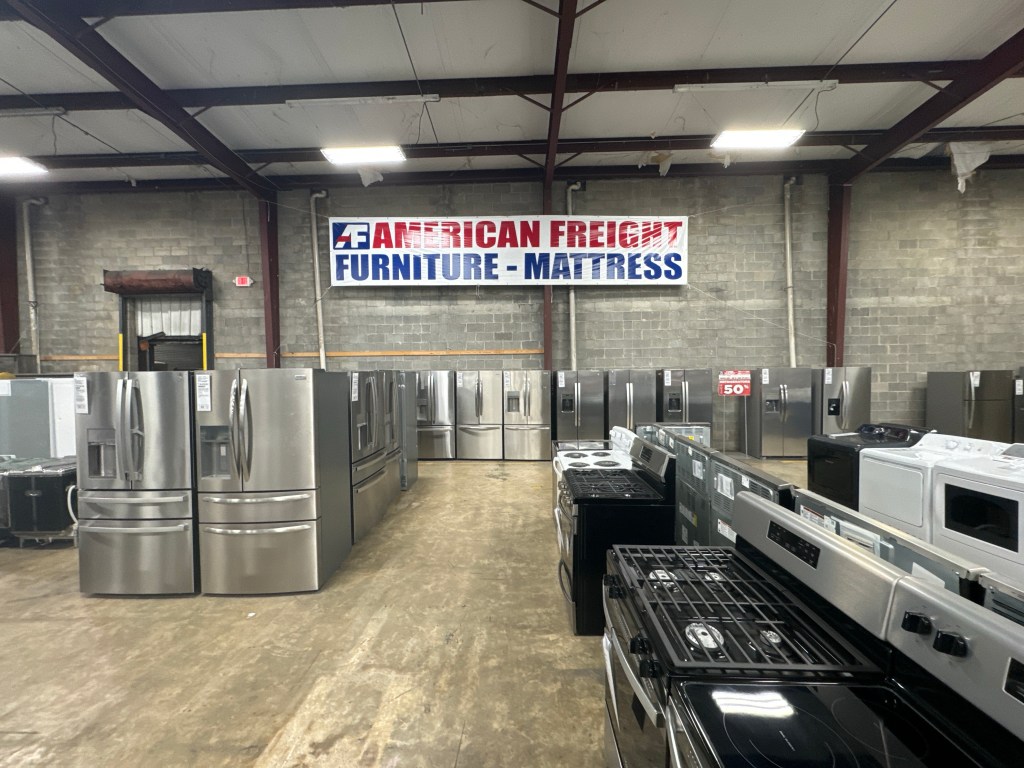
We are waiting in American Freight, a furniture store inside of a warehouse located in one of Tallahassee’s few light industrial areas. This is an area–always quiet on the weekend save for this furniture store–characterized by long, low buildings broken into sections of anonymous rollup doors, swimming pool and solar panel companies, fenced parking lots, box trucks.
Even if you aren’t located near one of the company’s 370 give-or-take warehouses, I am willing to bet something else like this exists in your town. Here are some characteristics.
Business is done in a warehouse setting. There is no showroom, no fake televisions or coffee table books. There is no front door, in fact, just a large roll-up door at the top of a loading ramp.
Customers back trucks and trailers up the ramp to the big door.
You never see the same people working there. You may visit two or three days in a row and see different–but invariably young and business-casual–salespeople each day.
After the first wait is over, customers back their trucks and trailers up the ramp to the big roll-up door and wait a bit longer there for someone to come load up their couches, dressers, armchairs, mattresses, tables, and dishwashers.
FM radio plays loudly from speakers at the sales desk but is mysteriously turned off at peak wait time: two hours prior to closing.
I can describe its characteristics, but I am still left wondering: what exactly is American Freight? Buying markdown scratch-and-dents in a warehouse feels like both the purest expression of capitalism and, somehow, its negation. Does this warehouse take us backstage of the commodity showcase, peeling away the curtains to reveal the artifice? Or does it elevate commodities to an even more rarified sublime?
No matter the theory, this seems like the kind of place where the story behind the story is fascinating, where the truth is stranger than fiction. How do these random recliners and major appliances arrive here? Are these storage beds made for American Freight, or have they been rejected by some other, more discerning retailer? What’s going on here?
Here’s another flyer I designed for a show coming up soon here in Tallahassee. Inspired by vintage postcards and classic Florida tourism, this flyer is also in square format for Instagram. Everything in our music scene runs on Instagram, like it or not, so it’s best to just design for the square format that works best on the platform and get on with life.
Easter egg: the bricks in the background up top are on the sidewalk of St. Roch Avenue in New Orleans, where we stayed at an AirBnB in 2021. I try to photograph interesting textures whenever I can and file them away for later.














 C.B. Crenshaw