
Tag: Art
Penelope Kosmonaut
My dog is named Penelope. Penny for short. Here’s Penny.

Now, here’s Penny in her alter ego costume: Hero Kosmonaut of the USSR!

That is all.
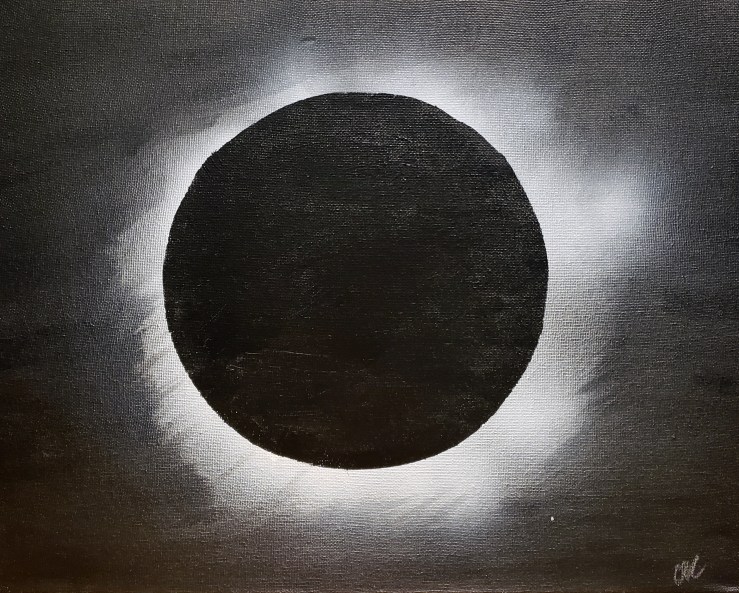
Art on Sunday: Solarium #1
Just a painting of an eclipse that I did. I’ll be at a conference starting tomorrow, so have a great week if I don’t post again.
Breaktime
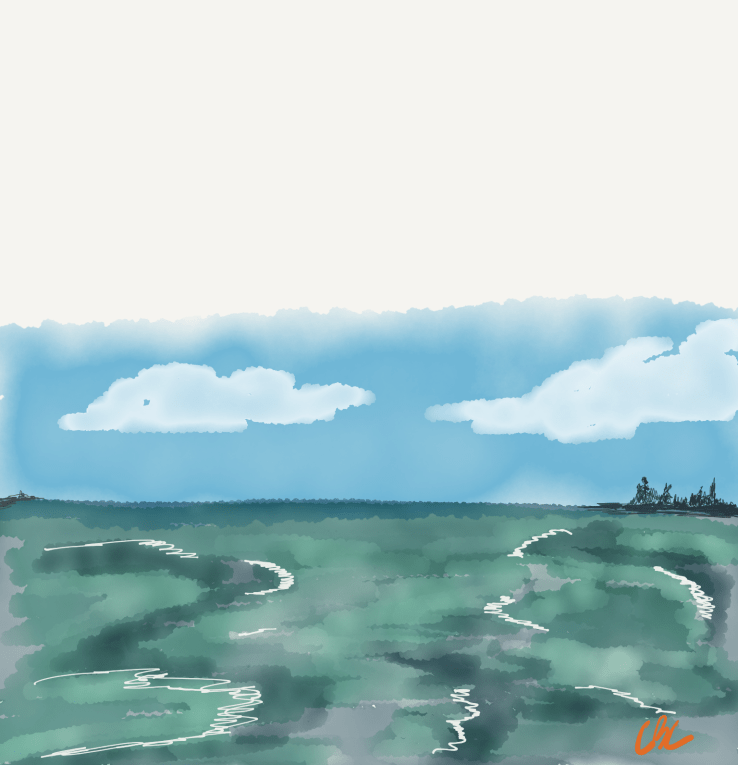
Dreaming of distant seas as this languid summer Friday shambles toward the weekend.
Link: “Does Having a Day Job Mean Making Better Art?”
This wonderful essay about artists and work deserves to be passed along with minimal comment, but I can’t help myself so I’ll offer two brief points.
In this case, first, it is actually illuminating to read the comments beneath the article. One of the commenters, “S. McClure” From Madison, Wisconsin, observes: “why must art be remumerative? Why must it be a profession? Perhaps it is an orientation that translates lived experience ‘into something rich and strange.’”
Which is very well put, S. McClure. From someone who spends his days working for someone else rather than creating, thank you.
For some reason, second, we decided in the twentieth century that a person could be only one thing. We decided that a person must be this one thing passionately, and that it must wholly consume them. We decided as well that if a person could not or would not submit their all-consuming passion to the logic of the marketplace, then they are a failure. Is this true? Is it fair?
I think there is a deeper intellectual history here wrapped up with the Earthly and Heavenly callings of Protestantism, the atomization of modernity, and the all-consuming fire of the market, but I’ll leave that for a more capable scholar to consider.
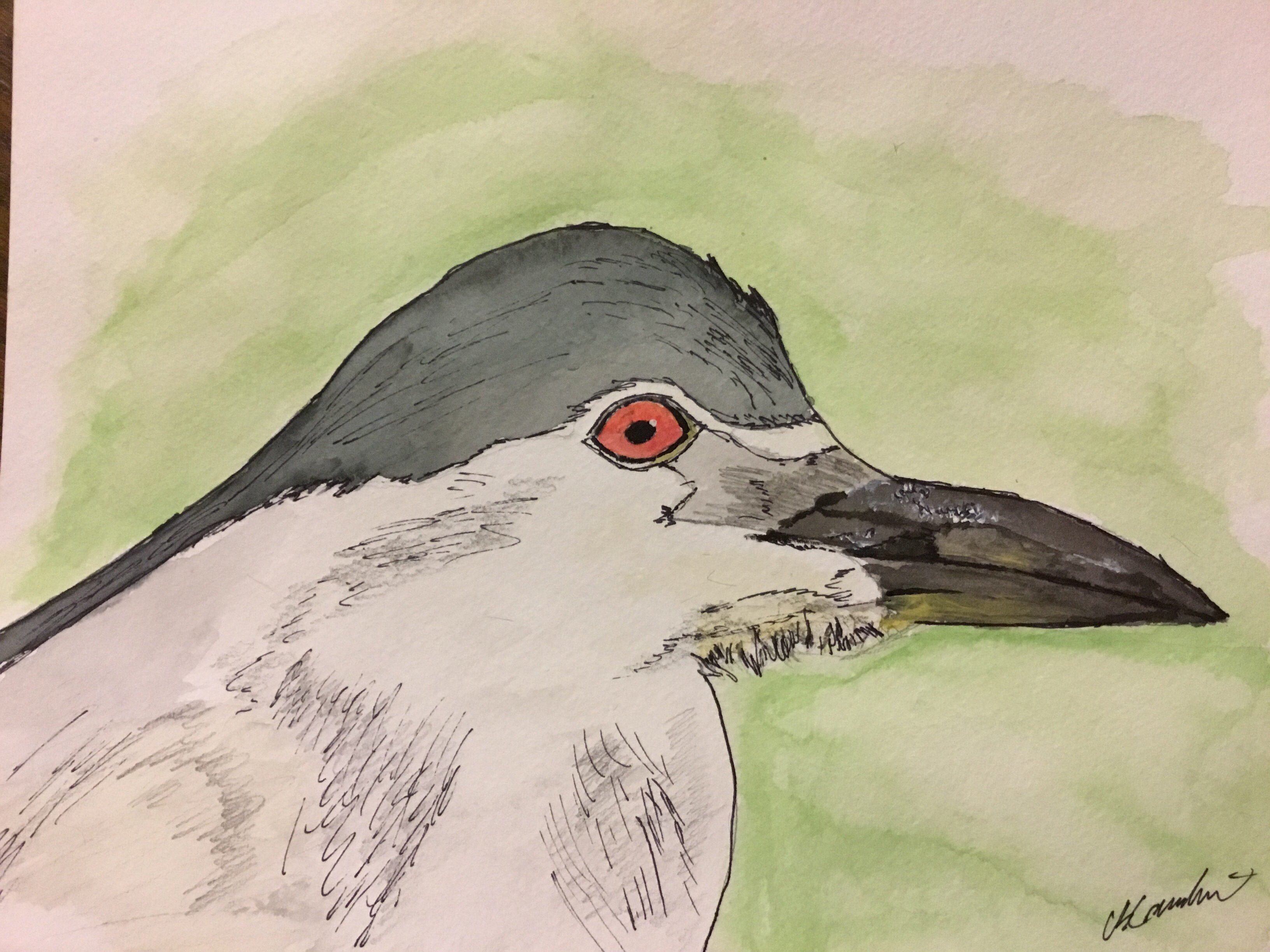
My First Watercolor
A Black-Crowned Night Heron.
Lots to learn…
Art and Culture and Hegemony and Stuff
Hegemony is a fifty-cent word, borrowed in its current context from Gramsci, that sits right up there at the top of the academic vocabulary vending machine alongside translated French philosophical words and phrases like “the ways in which,” or “discourse” and “practice.” But sometimes it’s useful. Here’s a tiny example of how the dismal hegemonic logic of buying and selling commodities warps our understanding of culture. Pardon the sarcastic quotations.
In “A blunt conversation about life online,” Huck writer Steven T. Hanley asks Bret Easton Ellis whether it is “overly cynical” to be concerned about “a generation with surface interests and surface knowledge” of “culture” because they don’t have to “take two buses to the only video store that [stocks] art-house titles” anymore. Ellis says, no, “it’s not cynicism.” Failure to “invest,” he continues, “equates to a lack of passion when everything comes so easily.” “If everything is at your fingertips in a matter of pushing a button,” Ellis asks, “then what does it really mean to you? What are you investing in it?”
Let’s ignore the vapid generational stereotype, because what’s one more soundless drop in the deep blue nothing of “millennial” stereotypes, and ask the real question here: what the hell is “culture?” And how in the world can one “invest” in it? Hanley and Ellis assume here (in this teeny, tiny part of an otherwise illuminating interview that you should definitely read) that culture is a sum of materialized aesthetics: that people think artistic things and transcribe their thoughts into some physical form, which, when placed alongside all of the other materialized thoughts, amounts to culture (1). In this view, culture is art. But if this is true, they miss the point. We can debate whether it is better to hold some material artifact of the idea we’re reading, watching, listening to, or whatever, but this is a fundamentally commercial question—which product is better?—that tells us very little about art. Far from “surface knowledge,” push-button aesthetics complete the sum for every viewer, reader, and listener.
Discussions of art frequently turn into conversations about things. Language reflects this tendency. Works of art have been called pieces since at least the sixteenth century, for instance. Artists have worked in a medium—materials facilitating the transformation of ideas into things—since the nineteenth century. Music, video, and digital visual art still rely on things in order to be reproduced. It is not surprising, then, that Hanley and Ellis should find themselves talking about stuff when they mean to discuss art. A little more surprising, perhaps, is that they combine the two and call it culture. This is the commodities warp: reduce and represent certain forms of cultural expression as material objects, first, and then substitute the objects in place of the vast and dynamic culture they dimly reflect.
A final thought that might be better developed elsewhere: the internet does not break the art commodities cycle, as Hanley suggests, by eliminating scarcity. It just modifies the variables. Where before both time and media were scarce, now it is only time. Hanley is doubtlessly correct in arguing that our relationship to media is changed, but as anyone who played Second Life years ago or spends real money to buy downloadable content in video games now can tell you, commodities need not be material to possess meaning. This is the real meaning of culture: the sets of rules, definitions, and sleights that allow us to ascribe meaning to everything there is, from art-house films on VHS and the buses we used to ride to find them, to interviews in digital magazines and novels from the 1980s.
(1) Well, Hanley more than Ellis. Later in the interview Ellis claims, “I think people respond to the content itself and not necessarily the medium, whether it’s films, vinyl or a hardcover book.”
 C.B. Crenshaw