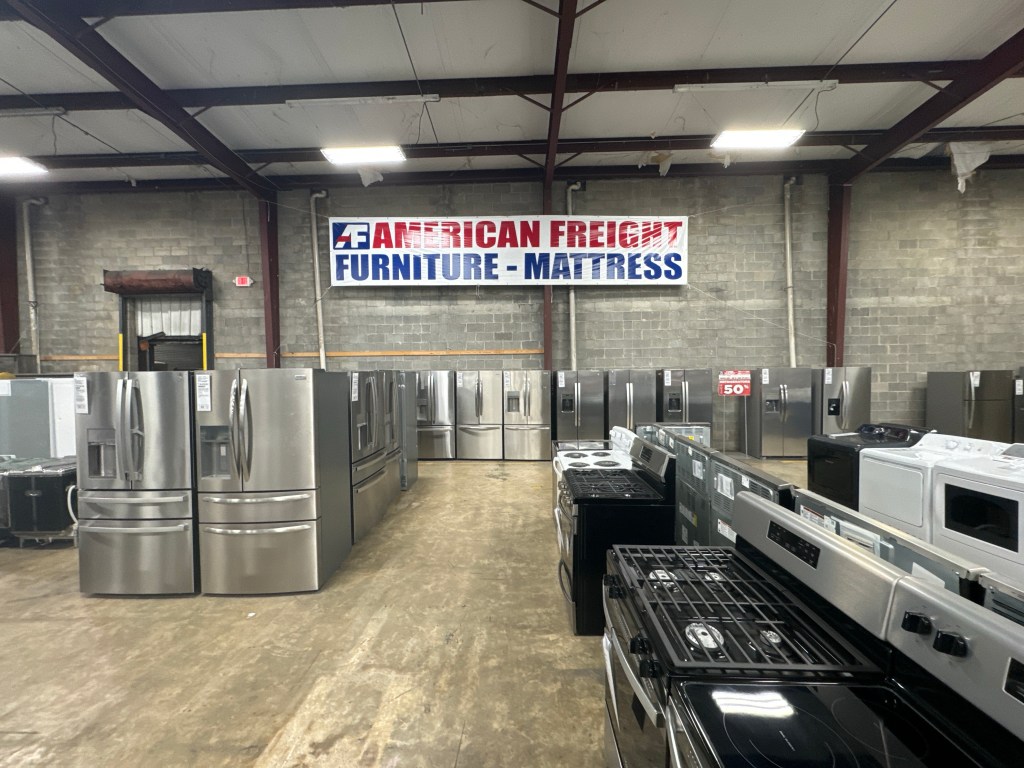
I am currently seated on a dark, gray-green “Cuddler Sectional” sofa in a quiet warehouse. A single fan is whirring somewhere in the corner over by the rollup door leading to a chaotically disarranged backroom full of giant boxes and stacked mattresses shrouded in opaque plastic wrap. A sign on the wall overhead shouts “FREE LAYAWAY” in blood-red block letters. Another proclaims, “SAME DAY DELIVERY.”
Somewhere I have learned that red is an action color, meant to provoke; but what happens here, mostly, is that people wait. I am waiting on this gray couch, for example. The printout taped to the couch in a plastic sleeve neat my head tells me the color is “Aspen Gray,” but no such color exists in nature. Across from me, an elderly woman is waiting in a black leather recliner. On a sofa several rows behind me another woman waits, staring forlornly at her phone. People wander around,
We are waiting in American Freight, a furniture store inside of a warehouse located in one of Tallahassee’s few light industrial areas. This is an area–always quiet on the weekend save for this furniture store–characterized by long, low buildings broken into sections of anonymous rollup doors, swimming pool and solar panel companies, fenced parking lots, box trucks.
Even if you aren’t located near one of the company’s 370 give-or-take warehouses, I am willing to bet something else like this exists in your town. Here are some characteristics.
Business is done in a warehouse setting. There is no showroom, no fake televisions or coffee table books. There is no front door, in fact, just a large roll-up door at the top of a loading ramp.
Customers back trucks and trailers up the ramp to the big door.
You never see the same people working there. You may visit two or three days in a row and see different–but invariably young and business-casual–salespeople each day.
After the first wait is over, customers back their trucks and trailers up the ramp to the big roll-up door and wait a bit longer there for someone to come load up their couches, dressers, armchairs, mattresses, tables, and dishwashers.
FM radio plays loudly from speakers at the sales desk but is mysteriously turned off at peak wait time: two hours prior to closing.
I can describe its characteristics, but I am still left wondering: what exactly is American Freight? Buying markdown scratch-and-dents in a warehouse feels like both the purest expression of capitalism and, somehow, its negation. Does this warehouse take us backstage of the commodity showcase, peeling away the curtains to reveal the artifice? Or does it elevate commodities to an even more rarified sublime?
No matter the theory, this seems like the kind of place where the story behind the story is fascinating, where the truth is stranger than fiction. How do these random recliners and major appliances arrive here? Are these storage beds made for American Freight, or have they been rejected by some other, more discerning retailer? What’s going on here?
Here’s another flyer I designed for a show coming up soon here in Tallahassee. Inspired by vintage postcards and classic Florida tourism, this flyer is also in square format for Instagram. Everything in our music scene runs on Instagram, like it or not, so it’s best to just design for the square format that works best on the platform and get on with life.
Easter egg: the bricks in the background up top are on the sidewalk of St. Roch Avenue in New Orleans, where we stayed at an AirBnB in 2021. I try to photograph interesting textures whenever I can and file them away for later.
I’ve been building a small but (spiritually) rewarding practice designing flyers for local shows here in Tallahassee and just realized that I haven’t shared any of them! Here is a recent example, inspired (obviously) by some of the old Haight-Ashbury and Monterey Pop posters from the late ’60s.
More to come. I am so busy with everything lately that it’s hard to keep up.
When Álvar Núñez Cabeza de Vaca passed through this part of Florida in late summer 1528, his names and nicknames trailing behind him like soldiers in the van, the haggard band of Spanish soldiers and clerks of which he was a part encountered a country ravaged by storms. He described a “country difficult to traverse and strange to look at,” covered with “great forests” full of “wonderfully tall” trees. So many of these giant trees had fallen, he wrote, “that we had to make long detours and with great trouble” to pass through the country. The trees still standing, he continued in his memoir, were “rent from top to bottom by thunderbolts.” For a man reared on Spain’s rocky, sandstone-colored Mediterranean coast, it must have been strange country, indeed.
Walking in our little corner of the Red Hills in the days since Hurricane Idalia passed by, I’ve been reminded of the old Spanish invader’s experience here. There was a venerable old pine tree that came down up the hill from our place, leaves and sticks and clumps of sodden leaves and moss everywhere, puddles and piles. The most motivated neighbors in our little community set to work right away sawing, raking, grouping, piling, anxious to restore order. Mere hours after the storm, when most of us were only just beginning to open the door and peek outside, these intrepid workers had already mostly finished the cleanup.
People love to set things right like this, but nature prefers chaos. Left to themselves, all these sticks, leaves, and branches will fertilize the earth where they fell, literally becoming soil as the years go by. In the meantime, they swarm with life. Pick up a fallen branch after a few days in the sticky summer heat and you are likely to find a circus of living things—millipedes, roaches, slugs, worms, ants—in the cool, dark depression below. Life thrives in these overturned places.
Over on the other side of the hill, away from the tree felled by Idalia, they cleared a little patch of land earlier this year when a winter storm knocked over a different tree. One day there was a large maple tree standing there, surrounded by shrubs and bushes growing in the shade. A few days after the storm took it down, everything was gone. In its place was simply a patch of bare earth, brown and forlorn, covered with sawdust and drying leaves. Our instinct in a place like this is to stay away. My dog, Penny, snuffled around the patch for a moment and then moved on to the abundantly living places nearby.
Chaos is creative. It gives us new ideas, encourages us to play.
This lonesome state did not last, however. A week after the clearing, there were weeds shooting up all over the bare spot, little clumps of green rapidly colonizing the exposed soil. Vines crept among the clumps of weeds, tentatively, like explorers working across the frontier. A few weeks later, there were little bushes there, a thickening verge of nightshades, kudzu, and wildflowers swarming with bees, wasps, and butterflies. Now, six months later, the little bare spot is wild with greenery, vividly alive with flowers, vines, insects, snakes, mice, birds, lizards, even—oddly enough—a thriving tomato plant.
The formerly bare spot.
There are some, I’m sure, who would like nothing more than to rip that little wild spot out, replace it with St. Augustine grass, and turn the sprinkler on it. I pray to every goddess, god, and lesser celestial entity who comes to mind that these people never get their way. Let them have the rest of the world and leave this two-hundred square feet of jungle to itself.
Chaos is creative. It gives us new ideas, encourages us to play. When I was a child, running around the suburban streets of southern Maryland, there was a nice patch of ignored woodlands next to the house. About five acres, hemmed in by roads, apartments, and fenceless back yards, it was densely treed, networked with narrow paths over dry, deciduous hills and down into boggy depressions. There was even a little pond back there, fifty yards across, murky and filmed with white bubbles in the summer but beautifully iced over for a few blessed days in the winter. I spent hours in that little patch of woods, my magic place, roaming the paths by myself or, more often, trooping down the leafy trails with the peripatetic gaggle of neighborhoods kids.
One day a group of us were ducking and snapping through a trackless portion of the woods about two hundred yards back of a kid named Josh’s house when we made a remarkable discovery. We found a place where some trees had fallen together, interlocked like dominoes that tumbled in different directions. One had fallen over completely, roots and all, a giant clump of red earth at the base looming over a deep hole. One kid, an intrepid girl named Katie, shimmied down in to the hole and found a bunch of tightly packed clods of marbled red and brown dirt. We marveled at these for a moment, these little artifacts of a world long-buried beneath our feet, longer than some clumps of dirt probably deserved. Meanwhile the fallen tree leaned at about a thirty degree angle, many feet up, supported by the strong limbs of a neighboring tree that had managed to survive the storm. A kid named Mark balance-walked right up the leaning trunk of this fallen grandfather. Another tree in the middle of these two had not survived, however. Struck by Mark’s fallen pine, it broke off about ten feet up the trunk and fell into the arms of another tree nearby. Together, along with dangling branches, shrubs, and decaying logs, these fallen trees formed a sort of enclosed clearing, like a cathedral in the dense woods. We saw the potential for this place immediately: this was a fort. We gathered the clods from beneath the tree and piled them at strategic locations along the stockade—dirt bombs. We stationed a sentry at the top of the root-ball tree to keep an eye out for anyone coming.
Sure enough, after a couple days, a group of older kids came by and heard us playing back in the fort. They saw the potential too and undertook a siege on our position. We took up our battle stations and pelted them with dirt bombs until one of them told his little brother (Josh, who had learned of the fort when we came out of the woods into his backyard the day before) that he would tell their mom what we were up to back there. This was a compelling argument to Josh, for some reason, and in his sputtering confusion the older kids broke through our defenses. They chased us for awhile before returning to claim the fort for themselves.
In these days after the storm, I remember the fort vividly. I think about the way this place has always been characterized by fallen trees, draining lakes, flooding rivers, raging forest fires. Living things—plants and millipedes and children, too—thrive in the aftermath of these events. Everything is born of chaos and disorder, and everything will one day return there. We may as well climb the trees and make some dirt bombs in the meantime.
I think there is another post here somewhere (found it -CBC) which makes the same point in greater detail, but I cannot stress enough how strongly I believe this. Two more articles I read today continue to beat the drum punctuating the internet’s rapid fall from the mountaintop of human experience.
The Future is Local. This does not mean that people will turn away from global culture. There will still be K-Pop fans, Russian goths, and other Very Online™ people; but they will use these global identity traits to find meaning among their friends and neighbors in person, rather than an anonymous clique of forum users on the disenchanted, sterilizing network of computers that have dominated our lives since around 2008. Networked computers aren’t going anywhere; they’re just moving to the backseat.
The Future is Physical. Digital artifacts are dismally fucking boring. It’s as simple as that. People aren’t reading magazines on the internet because reading text on the internet is an awful experience. Building a collection of streaming music is about as exciting as sorting paperclips. We do it, but we don’t enjoy it. Watching videos on the internet is what it was like to watch TV in the decades before. You can have a good time, but it doesn’t stick like going to a movie or buying a disc (or a tape, for that matter). Looking at art on Instagram or the web is like watching free porn; do it long enough and you’ll make yourself crazy for the real thing. For all these reasons, the internet cannot take the place of physical things in our lives.
Print, burn, press, paint, draw, record. It’s the way of the future.
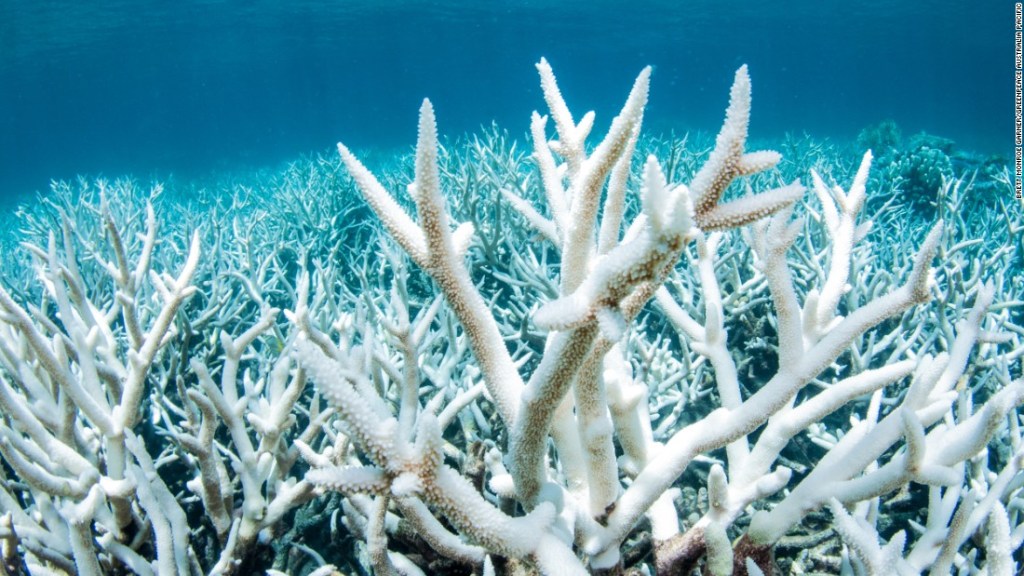
This is a list of articles documenting the ongoing destruction of the environment. If you believe “it’s just weather,” or “the climate is always changing,” click around below and tie yourself up in a few more knots.
“We see increasing magnitude of certain types of disasters. We see increasing socioeconomic impact from disasters. We’re also seeing disasters in places where we don’t usually see certain types of disasters, and different types of disasters interacting with one another.”
Andrew Kruczkiewicz, senior staff associate at the International Research Institute for Climate and Society at Columbia Climate School, wuoted in Justine Calma, “Climate Change is Redrawing the Disaster Map”






 C.B. Crenshaw