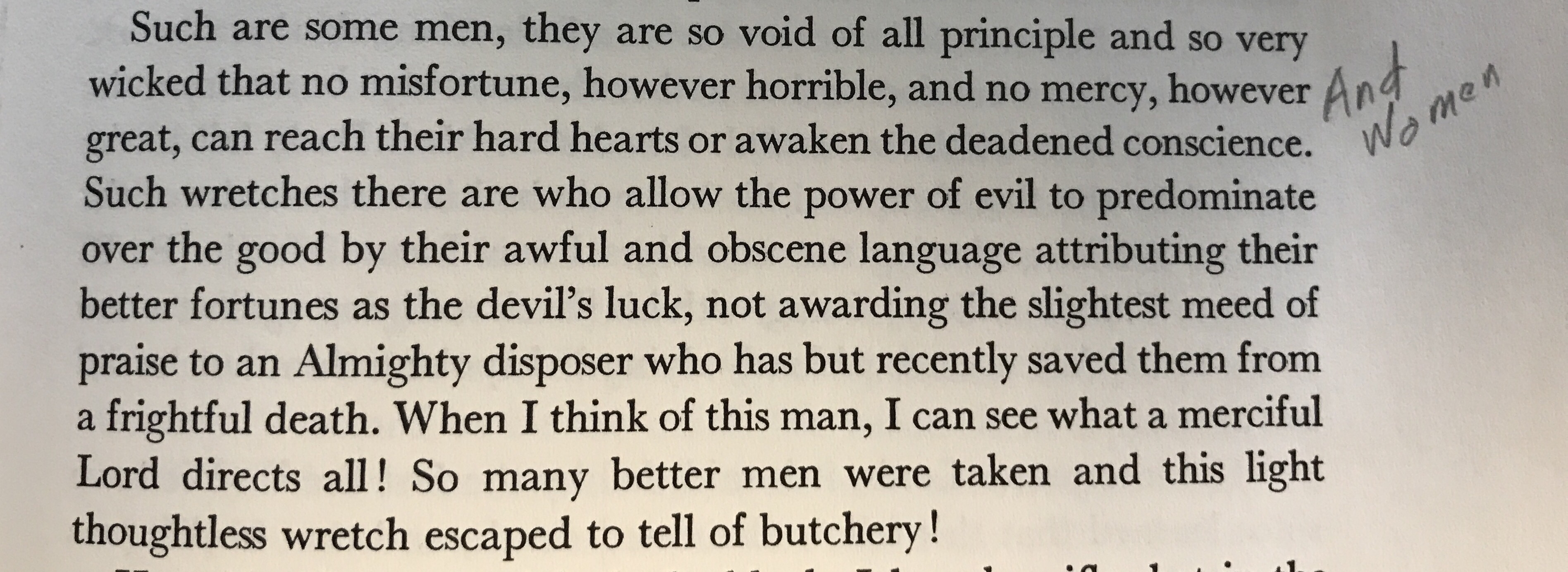
An Open Letter to the Author of Bitter Marginalia in Reminiscences of the Second Seminole War by John Bemrose.

Radical Equality

Dear Austin, 

Is it OK if I call you Austin? That’s what I imagine, and you haven’t given me much else to work with, so there we are. Me and you, Austin.

Austin, what happened? Until now, you were enjoying this book. Back there when we were reading about “friendly and simple-minded” Minorcans, you kept to yourself. You stayed quiet, too—with a grim set of the jaw, I like to imagine, but I’m not so sure—when “the unfeeling buyers of blood” at the St. Augustine slave market “[caviled] over the qualifications of human beings, with the coarseness of cattle jobbers.” “Picturesque” Indians (who were also, I’m sure you remember reading, “great beggars”); a Black Seminole interpreter “with his paucity of ideas”; Native “children of the woods” who wouldn’t hesitate to kill a “even a lisping babe!”; all went without comment. But not this. So why now?

I’ve been thinking about it, and maybe, Austin, feminism is your jam. All that stuff about race and ethnicity is someone else’s fight. Maybe it’s so clearly wrong-headed that it doesn’t merit marginal argument. But this, this is Austin’s battlefield: women can be unprincipled and wicked, too! Men and women alike can have hard hearts! Which, hey, you’re not wrong. Fair enough.

But I don’t think that’s true. I think you had an axe to grind when you read this paragraph. And it’s OK, we’ve all been there. Like, just this morning on the way to work I was stopped at an intersection waiting for someone to pass so I could turn right; but then, right at the last second, they whipped the car into a turn. No signal! And then the next car did the same thing—and no, they weren’t in a turn lane, I know what you’re thinking, Austin, this was a two-lane road—and then the next one, and the next one, until finally the light changed and I was stuck. I could have turned ages ago if only I had known! So then, later this morning, someone was trying to talk to me about an unanswered email and I couldn’t wait to say, “I know, it’s just like people who don’t use their blinkers! Why do people do that?” And they just sort of laughed and then kept going on about the email.

I’m guessing that whenever it was that you read this, Austin, you felt pretty much the same way about women. Someone would say, “Know who was a real piece of work? Mussolini, that’s who,” and you would say, “I know, I know, but women can be evil, too.” Or someone else would go, “I burnt my fingers on my toast this morning,” and you would say, “yeah, kinda like women can burn your heart.”

If you still feel the need to scribble your rage in old memoirs, OK. The past is a safe space: lived-in, comfortable. That’s one of the reasons we historians like to spend so much time there: we already know the bad parts of the movie, and we know the heroes and villains can’t hear us or object when we grind our axes on their words.

But, Austin, we can also talk about it if you want. I think you might need to talk about it.

All the best,

Chris

Cicadas

Heard the first cicadas of the year this afternoon and wondered what I was doing when this brood entombed itself, a living time capsule, a few inches below our feet. In other parts of the country they know their cicadas better than we do here in Florida, so I can only speculate. Maybe I was in Gainesville, playing in bands and going to shows–but mostly just wandering the aisles at Walmart. Maybe I was standing at a door machine at a Jacksonville lumber yard, dreaming nothing, day to day. Maybe it was just last year, and I was pecking at keys on a tiny screen, just like now, when I should have been sleeping instead. I don’t know. We don’t know our cicadas here.

If you live somewhere north of here, you can be more precise. This year’s brood up in South Carolina, down into Georgia, and across the broad freeway-crossed South laid itself down at the dawn of the new century, in 2000. Who knows how I would have been if I had been raised a Georgian, Carolinian, or Kentuckian, but I like to think of myself down in the sprawling suburbs of North Florida posing for the yearbook with pink hair and a tie knotted well above the neckline of a T-shirt just as the magicicada were burrowing below.

Wherever you are, cicadas are a link to the past. Springs and summers past; burrows dug and uncovered again.

It’s entertaining to imagine myself a teenager again, but what must these poor baffled insects think as they emerge into this spring and look at what we’ve done to the world their parents left in our hands when they burrowed below? Talk about woke.

Native Hatred and American Populism: The Jacksonian Beat

As Americans struggle to understand or resist the travel ban, hate crimes, aggressive immigration agents, and government-maintained lists of immigrant crimes—to list but a few of the earthquakes rollicking the American social landscape so far in 2017—it can seem as though we are living through events without precedent in American history. A quick stroll through the archives reveals that this simply isn’t true. Here’s a commonplace example from the late 1830s that resonates with today’s dark mood.

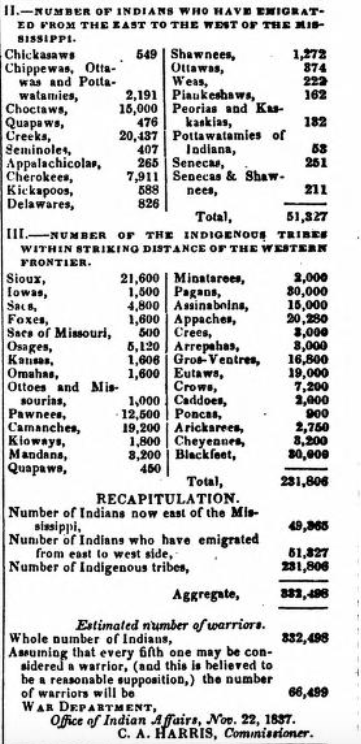
Screen Shot 2017-03-05 at 10.46.40 PM


The 1830s were just as seismic as our own time. Andrew Jackson ascended to the Presidency on the one-two punch promise of populist upheaval and Indian removal in 1828. Historians will argue over the extent of the “democratic surge” until we’re all speaking hexadecimal or Martian, but only an insane person could argue with the “success” of Jackson’s Indian policies. Indian hatred laid down a persistent beat beneath the American freestyle throughout the 1830s. Thousands of Indians in the Southeast were marched westward at the point of the bayonet and on the razor’s edge of starvation. Wars in Florida and Alabama tore villages apart, forcing the most intransigent or tragically fortunate Native peoples deep into the South’s swampy fastnesses, while war in Illinois signaled the end of organized Native resistance in the Old Northwest. When it comes to basic human conditions like peace and prosperity, the 1830s—like most decades since the European invasion began more than five hundred years ago—were bad for Native Americans.

American newspapers kept the anti-Indian beat pulsing throughout the Removal era. The image above comes from the February 1, 1838 issue of the Army and Navy Chronicle. It does a lot of work in support of American colonialism. It creates the illusion of certainty and superiority by enumerating and classifying Indians—similar, perhaps, to a list of countries with suspected links to terrorism. It instills fear by associating these thousands of potential enemies with “striking” on the frontier—not too far from, say, a list of crimes committed by immigrants, or claims of 122 “vicious” combatants returned “to the battlefield” from Guantanamo. And it links these numbers to the military by publishing it under the heading of the War Department—a bit like the current “military operation” sweeping fearful immigrant communities throughout the United States.

Most newspapers from the era laid down the same beat. If the rap wasn’t Indian war, Indian fear, or Indian hatred, it was a breathless accounting of the things that were possible when the Indians were gone. Books and newspapers in the South instructed readers to plant cotton beneath the tilled husks of old corn fields, for example, for best results (i.e., profits to buy more human beings, but that’s a different story). These “fever dreams” of cotton wealth and “flush times,” as Joshua Rothman calls them, created spectacular booms and devastating busts. We should keep that in mind as we argue over what it means to “Make American Great Again.”

Street Theatre of Oppression

An extraordinary poet spends his days at the bus station in Jacksonville, Florida. He performs his most important poem as a drama in two parts. The street theatre of oppression.

Act One, in three scenes: The poet covers his face with a black ski cloth and runs blindly across State Street, pauses for a moment, and runs blindly back.

We read his steps in the first act crossing the street. Each staccato footfall strikes a rising note of caution and uncertainty: one, safe; two, safe; three, safe(?); four, danger; five, death(?) The poet pauses momentarily on the other side of the street, a blank mannequin head-shape protruding from a brown jacket over blue jeans, regarding the stunned audience. Those who did not witness the first act enter the theater usually during this laconic second act soliloquy. The poet does not see the newcomers. His thoughts and emotions muted by the blank shroud covering his eyes and mouth, he further decenters himself in the third act. Cars, trucks, and vans are the actors in the climactic drama. Killers all. Missiles. They race toward the protagonist with elemental abandon.

The poetry of the tightrope walker is of tightly-structured poise: supreme control of body and mind. The street-runner’s poetry is of a different sort, a sport of sheer abandon, a plaintive wail enacted for the passengers collected at the Rosa Parks Bus Terminal at 9:40 on a Thursday morning. The poet’s death-defying sprint across eight lanes imparts profound hopelessness. He and his audience must trust and hope that the racing motors do not bring the show to an end, but there is nothing they can do.

At the end of the performance, the poet returns to the terminal and uncovers his head with a stoic but exhausted mien, a celebrity especially to the adoring public awaiting Bus 8B to Beach and Atlantic Boulevards.

Act Two, in two scenes: the poet transforms himself into the oppressor and whips the trash. 

As the poet removes the mask, the curtains go down over his face. He sits on a bench for a moment and gazes at nothing, staring into the past and shading his eyes from the future. Gradually the curtains go up over his face, and he rises from the bench, removing his belt.

The poet’s face remains blank but he focuses his attention on the belt in his hands as it transforms from an article of support into the penultimate weapon of degradation—a lash. His body is transformed then into a terrible machine as he twists the lash, cutting the air with cruel, windy sounds. Several twists, a violent thrust, and then the poet focuses the lash on the steel rim of a trash can, whipping again and again. His face remains blank, emotionless and incapable of projecting the show’s meaning. He continues whipping the trash, again and again, as the bus pulls away. The curtains go down as the audience joins the elemental machinery of death on State Street.

The poet’s ouevre of despair revolves around dualism. Hopeful and hopeless, he recites a litany of helpless despair with each footfall forth and back across State Street. Support is transformed into subordination, the body transformed into a weapon. The trash can is himself, is everyone who was or is or will be enslaved, is everyone who has been a child, is all of us. Mute and blank, his voice rings loud and true.