Prompt 2: Tension

Close your eyes and check in with your body. Start with the top of your head and scan down to your toes. Check for places where you’re holding tension. What’s your posture or pose like? Where are your muscles relaxed or contracted? Write about your current state.

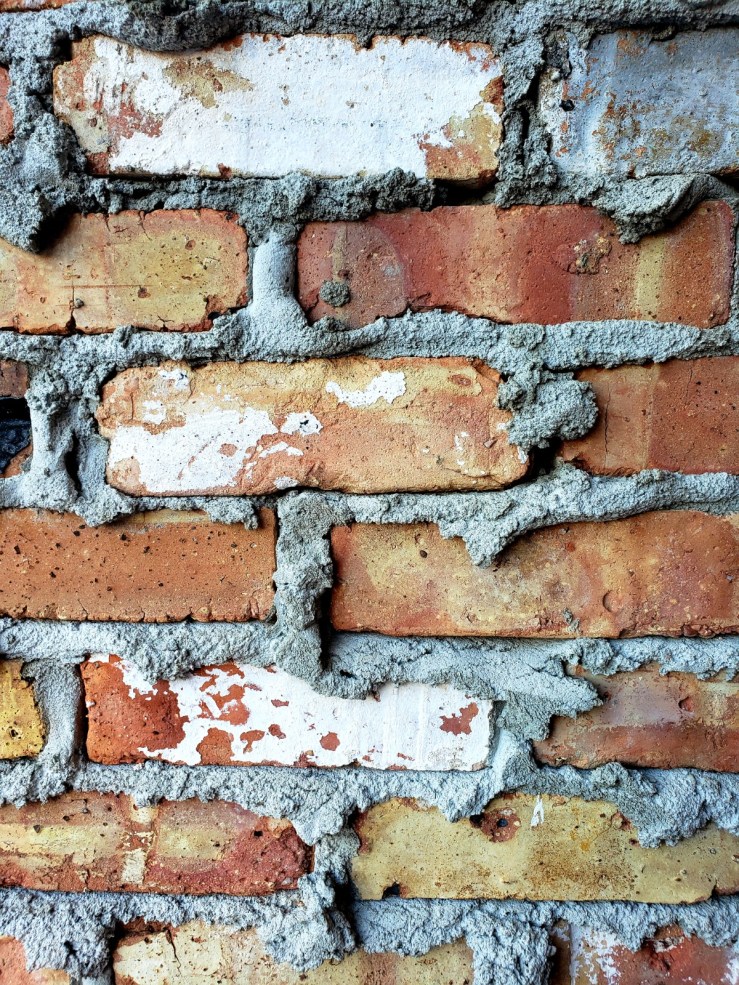
People say we “hold tension” like it reflects negatively on our character. I just want to say hey, maybe this tension is carrying me right now, but I don’t think we’re supposed to say that here in the always-be-positive land of the lean-into-adversity go-getters. And then again maybe I’m just troubled by this prompt because I am carrying a bit more tension, I think, in my neck and shoulders these days, and I don’t know what to do about it.

With education you progress, it seems, from a machine to a bench to a desk; but here, eyes straining behind dusty spectacles, legs and arms bent in a collared shirt and wrinkled slacks, I sit before a more cerebral machine as it shapes me into an image of itself.

Prompt 1: A Postage Stamp View of my Office

Note: I am working through the book The 1-Minute Writer by Leigh Medeiros, which is available right now as part of a Humble Books Bundle at Humble Bundle.

You’re on the phone with a far-flung friend who wants to hear about where you are right now. Check out your surroundings. Capture the essence of what you see around you in just a few sentences.

The light streaming through the windows in my office is brilliant most mornings, but this morning it is shifting with the clouds: bright yellow-white one moment, a dull gray-white the next. It shines on a mess of papers spread around my computer—the litter of a week in which I missed two days sick and came back to a growing list of things to do. The computer and its two glowering eyes perched atop the desk leave little dominate my field of vision as thoroughly as they dominate the room itself. I wonder sometimes if I am meant to serve the computer or if it is meant to serve me. The brilliant light streaming through the windows eases these thoughts, while the pines, water oaks, flowers, and grass it reveals with each blossoming moment offer a compelling antidote.

A Gift

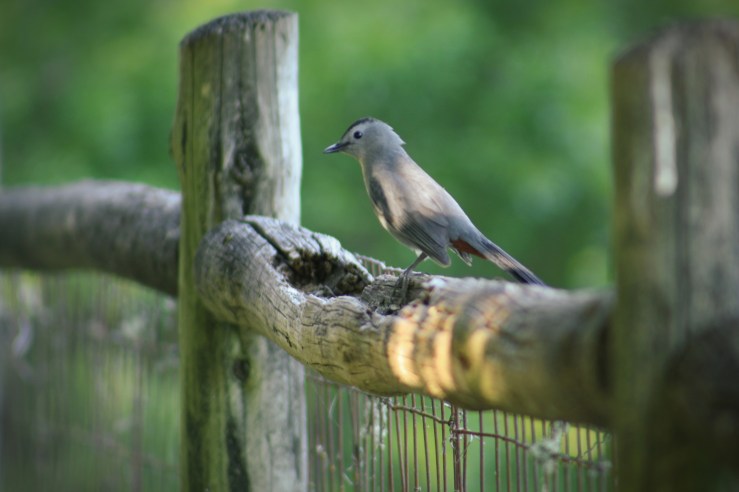
I live for moments like this. The ‘secret pond’ I like to visit every few weeks was aflutter with chattering songbirds when I stopped by a few days ago. I walked slowly around the edge of the pond, trying desperately to capture a good shot of the Jays, Wrens, Warblers, or Mockingbirds hidden in the leafy branches hanging over the water, to no avail. I had given up for the day and started heading back toward the car when this little bird stopped to have a look at me. Moments like this are a gift.

Field Notes: Morning Walk with Old Mr. Green

Interstate 10 runs right by my office window, back behind the trees, as it winds a course to Jacksonville one way and Long Beach in the other. I am of a disposition to amplify the effects of humans, so on my walk this morning my first impulse was to fixate on the interstate and the constant din of trucks, cars, motorcycles, choppers, jake brakes, ambulances, and so on that roar by all day long. But if I get on with life and forget about the highway, the most dominant noise is the wind, billowing through an utterly shameless profusion of rich green leaves. They are this year’s bumper crop and, out of nowhere, they have filled in winter’s blank spaces by the billions. Where before I could look out across the parking lot at the people lined up in front of the food truck, now I see only a wealth of spring greenery. It is a miracle of rebirth.

The wind touched every one of the trees on my walk this morning, passing through the trees like astral fingers stroking the hair of the earth as the temperature dropped ahead of today’s April shower. Birds rushed to finish their morning business, calling out to one another last minute warnings and desires over the cacophony of road and weather. A Mockingbird chased a Cardinal up a dense leaf-lined avenue overhead, warming the walk with a flash of crimson followed by a white and gray streak. The other birds hid themselves well, not as prone to the Mockingbird’s passion or the Cardinal’s exuberant plumage.

The wind whips up a potent mélange of smells—not all of them natural, but all a welcome deviation from the anodyne air in the office above. Cut grass from the faded green tractor plying the margin of the interstate, delicate flowers peeking out from the sun-dappled spots of bushes along the way. Hot rubber tires. Sighing asphalt. Leaf litter. Unidealized bark.

I lose myself in the symphony of it all and walk through a wisp of Spanish Moss. It reminds me of childhood visits to Memorial Park. Dad playing the part of Old Mr. Green with the Spanish Moss beard. Mom was flabbergasted when I played the part myself later that week. “You’ll get redbugs!” she gasped, and I threw the moss away like some sort of cursed memento mori. But dad didn’t get redbugs, and neither did I. Old Mr. Green was all bugs, though, and leaves and sticks. Old Mr. Green was potent earth and leaf litter chasing children through the park in 1990. He sings to me now from the parking lot outside. You only have to know where to look. You only have to ignore the interstate.
On the Edge of the Ocean: Florida and Sea Level Rise

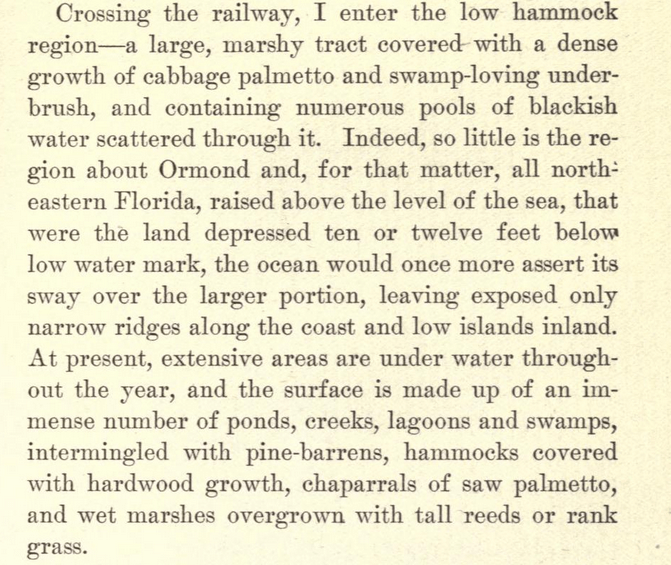
As the Florida legislature takes up sea level rise, I keep hearing voices from the past resonate over the conversation.  This passage, from Willis Blatchley’s A Nature Wooing at Ormond By The Sea (1902), highlights one northern visitor’s awareness of the state’s precarious seat on the edge of the ocean almost 120 years ago.

This isn’t a secret, of course. You could find thousands of similar quotes and passages in Florida history. But it can be easy to forget when just about every reporter writing a story about sea level rise in Florida pretends that seawater washing over the peninsula is a new problem instead of an ancient trend.

To be sure, sea level rise is a new problem. Understanding that Florida is built from the ocean, however, that it was seafloor not so long ago, and that it is a vast watery expanse even at the best of times, can help us adapt intelligently.

Screenshot from 2019-03-21 23-14-53