Field Notes: Morning Walk with Old Mr. Green

Interstate 10 runs right by my office window, back behind the trees, as it winds a course to Jacksonville one way and Long Beach in the other. I am of a disposition to amplify the effects of humans, so on my walk this morning my first impulse was to fixate on the interstate and the constant din of trucks, cars, motorcycles, choppers, jake brakes, ambulances, and so on that roar by all day long. But if I get on with life and forget about the highway, the most dominant noise is the wind, billowing through an utterly shameless profusion of rich green leaves. They are this year’s bumper crop and, out of nowhere, they have filled in winter’s blank spaces by the billions. Where before I could look out across the parking lot at the people lined up in front of the food truck, now I see only a wealth of spring greenery. It is a miracle of rebirth.

The wind touched every one of the trees on my walk this morning, passing through the trees like astral fingers stroking the hair of the earth as the temperature dropped ahead of today’s April shower. Birds rushed to finish their morning business, calling out to one another last minute warnings and desires over the cacophony of road and weather. A Mockingbird chased a Cardinal up a dense leaf-lined avenue overhead, warming the walk with a flash of crimson followed by a white and gray streak. The other birds hid themselves well, not as prone to the Mockingbird’s passion or the Cardinal’s exuberant plumage.

The wind whips up a potent mélange of smells—not all of them natural, but all a welcome deviation from the anodyne air in the office above. Cut grass from the faded green tractor plying the margin of the interstate, delicate flowers peeking out from the sun-dappled spots of bushes along the way. Hot rubber tires. Sighing asphalt. Leaf litter. Unidealized bark.

I lose myself in the symphony of it all and walk through a wisp of Spanish Moss. It reminds me of childhood visits to Memorial Park. Dad playing the part of Old Mr. Green with the Spanish Moss beard. Mom was flabbergasted when I played the part myself later that week. “You’ll get redbugs!” she gasped, and I threw the moss away like some sort of cursed memento mori. But dad didn’t get redbugs, and neither did I. Old Mr. Green was all bugs, though, and leaves and sticks. Old Mr. Green was potent earth and leaf litter chasing children through the park in 1990. He sings to me now from the parking lot outside. You only have to know where to look. You only have to ignore the interstate.
On the Edge of the Ocean: Florida and Sea Level Rise

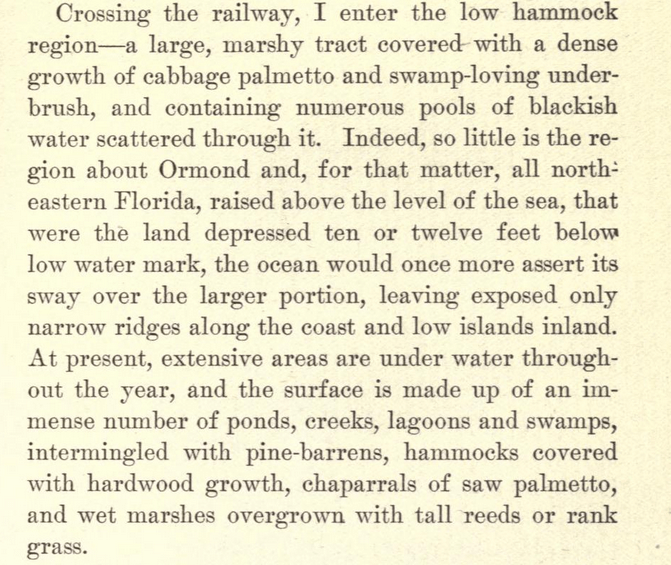
As the Florida legislature takes up sea level rise, I keep hearing voices from the past resonate over the conversation.  This passage, from Willis Blatchley’s A Nature Wooing at Ormond By The Sea (1902), highlights one northern visitor’s awareness of the state’s precarious seat on the edge of the ocean almost 120 years ago.

This isn’t a secret, of course. You could find thousands of similar quotes and passages in Florida history. But it can be easy to forget when just about every reporter writing a story about sea level rise in Florida pretends that seawater washing over the peninsula is a new problem instead of an ancient trend.

To be sure, sea level rise is a new problem. Understanding that Florida is built from the ocean, however, that it was seafloor not so long ago, and that it is a vast watery expanse even at the best of times, can help us adapt intelligently.

Screenshot from 2019-03-21 23-14-53


Field Notes: Spanish Needles in the Mohawk Patch

There is an overgrown patch in the middle of my backyard that sprung up last month when winter began to gasp away. I remember it happened all of a sudden. The grass was not short—it rarely is in my yard, sadly—but subdued. More bohemian gardeners might have almost called it respectable. But then it rained one Thursday night, one of those surprisingly thunderous late winter gullywashers that sends the cats scurrying beneath the bed, and the grass woke up next to the fire pit on Friday morning with a wild mohawk and a raging sneer. Since then I’ve been ignoring the boisterous patch of turf like a shamefaced Baptist hiding in the back of the church. It feels too early still to tune up the lawnmower, a cantankerous old Snapper tractor that is probably busy popping its own front tires as you read this, and get down to work; but I know it’s going to have to happen if I want to stay on speaking terms with the neighbors and my dog, so I’m locked in a debate now between the slothful devil Chris on one shoulder and the industrious angel Chris on the other.

When I went home at lunch today I took the dog outside and saw that the patch had broken into an enthusiastic bloom of Spanish Needles. Most anyone you ask would call these weeds, and, well, they’re not wrong. But I’ve been reading gloomy articles about the insect apocalypse all winter, so I was a little happier than I should have been when I noticed that this patch in the yard was practically swarming with honeybees. My shame over avoiding the yardwork was transformed into respect and wonder for these little plants and the insects they attracted. Where would these bees be right now if I had cut the grass last weekend?

20190315_12144820190315_121436

I’ve read that the best thing we can do to save the bugs, aside from advocating for the more thoughtful regulation and use of pesticides, is to promote an insect-friendly environment in our own backyard. These little Spanish Needles on the rebellious mohawk patch taught me a lesson today: sometimes that means letting go, just a little, and letting nature work. As insects, water, and other precious things dwindle, it’s more important than ever before to balance management needs against the needs of nature. Next year I intend to promote this little weed, to make it an intentional part of the yard, along with other insect-friendly plants.

Until then, I probably need to cut the grass.