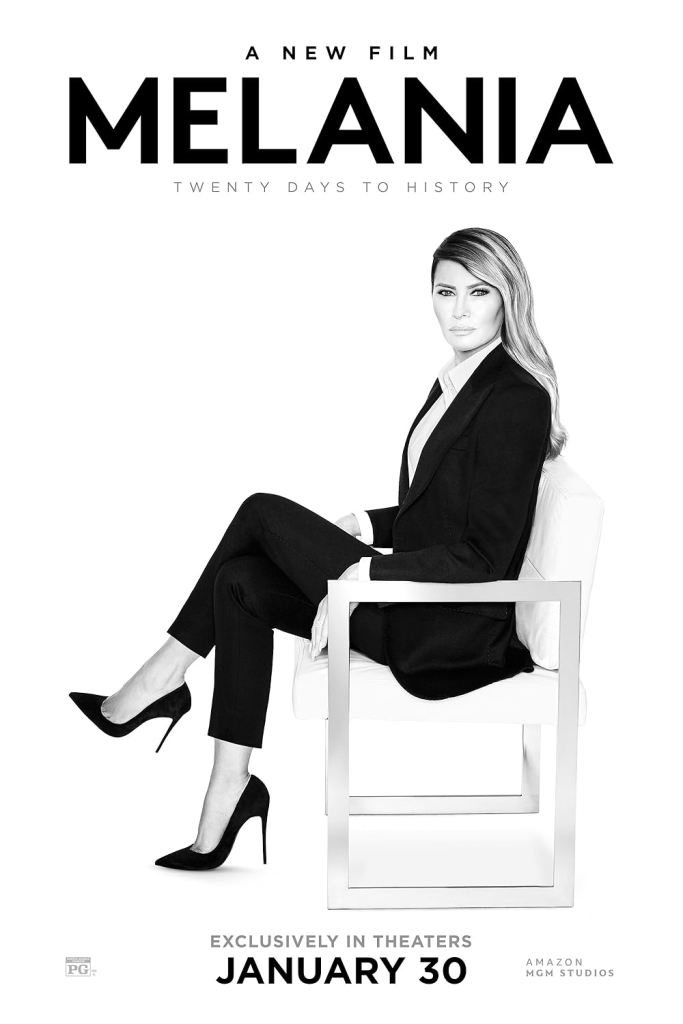
Melania (2026) and The People Who Love It

I watched Melania last weekend in a multiplex theater located in the heart of a huge shopping center in Birmingham, Alabama. When I bought my ticket, I was surprised to see that some of the seats had already been chosen. This is not a normal experience lately. In theaters like this one recently I’ve watched Oscar-buzz films, kids movies, beloved classics, horror, action thrillers, comedies, and dramas, and in the past 18 months I haven’t once shared the theater with more than ten people. You can imagine my surprise, then, as the commercials for Coca-Cola and Cadillac and Amazon streamed before the show, when every seat in the theater filled up—I’m not exaggerating—and the room rang with the bygone buzz of crunching popcorn, slurping soda, crinkling candy wrappers, and soft conversation.

My surprise deepened as I surveyed the room. This audience, I am confident, was unlike any audience at a recent screening in America, because it was all women. Let me not mislead you. There were two men there: myself and one other guy, a single father who brought his daughters to the show. But, with these two exceptions, the audience was otherwise made up of dozens of women. They arrived in groups of two to five, and they skewed mostly, but not exclusively, to the upper boundaries of middle age. I’ve never seen anything like it, and I will probably never see it again.

I don’t give a damn about the hyperpolitics of Melania. If you want to take this strange fact about a theater full of women as evidence about which “side” might be “winning” the culture war, you are welcome to draw your conclusions. I’m not here to do that. I’m here to consider the film and try to understand what could bring so many people out to see it.

Melania is bizarre and stupid, a deeply cynical exposition of navel-gazing banality masquerading as a biopic which manages, somehow, to be both flashy and incredibly dull at the same time. You could cut the film into 104 slices, one for each soul-crunching minute of its self-indulgent runtime, and not a single one of them will excite or motivate or inspire you in any way. I started the film with a sense of purpose, attempting to read the minute tells of the subject’s real feelings, or to divine some meaning from the visual style, the non sequiturs, the nods and winks, and all of Brett Ratner’s odd choices, but this exercise left me feeling, about halfway through, strangely numb and vaguely ill, like facing a blank wall while traveling backwards on a train moving slowly through a never-ending tunnel. It sucks.

And there are indeed some odd choices here. There is, for example, the Rolling Stones song “Gimme Shelter” rolling over the opening scene, the backup singer screaming “RAPE! MURDER! IT’S JUST A SHOT AWAY!” while the First Lady (Elect) boards an airplane. There is the rest of the soundtrack, which alternates between classical music and rock like a project executed by an undergraduate film student who cannot decide if they wish to channel Stanley Kubrick or Martin Scorsese for their BFA thesis. There are the indulgently long cuts; the scenes that do nothing to help the story. We spend a moment, for instance, watching the Secret Service wave a metal detector over an Israeli woman visiting Trump Tower to speak to Melania about the hostage crisis in Gaza. Why? Then there are also apparent mistakes masquerading as choices. Why do “old-fashioned” Super 8 or 16mm frames begin to appear for select shots about two-thirds of the way through the movie? Was this was an idea that someone came up with two weeks into the production, or did something go wrong with a whole bunch of shots and they had to salvage what they could?1 Who cares?! It’s a jumble of a film which requires every bit of Hollywood flash its experienced producers can deploy to simply cohere. It only manages to achieve this because it progresses through time in a linear way, and time, as a byproduct of our existence as organisms rooted in time and space, has a tendency to feel coherent if you go from start to fucking finish.

Now, again, listen: I may just be a jaded fool. My experience was not universal. The women in Birmingham seemed to thoroughly enjoy the picture. They laughed at the very rare moments when the film did something funny. They stuck around after the credits to talk it over. They whispered asides to each other while the film played.

Perhaps one of these asides offers a clue to what they saw in it. Around the time when Melania is meeting with event planner David Monn, talking about drinkware and paper choices, one of the women in my row turned to her friend and whispered, “I know why she made this movie. I bet she wants the world to see just how much she works her butt off behind the scenes.” I think she’s right. That makes a lot of sense. Further, I think it offers a great insight into who this film is for, and why that theater was so uncharacteristically full last weekend.

It is an accident of chance that I happened to watch the episode of Celebrity Wife Swap featuring Dara Gottfried and Tanya Thicke the night before I watched Melania, because an offhand statement Thicke made in the show stuck with me, for some reason, and then resonated deeply with the aside I heard in the theater. Like all episodes of Wife Swap, this one tries to create dramatic tension by swapping characters representing easy-to-understand opposites and then allowing viewers to judge each other by viewing the swapped wives through the eyes of the opposite family. Some episodes might contrast, for example, extreme permissiveness with extreme discipline by placing a mom who lets her children eat anything they want into the household of another woman who forces her children to eat a vegan diet. Even better if one wife is from New Jersey and the other Midwestern, maybe; one black and the other white; one plump and the other thin. The producers place these characters in three or four awkward situations per family, and then bring the couples together to confront each other in a debrief when it’s all done.

The Gottfried-Thicke episode explores a few of these dichotomies. Thicke lives on an estate in California; Gottfried lives in an apartment in New York. Gottfried is casual, while Thicke seems more reserved. Thicke enjoys spending money on fine furnishings, clothing, jewelry, hosting dinner parties; Gottfried is practical and thrifty. The producers place these women and their celebrity husbands in situations designed to maximize these differences, and then we go to the debrief.

It is here that I wish to pause. After a tense exchange between Thicke and her husband about whether he has tried to buy her love with gifts, she announces, “People think, ‘oh, well maybe Tanya has a staff, and she doesn’t work, and she doesn’t do anything,’ well that’s not true. I work very, very hard in my house. Everything that I have there, I did. Every fabric has been picked out by me. Every color on the wall, I found in a magazine that I liked and wanted it like that.” And then, while comical music plays to emphasize the point, she returns some sapphire or diamond earrings that she had earlier removed in protest back to her ears and says, “I’m taking this back, because I work that hard.”

There are no right and wrong characters on Wife Swap. There are only archetypes. Viewers who find Thicke’s ideas about work in the home ridiculous are not, I believe, the target audience of Melania. Viewers who might be philosophically or spiritually unsettled by drawers full of jewelry and overstuffed closets in their home are unlikely to identify with Melania. Viewers who believe that deploying their taste to furnish a home or make an event qualifies as hard work might like the film. Those who believe that taking care of their bodies and dressing up to put on a respectable face for their partners, and especially those who believe that they ought to receive some nice gifts and a comfortable life in exchange for this labor, are very likely to identify with Melania.

I don’t think this, in itself, tells us much about how this audience will vote in the midterms, or what sorts of beliefs about other people they might share. Both liberals and conservatives fit these archetypes. The unprecedented way this audience turned out to see this bizarre and polarizing film does suggest, however, that they feel somehow seen by it, that it says something to them and says something about them. That, I believe, is exactly what supporters say about the bizarre and polarizing political tendency represented by the subjects in the film. Someone sees me. I am not here to argue for or against this point of view, but I think it offers a strong clue about why they chose to make their way to the theater in such an intentional way last weekend, and if I was a political scientist, betting man, or nervous type I might think carefully about what that augurs for the future.

In parting, one more anecdote. After the credits had all wound their way over the top of the darkened screen, and the aggressively nonchalant teens working at the theater descended on the auditorium with brooms and dustpans, a woman leaving the theater stopped my partner to ask her whether she liked the film. After they talked it over for a few moments the woman said, “It sure did make me think. I’m going to have to change what I eat if I ever want to wear clothes like that.”


  1. The film suggests that this is how Melania’s father used to capture family memories back in the Slovenian SSR—let’s not stop to think about that too carefully—but then he is clearly nowhere to be found in all but one of these grainy shots. Are we to believe that he was there, clutching a little antique Canon camera when the President-Elect and First Lady disembarked from their limousine at the Blair House in Washington the day before the inauguration? Are we to believe that the producers then took this amateur film to be processed, created a digital copy, and cut it into the print? ↩︎

Willie Taggart and the Hubble Constant Tension

There’s a problem with the universe.

Some people here in my hometown feel that way because the Seminoles are losing football games, but I’m talking about the real universe, the one out there. Right now, scientists who study the universe are puzzling over the answer to a simple equation, Ho=v/d. This equation has been with us since 1929, when Edwin Hubble discovered that all galaxies, in all directions, appear to be moving away from us here on earth. If you plug in a couple of measurements, he found–the velocity at which one of these galaxies is moving away from the Earth, v, and the retreating galaxy’s distance from the earth, d–you should come up with a simple number. This number describes the universe’s rate of expansion, and it’s called the Hubble Constant in honor of its inventor.

Edwin Hubble. From Wikipedia.

The Hubble Constant is important because it lies at the heart of how we understand the history of the universe. Using this measurement, physicists have inferred that the universe has progressed through three eras of expansion. First, they argue, it expanded very rapidly. This was the time around the Big Bang, billions of years ago, when the universe exploded into existence. Over time, the gravitational pull of a strange substance called dark matter slowed this initial expansion, but in the current era, a strange force called dark energy is speeding the expansion again. As you might guess, this model only works if the Constant is actually constant. For something that’s supposed to be a constant, however, the Hubble Constant has changed an awful lot.

When Hubble plugged in his numbers in 1929, for example, he came up with a number around 500 km/s/Mpc. That is around 99.4 miles per second per million-light-years, I think, but scientists were never happy with that number anyway. It took a long time for the physicists to reach consensus, in fact, but rival camps of researchers by the 1970s had at least settled into a pattern, with measurements of the “constant” ranging between 55 and 100 km/s/Mpc. Not only was the Hubble Constant unconstant, it was also controversial. When a group of physicists tried to solve the problem once and for all at a conference in Aspen in 1985, one of the participants says, “there really was no way to get the old timers to work with the young turks.” The controversy would continue. 

Thirteen of the Aspen group realized that the problem was really about calibrating instruments to come up with a good measurement. When you try to observe something with precision from billions of miles away, it turns out, there are a lot of things that can go wrong. I understand this. I tried to take pictures of the moon with my smartphone mounted to a telescope just last month and ended the night with two blurry photos and a bad mood. Even with the best equipment in the world and a PhD in astrophysics, trying to measure the radial velocity of a distant galaxy is really hard. 

Astronomy is hard. Credit: me.

Enter the Hubble Space Telescope. If you were alive in the 1990s, you probably heard about the Hubble on the news or read about it in the newspaper, because it was originally launched with a flaw in its enormous mirror and had to be fixed by spacewalking astronauts in 1993. Once the extremely expensive mirror was fixed, the orbiting telescope completely changed the field of astronomy. Solving the Hubble Constant dilemma was one of its goals and, with fresh new glass, it worked. By the late nineties, scientists using the Hubble reduced variability in measurements of the Constant to less than 10%. With the Hubble data, finally, scientists could tell us how quickly the universe was expanding and, therefore, how old it is. Cue the celebration.

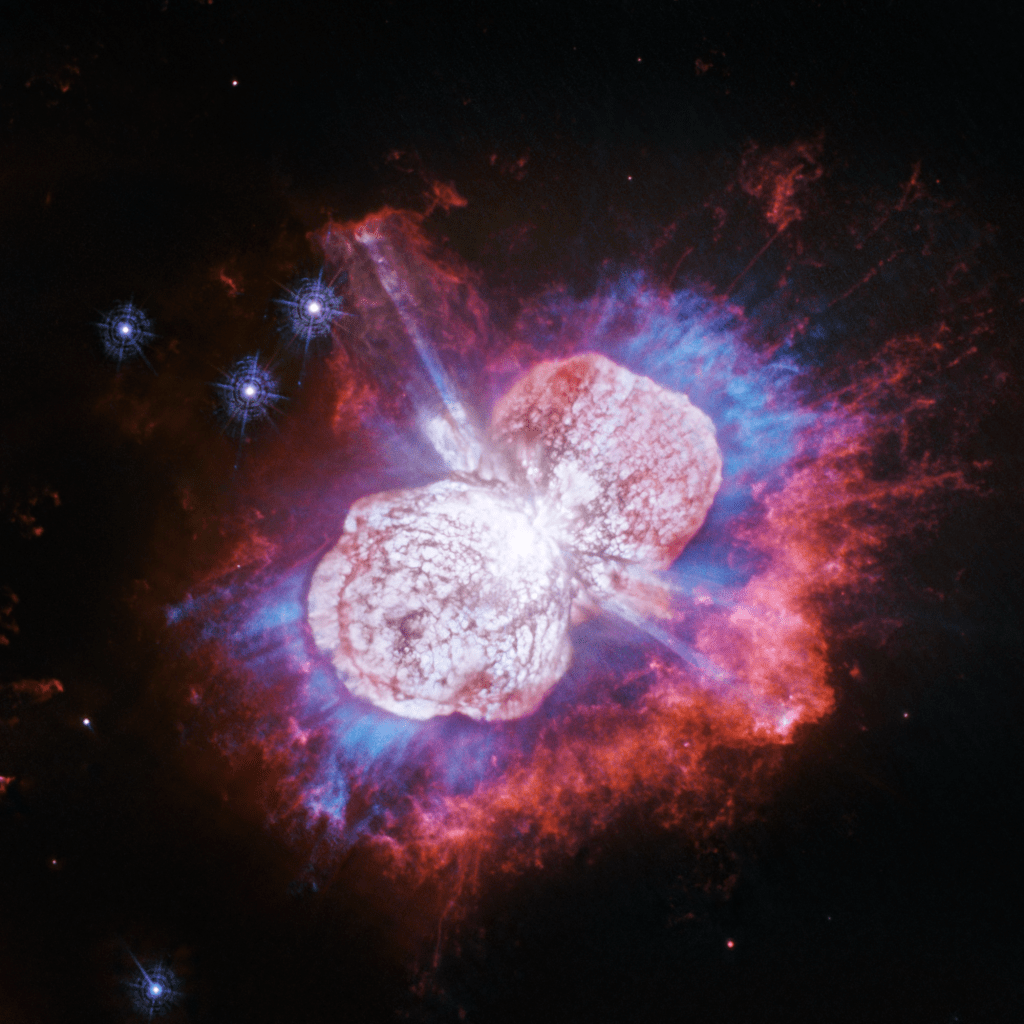
An image of the stellar system Eta Carinae taken by the Hubble Space Telescope. More information is here.

This celebration is coming to a halt. Over the past few years, physicists have been looking at new areas, using different tools and methods, and coming up with different values for the Constant based on where they look. After measuring the light from exploding stars, one group argues that the value is 73. Two other groups argue that the number is 67, based on measurements of cosmic radiation, or 70, based on analysis of the light from red giant stars. Last month, another group of physicists published a paper using gravitational lenses to argue that the value is actually 77. That nice model of the universe, with rapid expansion, slowing, and speeding back up? It doesn’t work if the Hubble Constant is different in different places. Physicists are struggling now to come up with a new explanation for how the universe works.

Tell me if this sounds familiar. Some time after World War II, everyone agreed on a norm. In this case, it was a Hubble Constant somewhere between 50 and 100; but you can imagine if you like that the norm might be something like, Presidents release their tax returns. Everyone used that norm to build a really strong and comfortable system. In this case, that system was the standard model of cosmology; but you can imagine, again, that it might be something like, postwar American prosperity. Then, new tools gave everyone a lot more information, and the norm started to break down. People started putting that information together in new ways, and, for them, the norm–the Constant–should be 73, or 67, or 77.The evidence supports their claims. It’s all just a matter of where they choose to look and what they choose to measure.

This reminds me of Willie Taggart, the unfortunate head football coach at Florida State University. Some of the facts about Coach Taggart are hard to dispute. Taggart was hired in late 2017, after the ignominious departure of the last coach, Jimbo Fisher. Taggart inherited a football team that was in trouble. Fisher had not recruited well in his last season. Many of the team’s most talented players had graduated in the two years before. Taggart promised success through simplicity nonetheless. He achieved a record of just 9 wins and 12 losses before he was fired by the university on November 3, 2019.

This is where we are right now: awash in so much information, so many points of view, so much evidence, that just about everything can be argued cohesively. While Taggart was here in Tallahassee–I assume that he’s gone now, just to get away from the smoldering indignity of it all–I read and heard and made so many arguments about the coach that I can’t remember them all. I heard he’s getting better, just look at the NC State game, and I thought: sure, yeah, that makes sense. But then I read, he’s not getting any better, just look at all of the penalties, and I thought, too: well, shucks, that also makes sense. I scrolled over similarly conflicting opinions on my twitter and facebook feed every Saturday, sparred over inconsistent and opposite viewpoints with friends on Monday, and most of the arguments on either side made sense. 

It could be that I’m just a bad reader of football opinion, but I’m not alone. The whole city this autumn was wracked by two poles of opinion. One: you can’t fire a coach until he’s had at least three seasons to turn things around. Two: if the team’s not getting better they need to move on now. These tribal pole stars were like Hubble Constants of 67 and 77. Both were plausible and well-supported by people who knew what they were talking about, and both were true if you accepted the evidence. They were also complete opposites.

This is where football starts to diverge from the Hubble analogy. Conflicting information in science leads to new science, but conflicting information in culture leads to politics. “Any time there’s a discrepancy, some kind of anomaly,” physicist Katherine Mack told the Washington Post for a story about the Constant, “we all get very excited.” I don’t think anyone is excited about politics anymore. Unfortunately, the politics of the Taggart situation are unavoidable. Like pretty much everything else in America, Taggart’s story boils down to the bone stock of the culture war: race and class.

The internet is made up of little building blocks of information. Like Legos, you can take this information apart and put it back together into just about anything you want. While there are more communities on the web than any of us can imagine, it seems like most people in these communities use politics to help them understand how they should put information together. College football communities are no different. Ever since Taggart arrived in Tallahassee, the culture warriors who care about FSU football started taking information about his tenure apart and putting it together in shapes that fit their worldview. By the end of his first season, an upset fan posted a lynching meme over the caption, “Believe in something. Even if it means sacrificing your rep.” The university condemned the post and everyone moved on, but the subtext was now out in the open. The stakes for Taggart were higher, and the obstacles more formidable, than they would have been for a white coach.

Ask any of Coach Taggart’s detractors, and they’ll tell you: they’re not racists. But, racists or not, race was such an important part of the Taggart story that we can’t ignore it. Earlier this year I found myself in the middle of an extremely minor Twitter skirmish between Taggart supporters and Taggart detractors arguing over a stunt involving a lemonade stand and a prominent Booster. The Booster told me the whole thing was a joke and saw himself out of the conversation, but critics and supporters kept coming in for a little while longer. It was hard to generalize about the coach’s supporters, but his critics were easier to pin down. Sunglasses, always. An exhausting barrage of exclamation points. Somewhere the phrase, “I support THE PRESIDENT.” Even a rebel flag. Some of the accounts have been deleted since then, for some later infraction or indecency. A true badge of honor.

Sounds about right.

The Taggart saga was only a minor flash point in the broader culture war consuming all of us, but viewing it through that lens makes it easier to understand how it could take over a town. Provocative critics pushed their arguments to the very edge of acceptability and, at least once, well beyond. The rest of us could only fume, could only point angry fingers at racism indirectly, like trying to look at a dim star you can only see when you look away. These provocateurs used football to talk about race. When they pulled it off just right, they could push a little further. When they failed, they could scurry behind a screen of deniability. It was all a joke. Chill out. It’s only football. Perhaps the rest of us, to be fair, are using race to talk about football. It’s deadly serious. Wake up. It’s more than a game. Either way, there’s so much information out there that we can choose which Lego set we want to play with. Nobody is happy with this state of affairs.

In the 1960s, a philosopher named Thomas Kuhn argued that scientific knowledge doesn’t grow in a straight line, steadily advancing as scientists dream up new experiments to test new hypotheses. Instead, Kuhn argued, science progresses through occasional, groundbreaking paradigm shifts, followed by long periods of “normal” work to test the paradigm. Kuhn’s argument was a breakthrough in 1962–a paradigm shift in its own right–that has come under fire, like pretty much all ideas, in the six decades since then; but much of it still rings true. Especially this, especially now: all of that “normal” work in science eventually introduces so much chaos to the theory, so many unanswered questions, that only a whole new theory can clear the board. This is why physicists are excited by the Hubble Constant tension. They can see new science just over the horizon. If we use football as a looking-glass on society, should we be excited too? Is there a new politics just over the horizon? Coach Taggart’s brief experience in the capital city suggests not. We’re long overdue for a paradigm shift.

Women’s Rage

The Cut is featuring an excerpt from Rebecca Traister’s forthcoming book, Good and Mad: the Revolutionary Power of Women’s Anger this afternoon and it is a doozy. If you’re interested in American history, in politics, or pretty much anything, you should definitely go read it. As a historian, I’m intrigued by the argument Traister lays out:

Look to the start, the germinating seeds, of nearly every major social and political movement that has shaped this nation — from abolition to suffrage to labor to civil rights and LGBTQ rights to, yes, feminism — and you will find near its start the passionate dissent of women.

I’m inclined to agree, but very much looking forward to working through the book. The historiography of women’s dissent has the potential to completely reframe our understanding of American political history. The book will be out October 2nd.