YES
A haunting song from a band who continues to grow and stay relevant. New album To Be Everywhere is To Be Nowhere out next Friday.
YES
A haunting song from a band who continues to grow and stay relevant. New album To Be Everywhere is To Be Nowhere out next Friday.

Thomas Hobbes was responsible for much of the better-or-worse modernity we have inherited, so it is not too much of a stretch to link an offhand observation in Leviathan to a self-consciously backward-looking rock band from twenty-first century Atlanta. “No man can have in his mind a conception of the future,” he wrote, “for the future is not yet. But of our conceptions of the past, we make a future.” Perhaps this is why the band–whose new Sub Pop release I Hear You sounds like a nineties college band’s interpretation of the psychedelic era, in a good way: like Hum, without the Gen-x introspection, jamming along with dad’s old records–channeled one of Hobbes’s chief interpreters in a recent comment for SPIN. “We hold these truths to be self evident,” the quartet maintains, echoing Jefferson: “This is now music of the modern era. No genre revival. If a voice within whispers ‘Listen’ you must respond I Hear You. As did we and will continue to do.”
But that’s enough pretentiousness.** I Hear You is a solid album, rich with promise for listeners hungry for a return to the stripped-down grit of rock instrumentation without submitting themselves to the staid genre conventions of punk or (too much of) the self-absorption of post-rock or heavier stoner bands. Arbor Labor Union intentionally refuses to break new ground with I Hear You, but that is the point. As much a response to the glimmering sheen of production that characterizes music today as an homage to psychedelia, I Hear You catalogues a yearning for the material over the digital–as in the band’s write-up about conifer trees and the singing ground, see the * below–and promises to reclaim it by eschewing the last twenty to forty years of music history.
Putting aside the question of whether the band’s effort to reclaim the past is relevant to the present, I Hear You comes as close as any record can to delivering on that promise without succumbing to retro kitsch. “Mr. Birdsong” recalls early grunge, but carefully; subsequent tracks “Hello Transmission” and “Radiant Mountain Road” build backward, linking the opener’s grunge sensibility to the less-restrained garage aesthetic of the seventies and late sixties. “I Am You” carries the union of these styles to a logical, if premature, conclusion in the middle of the album. Reminiscent simultaneously of everything since 1967 and nothing at all, “I Am You” underlines the record’s archival warrant in red ink. It works.
After cresting this psychedelic peak, the album drives gently downhill, back toward the present. Four-minute instrumental “Babel” suggests a more focused method beneath the surface and points—I hope—toward the band’s future. “Belief’d,” “Silent Oath,” and other tracks are better than filler, but the idea is already clear after cresting the peak. These tracks shine light on its musical nuances but illuminate its tidy corners, as well. “IHU,” finally, recalls the droning psychedelia of “I Am You.”
And what of the premise? Countless bands have turned to nostalgia—succumbed to what Derrida describes in a radically different context as “archive fever,” a madness for origins—in an attempt to reclaim that which was bold and bright in rock’s past, and, thus, in their own youth. Arbor Labor Union transcends crass nostalgia on I Hear You by reinterpreting the past for the present. The result is not perfect—repetition and experimentation sometimes derail the individual tracks—but it is remarkably fresh.
** Want more? From the band’s bio page at Sub Pop: “4 Years ago, in the Peach state of Georgia, there was a mighty green Conifer tree whose limbs were wider than the smile on the sun. From this tree hung many a seed. The tree was home to so many creatures big and small. The most fun of them all was perhaps MR. BIRDSONG. Mr. Birdsong was a single white dove…” and so on, including the line: “if you press your ear to the ground you will find that it too has a sound… and it sings.”
This music reminds me that we are all living in the future.
This track and others have been out for awhile, but Kaytranada finally dropped the whole very, very good album, 99.9%, on XL last week.
I don’t believe in hyperbole. This is an exceptional album. The bass line at the beginning of “Weight Off” alone is well worth your time and money.
It didn’t take an advanced degree in the humanities for me to realize that punk rock is a crock of shit. Just a sprained ankle. It wasn’t sour grapes, either, but dedication that broke punk’s fuck-it spirit wide open for me. For years I carried a big Fender bass amp–my only amp at the time, my precious–up and down the stairs to my Dad’s apartment. Every Friday and Sunday in 9th grade when it was time to visit Dad or go back to Mom’s, I dragged the damn thing like an Acme contraption from a Looney Tunes cartoon up those fourteen steep concrete slabs, heaving and cursing the whole way. Later, when I lived in the apartment and played in bands regularly, I lugged that heavy bastard up and down the stairs every other day like a religious ritual. It never got easier, and sometimes it lugged me down instead. But it was a price I had to pay. Asking Dad for a ride, schlepping the giant heavy box, looking like a fool, tumbling down the last three steps and limping for days afterward: far from anarchy, this was work.

Then there were the hours upon hours I had to spend practicing–an even more exhausting worship ritual than the semi-daily ritual of labor. Play the song; try the technique, again and again; pray the muscle memory remains the next day but keep trying anyway; do it over and over.
All of that work is why I can relate to the gracefully aging punks in The Guardian’s recent where-are-they-now profile, “Never Mind the Bus Pass.” 55 year-old former Alien Kulture bassist Aussaf Abbas knew, for example, that punk rock couldn’t pay the bills, so he went to work as an investment banker and has since “met prime ministers and finance ministers and CEOs of major corporations.” “This was unbelievable for an immigrant kid,” he insists, “who grew up in Brixton in a single-parent family.” One-time Au Pairs singer and guitarist Lesley Woods took a similar path to affluence. “After the band folded,” she explains, “my brain was quite scrambled and I needed to get my mind back, so I thought I’d do something really difficult and started studying law.” While she still “mucks about” with music, her work as a barrister is so intense that she only has time for a few recordings and “the odd performance.” Others in the profile tell similar stories.
The standard punk posture insists, outraged: Abbas, Woods, and their peers are sellouts, shills for neoliberalism. But for most people, music offers work—vast, endless vistas of work—with little more than a token spiritual reward at the end of the day. Investment banking may not be the best solution to the problem, but neither is Higher Education, which attracts an army of refugees from dive bars and touring vans every year. Everyone must negotiate neoliberalism on its own terms, and what choice does anyone have? Only those privileged with money or parents with money, a great deal of luck, or generous friends really have a chance to earn anything more than a few dollars and a few Facebook followers at the end of night. Most need all of these simply to live as a musician. Punk’s outrage and anarchy relies on an ocean of privilege, then. For the innumerable devotees whose parents and friends can’t or won’t support years of work without reward, punk rock’s promise of DIY catharsis is merely palliative. The truth beneath the posture gleams like a shiny nickel reflecting the inverse of the American dream: work all you want, kid. It ain’t enough.
To make matters worse, the posture has only ever been clear in retrospect. In an extraordinary piece in The Baffler last winter, “Punk Crock,” Eugenia Williamson wonders: “As punk pushes into its fourth decade, its rules, aesthetic, and parameters are still murky at best. Does punk retain any meaning at all?” Despite the claims of passionate devotees–like the Noisey Facebook commenter she quotes who argues that “the complex ideology of punk goes way beyond the genre of music–it’s also about not giving a fuck and doing exactly what is authentic to you”–punk is hidebound by an inherent logic based on fictions of lost purity and dying scenes. Beneath the aesthetic, her article suggests, punk was never really there. Its earliest adherents lived like the coke-fueled arena rockers they despised; their descendants have “not only voted for Rand Paul but [are] raising children in a McMansion funded by festival dates.” So much for anarchy.

My own decade-long encounter with cathartic do-it-yourself anarchy was far from revolutionary. I repeated the upstairs and downstairs rituals of labor and repetition later, for example, when I was still a dropout working at Walmart by day and playing the bass by night in a band that pretended it could barely bash out the chords to “Blitzkrieg Bop.” That had been the appeal of the band, actually, when I tried out: their unapologetic badness. They had posted a to-hell-with-it ad for a bassist on Craigslist citing their inability to play but their desire to try anyway. I replied. Everyone was better than they had claimed, of course. They had performed the rituals too. So within a week I was lugging another huge bass amp up three flights of stairs twice a week to the drummer’s apartment across the street from the University of Florida. We called ourselves “Surprise Blowjob”–SBJ for short–and played a few shows over the course of a weltering Gainesville summer before going our separate ways. We joked about “punx” with one breath and rented a practice space with the other; paid for recording with one hand (well, one of us did: Thank you, Ryan, if you read this) and burned our own CDs with the other. We booked shows when we weren’t practicing; drove to Jacksonville to play for 15 people. I designed stickers and merch; stayed up a few nights after work to design a website. And then it was over. A new semester, job hunts, and grad school were looming for the students in the band. They left. Other bands were calling me. Like the individual rituals of labor and repetition, the group ritual of band-building has to be repeated like a rosary. Friends and strangers come and go from the devotee’s life.

I packed and unpacked, carried and setup my amplifiers, my gig bags, my cables and pedals in and out, up and down, through every change. I understand now that these rituals of individual dedication and group support were the only authenticity punk rock could offer. Everything else is just an argument about aesthetics.

At some point in your life, someone will try to tell you that noodling jam bands, wispy art rock, odd time signatures, and unstructured song-writing are more rewarding—in their intelligence, you see—than the more pedestrian pleasures for which most of us line up at the trough, week after week, to consume like barnyard animals. And sometimes they will be right.
I’ll give you an example. There is a moment in the middle of “Epitaph” on King Crimson’s In the Court of the Crimson King that is sublimely transcendent. Under the right circumstances, it can carry you away, making apparent all of the pain and promise of the sixties in one brief chord progression. I have been moved by “Epitaph” and inspired by the entire album since a too-young age, probably twenty years. But such moments are ephemeral. In the Court of the Crimson King marked the one moment when King Crimson was a coherent band, rich with ideas; 1969 was one of only a few moments when “art” rock could move into the “real” world, “Epitaph” one of only a few songs capable of translation in that world.
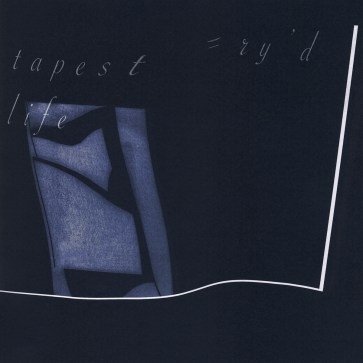
Pretend’s Tapestry’d Life is nothing like In the Court of the Crimson King, but it comes close at times. It offers no era-defining moments or spine-tingling chord progressions, to be sure. But it’s not bad, either. The opening track “Wrapped in Fantasy” is cerebral and interesting, firmly planted upon the ground–unlike most other songs of its kind. All of songs are similarly grounded, and all are rich with ideas. “Patternless Tide” is a wandering yet promising reflection, but it kicks off a long series of introspections during which the band points in countless interesting directions but seems to complete few ideas. “Doors” is a reward for the patient listener in the middle of this long experiment, but its rewards, too, are ephemeral and easily forgotten. Tapestry’d Life is heavy with promise but its rewards are sparse.
The problem lies in the genre itself. The boundaries of ideas are rarely so apparent in the pulpy paperback music most of us enjoy. In pointing to new ideas, Pretend–like most “post-” whatever bands–also point squarely at their own inability to realize them. The result sounds like a band straining against its own limitations as it attempts to deal with complexity—which does not make for a satisfying rock album, but is not without its rewards.
You can pick up the album here.
Another season brings another awesome sampler from Gainesville-based label Paper + Plastick. I might be biased when it comes to all things Gainesville, my former and beloved hometown (not to mention the setting for one or two questionable fashion decisions on my part), but with tracks like Bad Ideas’ “Damn My Clumsy Hands,” absolutely free, this sampler is hard not to love. Check it out.
Get the sampler here. And enjoy the video for “Clumsy Hands” below.

Like many young Americans longing for autonomy, I was once transformed by On The Road. It is a book rich with adolescent delights: an uneasy balance between navel-gazing and catharsis, a few tantalizing moments of prurience, a restless tapping of the foot, a bantam pulse. It was a book I could wear like a jacket or ponder closer to the skin, and I never looked at the highway, the bus station, or the dented stainless sheathing of passenger rail cars with quite the same gaze ever again. The road cuts through the heart of my imagination.
As important as On The Road has been to my life, though, I have only read it twice. The first time, I was somewhere in the middle of junior high, fumbling my way through a dog-eared Viking critical edition. I remember the used paperback well—unlike my first dog, oddly, or my first beer. It was spare: a deep and stolid yellow, embellished merely with a line drawing of a viking ship in an oval frame at the bottom of the cover that could have equally been the sly Ulysses’s trireme plying the wine-dark sea. I read it sitting on the curb waiting for the school bus or lying on the twin bed in my bedroom, the neighbors just fifteen feet away—their whole lives separate from mine in our whimsically-named subdivision, equal but separate in a way that Kerouac and his cast of intrepid boddhisatvas would have misunderstood as thoroughly as I misunderstood them.
The second time I read Kerouac he left a deeper mark. I was nineteen and working in a door factory, going through the first period of serious reading in my adult life. It was a mass market paperback for a letterpress life. I woke up in that year or two at 4:30 AM to catch an early ride with my friend and his dad in the dark, enclosed back of his pest control truck; onto a bus on the westside of Jacksonville, Florida at 6:10 for a forty minute ride downtown, weaving through the suburban warrens of the New South city; off into the cold morning and through the mostly-abandoned streets on foot to the warehouse on Harper Street by 7:00. I remember one morning in particular when I read and walked at the same time, my eyes dodging back and forth from the page to the road as I weaved in and out of the outstretched ends of trailers backed up to loading docks in order to avoid traffic. I slipped the book into a back pocket as I climbed the stanchions of a flat railroad car stopped on the tracks. Up and over and down again, onward to work breathing steam in the riverine cold with the book in one hand and a time clock in the other. Hemmed in by necessity and bad decisions, however, I could only mimic Kerouac’s perambulations in my morning walks. I could not leave it all behind. I did not have the imagination.
Similar to my experiences reading Kerouac, narrator Reginald Morse’s life in Hotels of North America reveals its meanings through the places in which it unfolds. Morse is not a traditional narrator, or a reliable one. Instead, he reveals his story piece-by-piece, in memory, through hotel reviews on the fictional travel website rateyourlodging.com. Morse’s story is as tragic as it is germane to the first decades of our century. From brittle affluence in investment banking and a salacious love affair through pathetic ruin to a sort of rebirth through nomadic scamming and motivational speaking, Morse’s online screeds track the tensions underlining the end of the American century and mimic the twilight howls of the white American male. Like myself as a young man riding the bus and climbing over railroad cars, Morse is not in control of his own growth. The hotels in which he lives and the people and ghosts and regrets with which he shares them mark his experience in ways that Dean Moriarty and Carlo Marx would have scorned.
Morse is in control of his story, however, in ways that Sal, Dean, and Carlo—stuck behind the pale glow of the headlights and between the yellow and white lines of the highway—could only envy. Morse offers his reflections in a seemingly random order: jumping from year to year and place to place. This is a form of power for Morse, who writes like an erudite and professional reviewer instead of a motivated amateur. But the flaws in this construction rapidly make themselves known. Morse’s language plods at times like a walrus on the beach; his faux professionalism quickly gives way to bold explanations of scams and crude sex acts. Though his story unfolds through a slipshod collection of reflections rather than a linear narrative–like Jay Gatsby glancing into some of his rooms as his own story begins to spiral out of control—Morse is as compelled to recount his failures as his readers are to arrange them into some sort of order. These are the kinds of spaces and identities the Internet encourages us to create: grand palaces of erudition or experience, beauty, and worldliness that are nonetheless bound to ourselves and limited by our own weaknesses.
It is unfair to compare Rick Moody’s Hotels of North America to On The Road, but one cannot read Moody’s tragicomic portrait of postmodern isolation without indirectly reading Kerouac. Roads and margins, isolation and self-absorption run through the heart of both. But where Kerouac’s protagonist Sal Paradise is firmly in control of the narrative–a uniquely postwar optimism that could find the shining possibilities even In vagrant idol-worship–Moody’s protagonist Reginald Morse reflects an inverse experience. Presented with the ability to tell his own story through online reviews, he is instead locked into the trajectory of his own failure. Sal Paradise could turn the relentless order of the road into an order of the self; Reginald Morse uses the chaotic tools of the digital age to offer an indefinite and unreliable self-portrait. Both are powerfully evocative of their times. Sometimes Hotels of North America is underwhelming in its yearning for accessibility, yes; and George Saunders is undeniably the master of this kind of individualistic prose, indeed. Yet this is a small novel with large ambitions. It achieves almost all of them.
Buy Hotels of North America or find it in your local library here.
“Everywhere, New York” is not a hometown. Neither is “South Florida” or “Orange County,” “The Research Triangle,” nor any of the other city limit-defying amalgams of suburbs, strip malls, and asphalt that most of the Americans I know call home. We live in less durable mental categories: states of mind; places connected by experience; places that feel alike.
Punk rock is one such place. More than just sound, punk rock is a network of sensibility. It is connected by performances and commodities, structured by claims on legitimacy. Its boundaries, like it or not, are as well-defined as those between zip codes: shows, vans, DIY, scenes.
The Red Owls claim “Everywhere, New York” as a hometown. I buy it. The lines connecting The Red Owls to other New York bands on the punk roadmap are too dark to ignore. Fans of Taking Back Sunday, Brand New, and Bayside—especially Bayside—will appreciate the yin and yang balance of polished veneer and rough-hewn materials The Red Owls strike on Do You Feel Any Better?, while those troubled by the mainstream accessibility of these bands can take comfort in The Red Owls’ DIY ethic and upcoming appearance at The Fest in Gainesville.
At the same time, “Everywhere, New York” seems to miss the boundless appeal of this music. The opening track, “Bad Advice,” would be equally at home on EPs by bands from more tropical climes. The connection with Paper + Plastick Records (and Less Than Jake) founder Vinnie Fiorello is apparent on this and the third track, “Party Lines.” Both are as much expressive of the irreverent spirit of Gainesville chill-punk as the album’s other two tracks, “Do You Feel Any Better?” and “Chaser,” are of the rust belt’s anxious energy.
Better than any recent release, Do You Feel Any Better? outlines the contours of punk rock. Members John Collura, Sean-Paul Pillsworth, and Justin Meyer—currently or formerly of The Ataris, Nightmares for a Week, and Anadivine—strive to “[add] a healthy dose of new life to this nostalgic genre.” While they point in new directions on this EP, only time and a full-length release will tell whether they follow the road forward. As it stands, Do You Feel Any Better? feels like the hometown I know and love.
Buy the EP here.
“Instead of sharing an experience the spectator must come to grips with things.” – Bertolt Brecht
What is it that historians do?
On the one hand, they must tell The Truth. This means reading, watching, listening to, tasting, smelling, or touching every bit of evidence they can find, weighing them against each other, and then putting it all together into a faithful account of the past. Which is pretty much what they do. But on the other hand, because they are humans, living in this noisy and contentious world, historians always have some axe to grind. History means something, they maintain. And besides killing readers with boredom, history without meaning would be useless. It would just be a list of things that happened. Everything that ever happened. So historians have to make the past mean something, too. This means throwing some evidence out, maybe pointing at other evidence that might not seem important and saying, “there it is! The Truth!” Figuring out what to keep and what to ignore is a real dilemma. Nobody will agree. This, in short, is the historian’s dilemma: making choices without appearing to make choices. Making claims about today by appearing to make claims about the past.
This is contentious stuff. Most academic historians have long taken postmodern subjectivity for granted, attempting in turn to do the least harm by pulling into their work as much evidence as possible, from as many opposing voices as possible. Their readers, however, are impatient with both the problem and the solution. Most readers tend to see the past as immutable—as a story just waiting to be uncovered—and the documents required to tell that immutable story as mostly self-evident. Rather than complications of interpretation, readers see challenges of comprehension and accessibility. Knowing where to find documents and how to translate their archaic prose is challenging enough, they claim. With this arcane knowledge, historians should have no problem interpreting what they find and telling The Truth. Efforts on the part of academic historians to incorporate alternative sources, to include an abundance of notes, or to challenge their readers with theory are routinely derided. Amazon reviewers often savage academic books for being too detailed, too unsure—too boring—while school boards argue that they are too interesting, too provocative or heterodox for students. What is a historian to do?
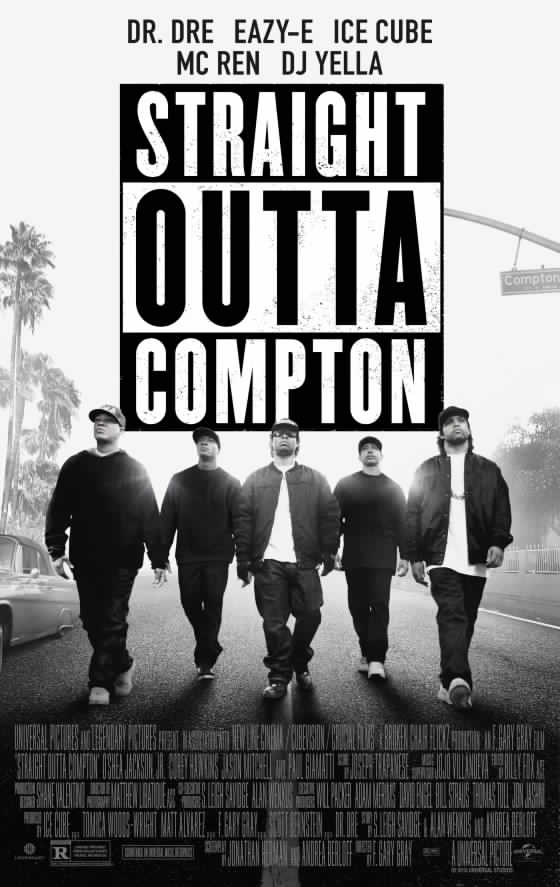
It is clear that Director F. Gary Gray and the producers of Straight Outta Compton faced the historian’s dilemma. Compton is a film obsessed with its own history, as though viewers are listening to a deep conversation between Dr. Dre, Ice Cube, and their own reflections in the bathroom mirror about where they’ve been and how they got there. Gray offers is an exceptional rendering of those conversations, replete with outstanding performances from a fairly green cast—anchored by Paul Giamatti—and a workmanlike attention to detail.
Too bad it doesn’t have much to say.
Let me tell you a story. Once upon a time—the late 1980s, a time increasingly shrouded in pre-Golden Age mystique—it was rough in the Los Angeles ghetto. A group of young black men were making their way through the hard times, honing their talents (or courting an early grave) in obscurity despite the efforts of the police state to break their will or end their life. One day, the group of young men decided to do something about their obscurity and formed a rap group. It wasn’t very difficult to record a hit single, but it was even easier to find a manager who could sell their talents to a record label after they did. They were immediately successful. A bunch of rock-star stuff happened, the group of young men got into a fight, and then the rap group split up. Two of them were immediately successful after the breakup; one wasn’t. A bunch of other stuff happened. The now-unsuccessful one ended his relationship with the agent and then, right before staging a comeback with the still-successful young men who used to be part of his rap group, succumbed to AIDS. The other young men cry and reflect.
That’s pretty much it. One does not get an honest sense of the struggle involved when obscure young black men build a career out of sheer talent and provocation from the very heart of the American nightworld. Police violence, for example—such a prominent part of the film’s first two acts and in the real-life NWA’s meteoric rise to fame—simply disappears in the third act. Gone. Manager Jerry Heller’s treachery is only vaguely outlined. Less vague, perhaps, are the hints of cultural and social tension between the fairly affluent Heller and the rappers he represents, but not much. Dr. Dre and Ice Cube’s success is not vague at all, however. Both easily sidestep the belligerent malfeasance of entertainment capital: Ice Cube by obliterating obstacles with a baseball bat, Dre by rolling over them with a steam-powered Suge Knight. Eazy-E alone struggles with the system. One-by-one, the fragments of late twentieth-century failure pile on E’s shoulders: friendships broken by bounced checks, a heartbreaking series of moves back toward the underclass, and, finally, the cruel denouement offered by HIV and AIDS. These are Eazy-E’s problems, though, and don’t belong to his friends or the viewer. None but E are complicit in his fall from grace.*
These are tragically missed opportunities. Unfortunately, Straight Outta Compton takes the easy way out of the historian’s dilemma: mere narrative; evidence without meaning. The narrative itself is solid and entertaining, absolutely, but the whole is dissatisfying. By refusing to answer or even pose deeper questions of meaning, the filmmakers leave it up to viewers to formulate their own questions and answers. Is this just another touchstone of American consensus, another tired affirmation that we, too, can be successful if we are talented and hard-working enough to overcome adversity? Perhaps. Or is there something else here, some covert meaning in the filmmakers’ refusal to pose these questions? Maybe that too. Eazy-E is a remarkably tragic figure, after all.
But then again, maybe not. Ultimately, one must ask: what is the argument? I don’t know. Straight Outta Compton doesn’t have the answers.
* And maybe Jerry Heller, but, again, the details are hazy.
As hardcore withdraws back into thousands of local fastnesses to rethink and regroup, decent national releases like this one are rare. European bands have been holding down the scene’s bona fides for some time now, though—tough-guy mistranslations like pretty much anything in the Hardcore Worldwide video catalogue aside—and France’s Birds in Row is a prime example of post-hardcore’s lingering impact on the vast frontiers of the heavy music world. The band’s 2012 release You, Me, and the Violence was top-to-bottom quality. Personal War (October 30, Deathwish Inc.) promises more of the same.
“Weary” is a tantalizing taste of the forthcoming album. Watch below, pre-order above.