
Breaking Through

You enter the facility through an abnormally large air vent in the bathroom. The vent hangs open over an empty bathroom stall. You can see, in the next stall over, a young soldier in a garishly green uniform. You take aim at his head, probably not thinking about his neatly pressed garrison hat at all as you peer over the sights of your silenced handgun. You fire a single shot, killing the young man instantly. You drop—silently, ever so–into the stall below, careful not to slip on the toilet looming beneath the vent. You kick open the door, gun poised, and fire two more mercifully silent bullets tsk tsk into the body of another soldier regarding his reflection in the mirror. If you are skilled, he is dead before he even realizes you’ve entered the room. His body slowly disintegrates until nothing remains. One more soldier cowers in a stall across the room. You kick open the door, gun blazing, and he is gone.
Now the bathroom is yours. You’re free to take in the surroundings.
The ceiling and walls are an unassuming gunmetal gray—a dark, damp concrete poured, no doubt, with a careful eye on the ledger book instead of the architect’s vision board. An economical white tile begins at eye-level, continuing onto the floor beneath your feet. A large service column divides the room into moieties, like restrooms you’ve seen in a truck stop or rest area. There are sinks set into the outer walls. They are bare-bones fixtures; stainless steel, no flourishes to arrest the eye or introduce a measure of warmth to the fluorescent cold. Opposite the sinks there are urinals bolted in the recessed wall of the service column. Perhaps an elevator or chimney shares the column with the plumbing. Perhaps if you waited long enough you would hear the inner workings of the facility behind these spartan walls. Unlike the soldiers guarding this facility—two of whom will never live, laugh, or love again—you won’t be spending a great deal of time in this restroom. You are merely passing through.
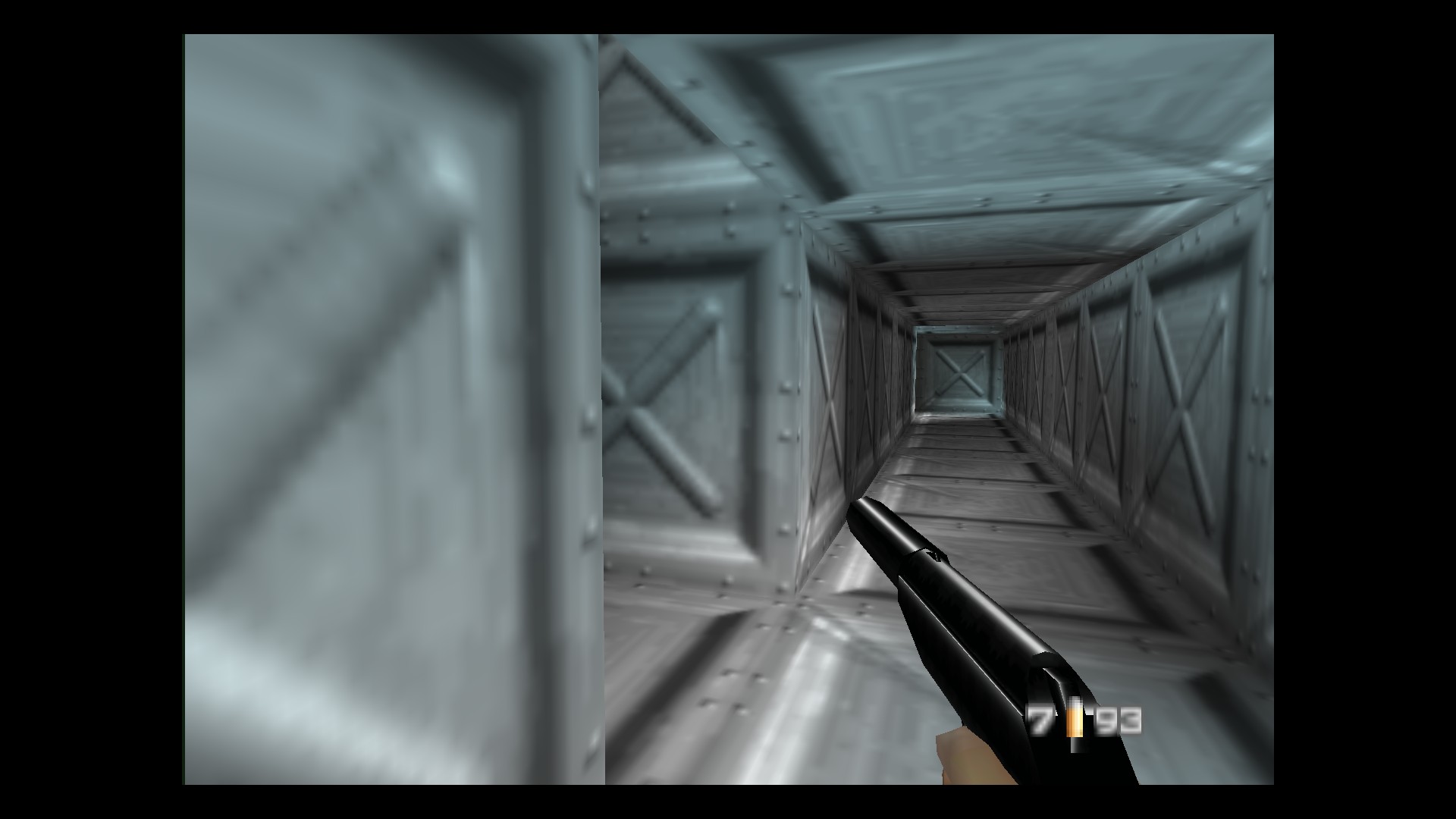

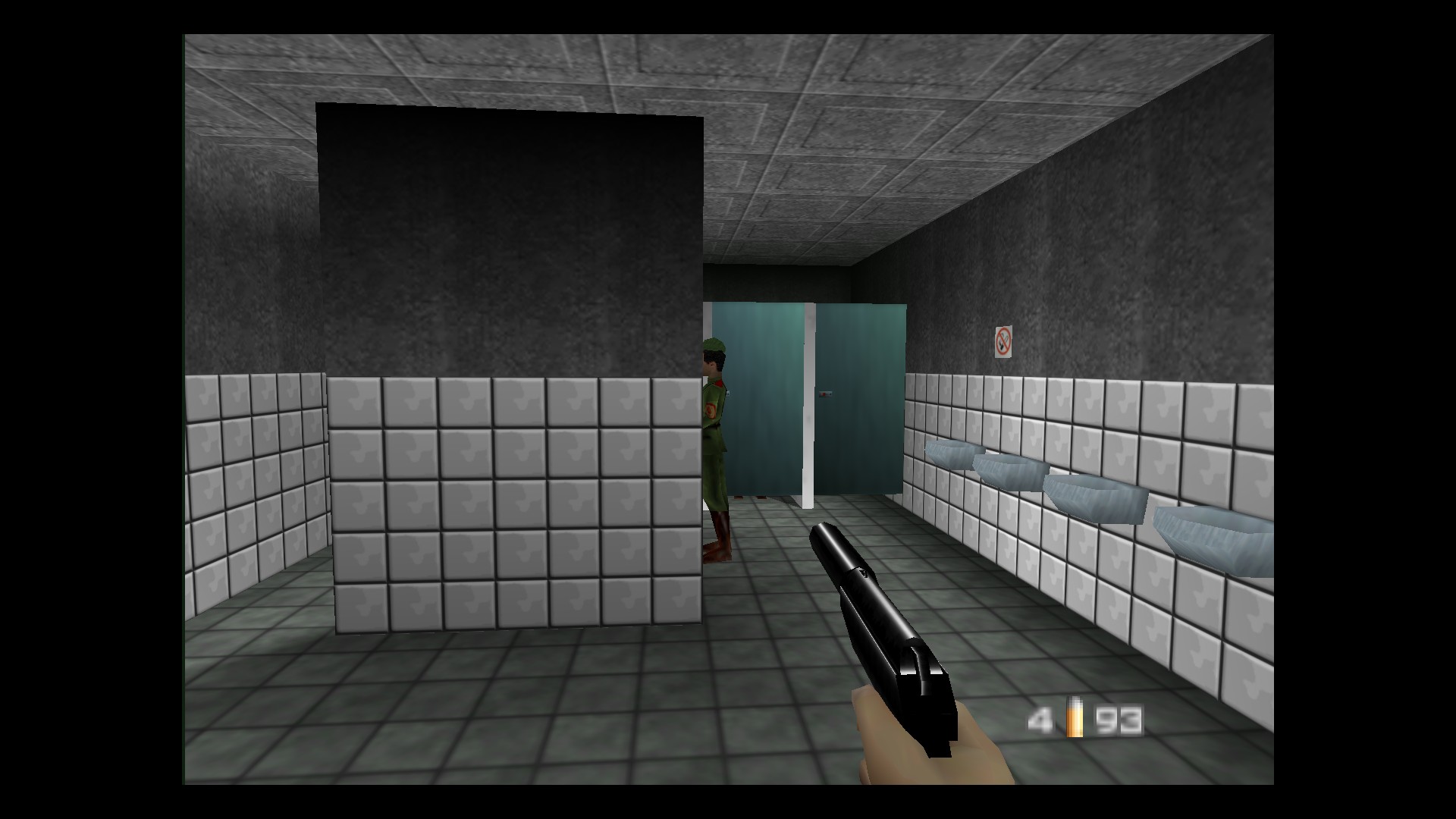


You are not an assassin or spy. Perhaps you are a student, in fact. You could be a cashier, a mechanic, maybe a teacher. But for a few nights a week, especially if you were alive around the year 1998, you may have spent a lot of time here or somewhere nearby. This is the opening scene in a level of the classic first-person shooter video game GoldenEye. The rest of the level, like the rest of the game, is full of similarly constructed spaces: offices, archives, corridors, laboratories, guard towers, missile silos, control rooms, closets, warehouses, a naval vessel, even a radio telescope. More than anything else, in fact, GoldenEye is characterized by space–by hundreds of spaces, each designed with care and constructed from raw materials and assembled through a combination of logic and skill. The facility in GoldenEye is a building. Its designers were architects.
If architecture is a way of shaping the human experience by shaping the spaces in which it unfolds, we must include video games in this category. We spend so much time there. My first exposure to a personal computer unfolded in the corridors of the Castle Wolfenstein nearly thirty years ago. I remember spending hours exploring the dungeons, hallways, banquet rooms, guard rooms, on and on, spellbound by the castle’s winding corridors, by its secrets. I’ve been back many times.
I still feel that sense of immersion and awe I experienced as a child. I’ve passed more time in the world of Wolfenstein and GoldenEye than the lavish spaces of the colleges and universities I’ve attended. I remember the facility bathroom in GoldenEye better than the restrooms at my middle school. If those schools are works of architecture, so is the facility.
GoldenEye is designed as a series of spaces through which the player navigates, but all video games—even card games, board games, and puzzles—are primarily spatial. They draw us into the action unfolding on the screen, compelling us through the strength of their design to withdraw from the space in which the screen is situated. Unlike television or movies, however, they invite us to interact with that space, to inhabit it and make changes.
Unlike movies or television, then, we should criticize and praise video games, perhaps glory in them, just as we would a work of architecture. We live in these spaces. We socialize there. If we view Zoom, Teams, and similar software as gamified work platforms, we work and go to class in these virtual spaces as well. As more of our life moves from physical to virtual spaces, the architectural aspect of video games—their ability to shape how we feel about ourselves and how we interpret the world—is more significant than it has ever been. It is worth exploring some of the many electronic spaces we inhabit in more detail.
Similar to other recurring features I’ve been launching lately, I will explore these virtual spaces on the pages of this blog by posting screenshots and recordings from the games I play along with personal or critical essays. Hopefully I’ll hear from you along the way! Feel free to comment below. I welcome thoughts and suggestions for spaces to explore.

In Grafica della Strada, designer Louise Fili lovingly documents the wildly creative shop signs, billboards, and other signage of the Italian street. “In the hands of a sign craftsman,” Fili writes, “type took on a new life, with a tantalizing menu” of styles, materials, and techniques. “Many of the signs proudly bore the imprimaturs of their makers” she explains. All of them are beautiful and inspiring.
Inspired by Fili’s valentine to Italian signage, over the years I began looking around for examples of well-crafted or creative signage here in my little southern hometown. To put it mildly, I’ve been disappointed. American streets certainly match their Italian counterparts in quantity. We are surrounded by signs, assaulted by their messages all day. When it comes to variety or creativity, though, our humble American streets leave much to be desired.
The problem, I believe, is one of commodification and transportation. What makes the signs in Fili’s book so wonderful are the myriad personal touches, the unique lettering, the diverse materials. They catch the eye in spaces that operate on a human scale, like pedestrian areas and urban centers where people move slowly. American signs must catch the eye on the scale of the automobile. Just about every sign here seems to be a sheet of printed plastic hung in front of a bank of lights, therefore, towering above the street where it can be seen from a distance at a high rate of speed. Signs are manufactured to corporate spec by franchisees for many businesses. In almost all cases they are manufactured using commodity materials, a limited design language, and industry-standard methods. It is a competitive business with precious little room for experimentation, serving customers with precious little appetite to break the norm. As business moves more online, I suspect this trend will only worsen.
Or so it appears. I’m willing to believe that this is a superficial reading of the American sign landscape, and I hope to prove myself wrong on this blog.
I’ll start with an example that is not beautiful, necessarily, but is remarkably different from the norm. I spotted this sign at the entrance to an “established” (that means old, in real estate terms, but not old or special enough to be “historic”) neighborhood on the opposite side of a busy road headed out of town. I swung around to take a few pictures, but could not find a good place to pull over until I spotted a side street a few hundred yards down the narrow entrance road. This gave me an excellent opportunity to walk through the neighborhood. The sun was shining warmly, and birds were singing songs of early spring in the trees overhead. Homeowners along the street have added, over the years, little hahas and embellishments to their yards. The neighborhood was peaceful, lived in. Alain de Botton argues that “those places whose outlook matches and legitimates our own, we tend to honour with the term ‘home.'” To call a place “home,” he says, is “to recognize its harmony with our own prized internal song.”
I was easy to see how Runnymede is home for its people. This sign was not as handsome as it may have been thirty years ago, but it speaks to the unique character of the community it represents. Perhaps it “sings” their “prized internal song.”

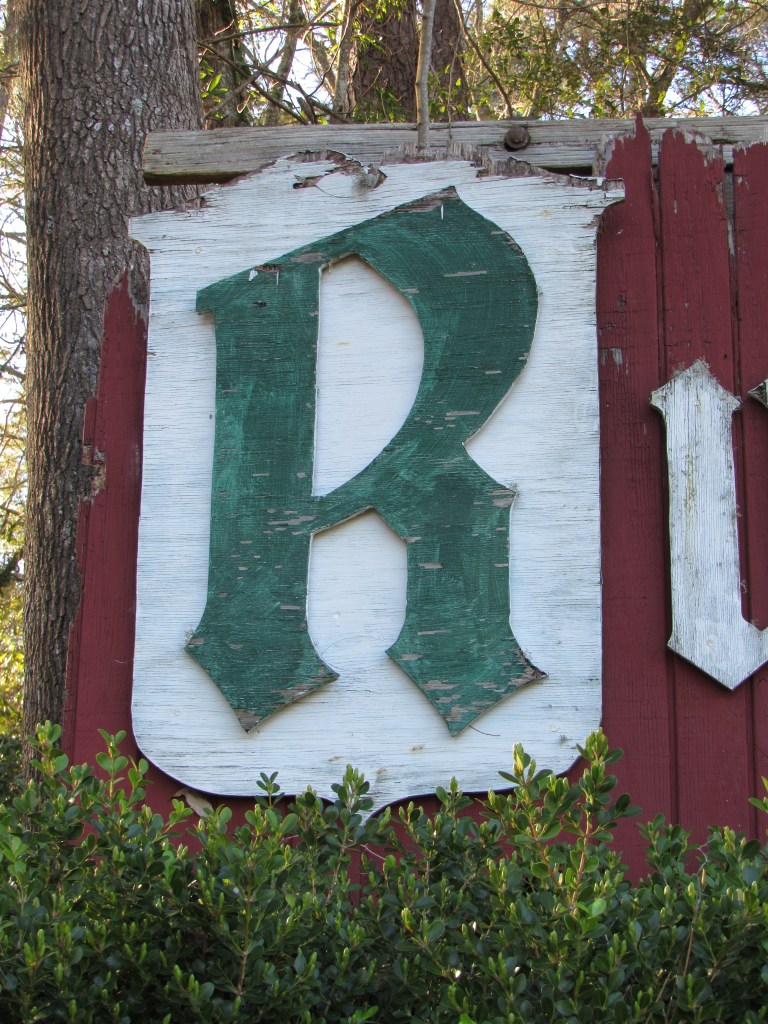
This is the first lesson in my study of American signage. Context is important. John Dewey rather famously wrote: “When artistic objects are separate from both conditions of origin and operation in experience, a wall is built around them that renders almost opaque their general significance.” A viewer cannot fully understand art unless they see it in the place and form in which it was meant to be seen. A sign is meant to be seen in a particular place. That is its purpose. Its value as a work of art is way down the list of priorities. I regret now that I did not do a better job of capturing this sign in context.

If you list the forces in 2021 working against jazz, and against an album like this one, it can feel overwhelming, depressing even. Do not despair. This is only a feeling. The truth is somewhere else, somewhere deeper.
Let us list the forces anyway.
First there is our shared understanding, taken as universal truth for at least sixty years now, that jazz is a thing for the museum set or the coffee shop, a factory of ambiance for Olive Garden or an upscale brunch. Jazz was once a living thing, this view holds, a music for crooks and drunks and junkies. Now its proponents and creators emerge from university programs, bleary-eyed from study, fingers inked by charts and ears indented by noise-canceling headphones, marching toward classrooms of their own. Don’t get me wrong, these are artists. They know every head in the fakebook. They’ve mastered their craft and many of them capitalize on this mastery to move the art in new directions. But many of them are equally at home serving as historians and conservators, pulling riffs and solos from the grimoire or Slonimsky’s Thesaurus. When you put it all together, jazz viewed from this frame of reference feels a bit like publishing monographs for the academic press. This music once moved mountains. Now it must exercise its influence through the same channels as philosophy and the social sciences: grants, endowments, public television. If you support Jazz at Lincoln Center, you may qualify for a thank you gift. Ask your operator for details.
The old mountain-movers possess a sort of mystique, therefore, like former heads of state or old soldiers surveying the world with a thousand yard stare. Their numbers are dwindling, and with them passes a unique way of listening to the world and reacting to its vital rhythms. With jazz, popular music reached a crescendo of sophistication and creativity that took listeners to the very edge of popular sensibility and sometimes beyond. It was almost too much. It was almost as though Americans exhaled a collective sigh of relief when Little Richard took the stage. The best students of jazz will continue driving the form, and some of them will push it further, but it is almost seventy years since the heat of rock and roll displaced bebop’s cool, and the distance between here and there, now and then, feels greater than ever before.
It is mostly the session players from those heady days who remain with us now, not the stars, aging alongside the modern artwork in darkening valhallas from New York to San Francisco. If you dwell on it in this frame of mind, a jazz record can feel like a funeral procession. Perhaps this is appropriate. Born from the funeral marches of old New Orleans, jazz seems destined to return to the bayou shades.
We live in the age of the funeral procession, but jazz is not the music for this age. Witness the first moments of the video for “Sometimes I Feel Like a Motherless Child.” A duo is a uniquely intimate mode of collaboration. Especially in an improvisational medium, each partner in the duo must understand the other’s moves, must know their very mind. In this light, the distance between Shepp and Moran in the opening moments of the video feels like a yawning gulf. If the moment hits you right, the gulf between the artists on that dimly lit stage feels like the chasm separating us from all of the friends and loved ones we’ve lost this year. It feels like the passage of time, the inevitability of entropy and change. Thank God for the horn that moves us past that moment, into the now.
If you think of this album as a sort of fastness, a place made warm and safe through a powerful magic combining equal parts spirit, talent, collaboration, and history, you can hear the music repelling these forces like a force-field. Let My People Go is not a funeral march. It is not a testament to the passage of a generation or the decline of all things. It is, instead, a remarkable antidote to the depressing array of negative forces that send us into fits of melancholy at the beginning of YouTube videos or set us off on doom-scroling odysseys into the far corners of night. Let My People Go is a force for good.
The album opens on “Sometimes I Feel Like a Motherless Child,” a spare rendition of the moving Negro spiritual rendered all the more powerful by this remarkable duo. Jason Moran’s expansive intro sets a fitting stage for Shepp’s piercing exploration of the melody. Shepp and Moran play in proximity to one another but rarely together, probing the song’s musical themes like murmuring voices in the darkness, seeking one another, seeking consonance. This is the power and the promise of a masterful duo. Each artist has the space to stretch out, but the restraint to fill the voids left by their counterpart without drowning them out. Shepp and Moran achieve this careful balance on the album’s opening track.
My favorite moments on the album come on its second cut, a meditation on Billy Strayhorn and Duke Ellington’s 1967 standard, “Isfahan.” Where Ellington’s piece is a perfect study in restrained beauty, Shepp and Moran draw out its blue notes, seeking shelter in the spaces in between the notes of the melody as though from a quiet rainstorm. Shepp’s time spent playing alongside Coltrane shines through on “He Cares,” which opens on an expressive, birdsong intro and slowly climbs toward a moving crescendo across the next six and a half minutes. When Moran moves into the spotlight around 3:30, the piece coheres beautifully.
“Go Down Moses,” the fourth cut, seems to examine the dialectic of tension and possibility inherent in freedom through the interplay between Shepp’s opening improvisation, set against Moran’s restless, oceanic backdrop, and Moran’s solo improvisation building up to Shepp’s expressive, vibrato singing. The duo carries us into new territory with “Wise One,” a freer, more consonant space. With “Lush Life,” the duo flies the perennial Strayhorn standard beloved by Coltrane to transcendence, and the closing track, “‘Round Midnight,” keeps them firmly in those rarefied spaces.
“If my music doesn’t suffice, I will write you a poem, a play. I will say to you in every instance, ‘Strike the Ghetto. Let my people go.’”
Archie Shepp, “An Artist Speaks Bluntly,” Downbeat, 1965
The forces this record repels only feel overwhelming when they are framed as cultural forces, and that is only because we’ve spent the last sixty years convincing ourselves that culture is somehow both sacrosanct, on the one hand, and thoroughly shaped by immovable hegemonic forces, on the other. For music, this view conflates market forces with culture, valorizing expression through its quantification to argue that its forms are no longer valid when they fail to move units or fill seats. To put it as simply as possible: fuck that. Of culture and music we may say this instead: jazz gives the world meaning through a set of coherent rules and rituals. This way of looking at the world was supremely influential for a brief period before and after the second world war before giving way, as a popular commodity in the marketplace, to other forms of expression. It did not die when its practitioners moved to conservatories. It is not passing.
It is the crushing inevitability of commodification that Let My People Go most powerfully counteracts. Shepp and Moran’s message is a cultural one, yes, but it is also a social one. It is there that we should spend some time. “Let my people go” harkens to Moses in Egypt, but it was the terrible lash of slavery that reduced millions of Africans to things, to motherless children on the auction block. From the beginning of his career in the 1960s, Shepp’s music has been centered on liberation—wailing for freedom, exalting in its possibilities, lamenting its elusiveness. In 1966, he told Downbeat that jazz was “for the liberation of all people.” “Why is that so?” he continued, “because jazz is a music itself born out of oppression, born out of the enslavement of my people.”
The pandemic is a social force. So is violence in defense of power. So is the market, with all its cruel iniquity. We may feel these forces as an overwhelming weight upon our shoulders. We may view them as insurmountable, hegemonic. To do so would be to ignore that enduring promise of jazz, however, and the complete and utter freedom it offers its adherents. Art, Shepp insists, can be a countervailing force. Listening to his work with bandmate Jason Moran on Let My People Go, I cannot help but agree. It is fitting this art should find us in a dark hour.
A list of interesting things new and old that I’ve read or experienced this week. I do not endorse or even necessarily agree with anything on the other side of these links.

Adegbuyi, Fadeke. “LinkedIn’s Alternate Universe: How the professional platform makes networking weird.” Every.to. https://every.to/divinations/linkedins-alternate-universe-21780381 — Adegbuyi says what we’ve all been thinking: LinkedIn is weird.
Evans, Benedict. “Retail, Rent, and Things that Don’t Scale.” https://www.ben-evans.com/benedictevans/2021/2/6/things-that-dont-scale — Evans offers some interesting thoughts on the retail experience and, as a result, challenges readers to stop thinking of Amazon as a sort of indomitable dragon.
Ford, Paul. “The Secret, Essential Geography of the Office.” Wired. https://www.wired.com/story/the-secret-essential-geography-of-the-office — What makes a successful essay? One thing you can do is take something commonplace, like the office, and make us see it in a new way. Consider the passage: “I think of those as ‘weeping paths,’ part of the secret map of every office. You cannot sob at your desk, so you must go on a journey, smiling at the floor, until you find a place where emotion can flow.“Litvinenko, Yuri.
“Windows’ Little Brother, Bearer of Microsoft’s Grand Ambitions.” 30pin. https://www.30pin.com/features/windows-ce-history/— Perhaps you think that a history of Windows CE couldn’t possibly be interesting. Think again. This article sheds even more light on how Microsoft’s total dedication to the Windows brand between around 2002 to around 2010 seriously damaged the company’s ability to execute anything else.
Lowe, Katie. “The Rise of the Digital Gothic.” CrimeReads. https://crimereads.com/the-rise-of-the-digital-gothic/ — A thought-provoking critical perspective from an unexpected place. Perhaps, by placing us in constant contact with the many ghostly presences of capital, technology is hastening the end of the end of history.
Rizvic, Sejla. “Everybody Hates Millennials: Gen Z and the Tiktok Generation Wars.” The Walrus. https://thewalrus.ca/everybody-hates-millennials-gen-z-and-the-tiktok-generation-wars/ — Just to be clear, generational discourse is bullshit. But since we’re surrounded by people who believe in it, and then act on that belief, articles like this one are necessary. Roy, Sumana. “The Problem with the Postcolonial Syllabus.” The Chronicle of Higher Education. https://www.chronicle.com/article/the-problem-with-the-postcolonial-syllabus — Roy asks, what’s the matter with merely taking pleasure in novels? Why must novels written by authors living in “postcolonial” settings impart some sort of moral or offer some deep criticism?
The Little Things.
Death by Unga Bunga. Heavy Male Insecurity.
Various Artists. Cuba: Music and Revolution: Experiments in Latin Music, 1975-1985. — https://soundsoftheuniverse.com/sjr/product/cuba-music-and-revolution
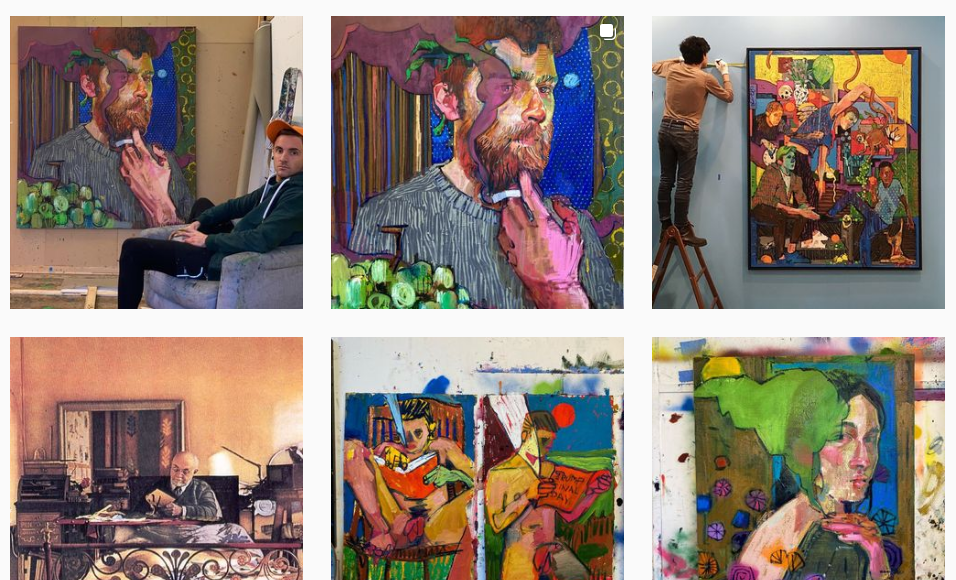
Andrew Salgado. — https://www.instagram.com/andrew.salgado.art/
Roadsworth. http://www.roadsworth.com/
Takram. “Moriota Shoten.” http://www.takram.com/projects/a-single-room-with-a-single-book-morioka-shoten/ — profile of a unique bookstore in Japan which sells one book at a time. Benedict Evans discusses this store in his article above.
Coupland, Douglas. Bit Rot: Stories & Essays. New York: Blue Rider Press, 2016.
Cory, Cynie. Here on Rue Morgue Avenue. Tallahassee, Fla.: Hysterical Books, 2018.
See you next week! (Or, you could keep an eye out for more writing, photos, art, and other stuff here during the week)…
 C.B. Crenshaw