Upcoming Books in Native American History

March 2018

Bockstoce, John R. White Fox and Icy Seas in the Western Arctic: The Fur Trade, Transportation, and Change in the Early Twentieth Century. New Haven: Yale University Press, 2018. Link

Calloway, Colin. The Indian World of George Washington: The First President, the First Americans, and the Birth of the Nation. New York: Oxford University Press, 2018. Link

Cover for  The Indian World of George Washington

Graber, Jennifer. The Gods of Indian Country: Religion and the Struggle for the American West. New York: Oxford University Press, 2018. Link

Little, Ann. The Many Captivities of Esther Wheelwright. New Haven: Yale University Press, 2018. Link

Monaco, C.S. The Second Seminole War and the Limits of American Aggression. Baltimore: Johns Hopkins University Press, 2018. Link


April 2018

Kracht, Benjmain R. Religious Revitalization among the Kiowas: The Ghost Dance, Peyote, and Christianity. Lincoln: University of Nebraska Press, 2018. Link

Nohelani Teves, Stephanie. Defiant Indigeneity: The Politics of Hawaiian Performance. Chapel Hill: University of North Carolina Press, 2018. Link (Image)

Schulze, Jeffrey M. Are We Not Foreigners Here?: Indigenous Nationalism in the U.S.-Mexico Borderlands. Chapel Hill: University of North Carolina Press, 2018. Link

Sharfstein, Daniel J. Thunder in the Mountains: Chief Joseph, Oliver Otis Howard, and the Nez Perce War. New York: W.W. Norton, 2018. Link


May 2018

Biolsi, Thomas. Power and Progress on the Prairie: Governing People on Rosebud Reservation. St. Paul: University of Minnesota Press, 2018. Link

Power and Progress on the Prairie

Haynes, Joshua. Patrolling the Border: Theft and Violence on the Creek-Georgia Frontier, 1770-1796. Athens: University of Georgia Press, 2018. Link


June 2018

Archer, Seth. Sharks Upon the Land: Colonialism, Indigenous Health, and Culture in Hawai’i, 1778–1855. New York: Cambridge University Press, 2018. Link

Sleeper-Smith, Susan. Indigenous Prosperity and American Conquest: Indian Women of the Ohio River Valley, 1690-1792. Chapel Hill: University of North Carolina Press, 2018. Link
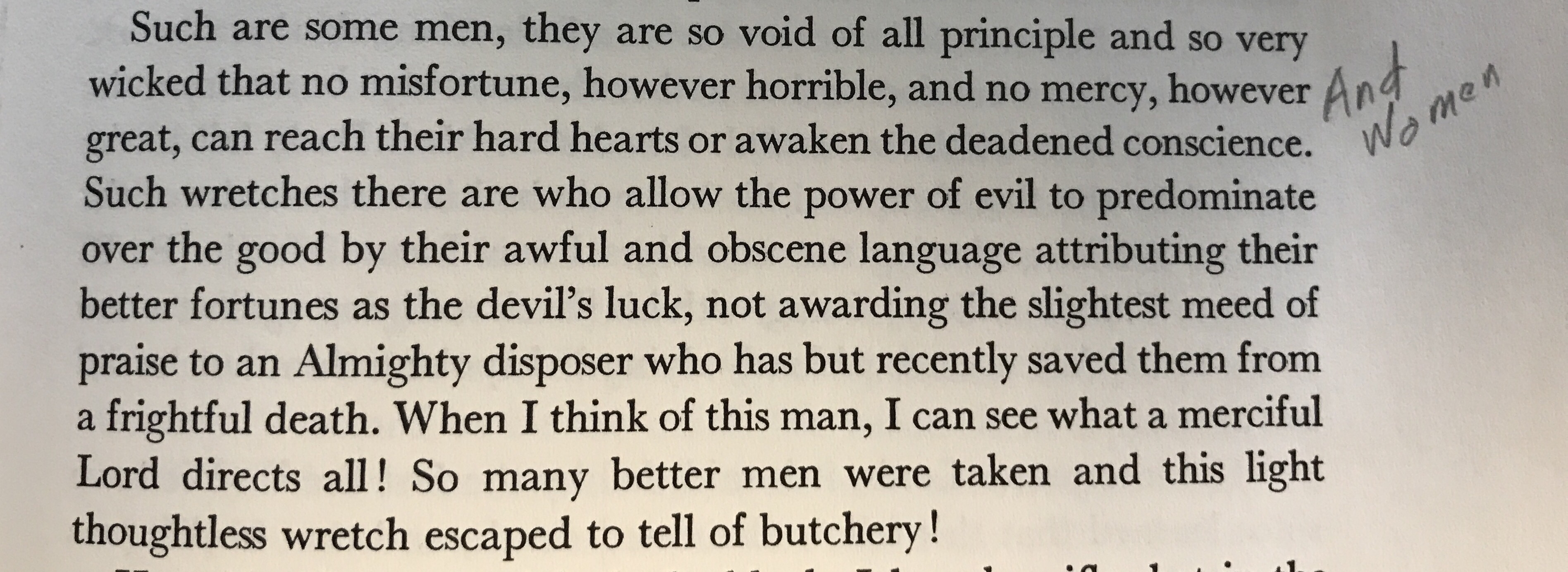
An Open Letter to the Author of Bitter Marginalia in Reminiscences of the Second Seminole War by John Bemrose.

Radical Equality

Dear Austin, 

Is it OK if I call you Austin? That’s what I imagine, and you haven’t given me much else to work with, so there we are. Me and you, Austin.

Austin, what happened? Until now, you were enjoying this book. Back there when we were reading about “friendly and simple-minded” Minorcans, you kept to yourself. You stayed quiet, too—with a grim set of the jaw, I like to imagine, but I’m not so sure—when “the unfeeling buyers of blood” at the St. Augustine slave market “[caviled] over the qualifications of human beings, with the coarseness of cattle jobbers.” “Picturesque” Indians (who were also, I’m sure you remember reading, “great beggars”); a Black Seminole interpreter “with his paucity of ideas”; Native “children of the woods” who wouldn’t hesitate to kill a “even a lisping babe!”; all went without comment. But not this. So why now?

I’ve been thinking about it, and maybe, Austin, feminism is your jam. All that stuff about race and ethnicity is someone else’s fight. Maybe it’s so clearly wrong-headed that it doesn’t merit marginal argument. But this, this is Austin’s battlefield: women can be unprincipled and wicked, too! Men and women alike can have hard hearts! Which, hey, you’re not wrong. Fair enough.

But I don’t think that’s true. I think you had an axe to grind when you read this paragraph. And it’s OK, we’ve all been there. Like, just this morning on the way to work I was stopped at an intersection waiting for someone to pass so I could turn right; but then, right at the last second, they whipped the car into a turn. No signal! And then the next car did the same thing—and no, they weren’t in a turn lane, I know what you’re thinking, Austin, this was a two-lane road—and then the next one, and the next one, until finally the light changed and I was stuck. I could have turned ages ago if only I had known! So then, later this morning, someone was trying to talk to me about an unanswered email and I couldn’t wait to say, “I know, it’s just like people who don’t use their blinkers! Why do people do that?” And they just sort of laughed and then kept going on about the email.

I’m guessing that whenever it was that you read this, Austin, you felt pretty much the same way about women. Someone would say, “Know who was a real piece of work? Mussolini, that’s who,” and you would say, “I know, I know, but women can be evil, too.” Or someone else would go, “I burnt my fingers on my toast this morning,” and you would say, “yeah, kinda like women can burn your heart.”

If you still feel the need to scribble your rage in old memoirs, OK. The past is a safe space: lived-in, comfortable. That’s one of the reasons we historians like to spend so much time there: we already know the bad parts of the movie, and we know the heroes and villains can’t hear us or object when we grind our axes on their words.

But, Austin, we can also talk about it if you want. I think you might need to talk about it.

All the best,

Chris

Native Hatred and American Populism: The Jacksonian Beat

As Americans struggle to understand or resist the travel ban, hate crimes, aggressive immigration agents, and government-maintained lists of immigrant crimes—to list but a few of the earthquakes rollicking the American social landscape so far in 2017—it can seem as though we are living through events without precedent in American history. A quick stroll through the archives reveals that this simply isn’t true. Here’s a commonplace example from the late 1830s that resonates with today’s dark mood.

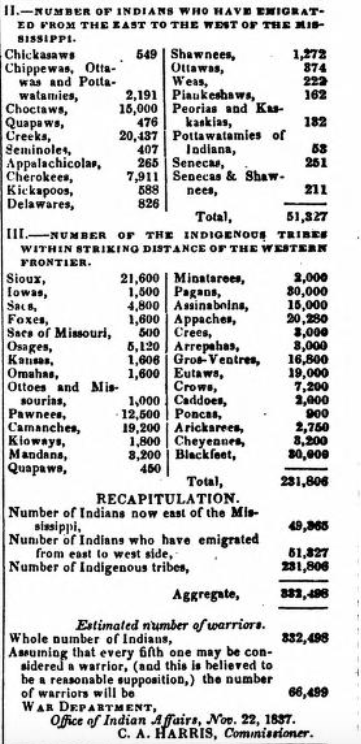
Screen Shot 2017-03-05 at 10.46.40 PM


The 1830s were just as seismic as our own time. Andrew Jackson ascended to the Presidency on the one-two punch promise of populist upheaval and Indian removal in 1828. Historians will argue over the extent of the “democratic surge” until we’re all speaking hexadecimal or Martian, but only an insane person could argue with the “success” of Jackson’s Indian policies. Indian hatred laid down a persistent beat beneath the American freestyle throughout the 1830s. Thousands of Indians in the Southeast were marched westward at the point of the bayonet and on the razor’s edge of starvation. Wars in Florida and Alabama tore villages apart, forcing the most intransigent or tragically fortunate Native peoples deep into the South’s swampy fastnesses, while war in Illinois signaled the end of organized Native resistance in the Old Northwest. When it comes to basic human conditions like peace and prosperity, the 1830s—like most decades since the European invasion began more than five hundred years ago—were bad for Native Americans.

American newspapers kept the anti-Indian beat pulsing throughout the Removal era. The image above comes from the February 1, 1838 issue of the Army and Navy Chronicle. It does a lot of work in support of American colonialism. It creates the illusion of certainty and superiority by enumerating and classifying Indians—similar, perhaps, to a list of countries with suspected links to terrorism. It instills fear by associating these thousands of potential enemies with “striking” on the frontier—not too far from, say, a list of crimes committed by immigrants, or claims of 122 “vicious” combatants returned “to the battlefield” from Guantanamo. And it links these numbers to the military by publishing it under the heading of the War Department—a bit like the current “military operation” sweeping fearful immigrant communities throughout the United States.

Most newspapers from the era laid down the same beat. If the rap wasn’t Indian war, Indian fear, or Indian hatred, it was a breathless accounting of the things that were possible when the Indians were gone. Books and newspapers in the South instructed readers to plant cotton beneath the tilled husks of old corn fields, for example, for best results (i.e., profits to buy more human beings, but that’s a different story). These “fever dreams” of cotton wealth and “flush times,” as Joshua Rothman calls them, created spectacular booms and devastating busts. We should keep that in mind as we argue over what it means to “Make American Great Again.”

Being There: Intimacy and Distance in History

Let’s start a blog post about history with a bunch of questions about the present.

I’ve had a couple of conversations with a respected local historian recently–we’ll leave names out of it–about a recent book addressing a historical site in Florida. The local historian is unimpressed. The author’s “never been there!” he told me this summer back in June. And again, August, he said the other historian’s “never even visited the site,” as though this indicates a self-evident and basic flaw in the work which bears repeating. I have no idea whether the author has ever visited the site, but the sharpness of this dismissal–and its seeming self-evidence–raises the question: does it matter?

In Swampwalker’s Journal, his meditation on wetlands, David M. Carroll writes, “The foundation of my writing and drawing is personal experience, my ‘being there,’ and what I have learned from having been there through so many epochs of my life.” Though indebted to scholars and other observers, he maintains: “Moments outside of the human world in the shallows of a marsh. with red-winged blackbirds calling and the wind rustling in cattails or reedgrass, or a solitary spell at the edge of a swamp on the edge of winter—these will bring intimations of the spirit that moves with the water, the light, and the life of the marsh.”

The aggrieved local historian seems to think that “being there” is an essential part of doing history—that significant sites somehow convey “intimations of the spirit[s]” of the long dead who once walked the soil long trod beneath that on which we walk today. He may be right. I have seldom met a historian who was not pushed toward the craft by a moving childhood experience at some historical site. Right or wrong, he forces us consider: do the dead inhabit the land, even today, or do their “spirits” live in the archives? Are we enriched more by the dust of the earth or the dust of documents?

He raises a couple of interlocking questions, really, that I can’t hope to answer in a single blog post:

  • Francis Parkman walked the battlefield trod by Montcalme and Wolfe, interpreting their steps, their sights and sounds, with his own senses. Writing in the nineteenth century, though, he looked out over a less complicated palimpsest. (Parkman died in 1893, in fact, just as Turner was proclaiming the death of the frontier he had so lovingly rendered.) For historians of the near past, Parkman’s sensory investigation may still be an option. But what about those who write of the far-gone early American past? What about the literally buried or submerged world of the ancients?
  • In “Historians who Love Too Much,” Jill Lepore describes stroking a lock of Noah Webster’s hair in the archives. That lock of hair, she writes, “made me feel as though I knew him—and, even lee logically liked him—just a bit better.” It is necessary to balance “intimacy” with “distance.” But what is the correct balance? Can I know someone without meeting them?

I am working on an environmental history of the Seminoles, the Seminole Wars, and the Florida we think we know. Like my friend the aggrieved local historian I do not believe that I can tell the history of this munificent Eden without “being there.” But like Jill Lepore I am a little troubled by a sentimental attachment to the things of the past. I must balance “moments outside of the human world,” like David Carroll, against moments outside of the present. This blog is not the place to find the answer to these deep methodological questions, but to lay down the blue lines of my thought. I will begin by challenging myself to breathe deeply: once to taste the dust of the earth, twice to choke on the dust of the archives

Walls of Privilege: Inclusion at the AHA and Other History Conferences

Late last week and over the weekend, my Twitter and Facebook were buzzing with posts from historians at the American Historical Association’s Annual Meeting in Denver. I was glad to see their posts, and especially glad to read of my friends’ and colleagues’ successes. The AHA’s digital success is a wonderful development, for all the reasons Stephanie Kingsley mentions in her Perspectives on History article published after last year’s meeting, but, for most historians, they might as well be tweeting from the fiery surface of Venus. Most of us–many thousands of grad students, historians working in government, adjuncts, secondary educators, and independent scholars, to name but a few–don’t have the freedom or resources to attend a conference in the Mile High City. We’re left on the margins of the conversation, attempting to piece arguments together from 140-character summaries made in the heat of the moment and conversations with colleagues after the fact. As the well-intentioned Tweets below suggest, it’s not always easy to follow along from the outside.

The AHA, OAH, and other professional bodies continue to advocate for the importance of historical training for students across all academic disciplines and the specific relevance of graduate training in history for students entering other professional fields. The OAH suggests that grad students should “develop [their] Plan A to include jobs that are not in academia and ones that [they] might enjoy equally as well as…teaching,” while the AHA’s Career Diversity for Historians Initiative is working with pilot departments “to explore the culture and practice of graduate education and how it can better support the changing needs of graduate students.” These initiatives and suggestions are timely and smart. As Anthony T. Grafton and James Grossman argue in a recent article in Perspectives, “holders of doctorates in history occupy, or have recently occupied, a dizzying array of positions outside the academy” including positions at every level of government, the armed forces, and cultural institutions around the world. Historians are everywhere.

Thoughtful essays and career diversity initiatives are too easily forgotten when annual meetings roll around. These distant and costly affairs make it startlingly clear who the AHA, OAH, and other major associations see as real historians: scholars with deep pockets. (1) Most scholars are cut out of the conversation, unable to scale the walls of privilege surrounding the field’s most important gatherings. We can read programs, thumb through exhibitor’s guides, and try to live vicariously through social media, but the most important aspects of the meeting—the exchange of ideas and professional networking—remain depressingly out-of-reach. (2)

It should not be this way. Streaming live video, moderated chats and debates, and digital publishing are ubiquitous, accessible, and inexpensive. Sessions, round-tables, and addresses should be broadcast over the web, open to moderated discussion by all. H-Net and Reddit AMAs should play a significantly larger role in the digital infrastructure of the conference.

While historians can’t help but walk into the future staring backward, avoiding these technologies is not prudently conservative; it is counterproductive. Technology is not a panacea. One look at the last Presidential election lays bare the internet’s deep flaws. But as a professional organization dedicated to career diversity, the AHA should lead the way in 2018 to open the doors of its annual meeting to the thousands of scholars who cannot afford a plane ticket, hotel stay, or cocktails at the bar. The OAH and others should follow. Until then, I’ll be at work in my government office, squinting at #aha17 tweets on my lunch break and plunging into archival sources by night.