Dracula (2025) and the Tyranny of Evil Men

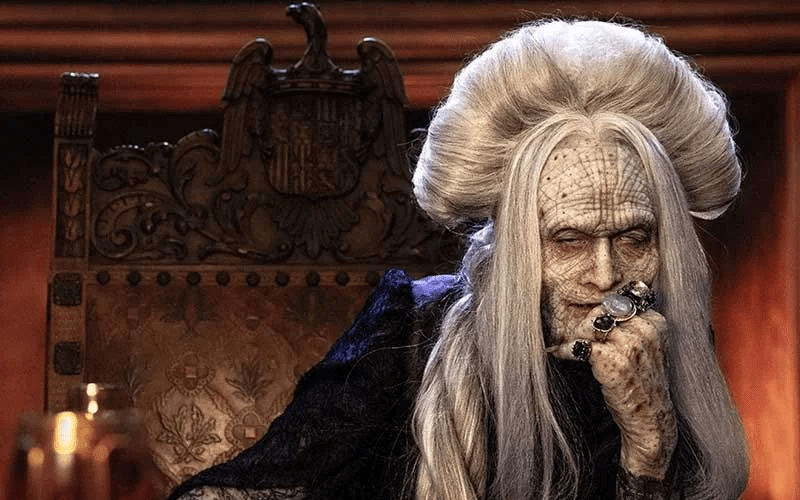
If your mind works anything like mine, at some point during Luc Besson’s Dracula—which is, let’s just get it out of the way, a sumptuous visual feast inspired in equal parts by John Boorman’s Excalibur, Tom Tykwer’s Perfume, and Disney fairy tales—you may find yourself asking: why are we asked to identify with this bloodthirsty creature? Is it actually good and noble to be an undead hematophagous thing, spreading a curse across Eurasia like a dark blot of ink? Should we aspire to be evil legends like this beautiful medieval knight-turned-cryptid fiend?

I think Besson is saying: yes, go for it. Which—without recounting the history of the man here—is not altogether surprising.

And, you know, come to think of it, Dracula and Iron Man and Film Directors have much in common. Iron Man and Dracula are solitary geniuses. Both toil in dark, secret lairs, where they manufacture mysterious and invincible technologies. Iron Man makes a suit of miraculous alloys, rocket-powered shoes, a futuristic computer familiar. Dracula produces mad familiars, enchanted gargoyles, armies of animal allies. Film Directors also like to imagine themselves as genius auteurs. Both Iron Man and Dracula have an inexhaustible supply of money. We see Dracula’s gargoyle minions stacking his dining hall with riches here, and the hellish fiend simply does not care. Film Directors, I like to think, are much the same.

It’s no wonder, then, that we are asked to see Dracula as some sort of hero. In the same way we are asked to see the rogue billionaire Tony Stark as a hero, and we are encouraged to look upon the definitely-not-a-sex-criminal Film Director (all of them, that is) as a singular genius, too.

Another thing you might think about, if you’re like me, is how each generation of films seems to ask us to identify ever more closely with Dracula and other horrifying things. The Count was always steeped in gothic romance, it is true, but it is only since the End of History in the 1990s that we have been asked to properly empathize with the beast as a modern man—to consider his point-of-view and find in it something worthwhile. This is a creature who sinks his teeth into the flesh of the living and either drains their life or damns them to an eternity of dark and vile urges. That the creature also happens to be in love with the memory of a woman who died in the 15th century seems beside the point. Doesn’t it?

Is it because the industry is peopled with monstrous men like Harvey Weinstein, Steve Bannon, and Jeffrey Epstein that we are encouraged to look upon seducing and drinking the blood of nubile young women, plunging cold steel into the hard bodies of young men, or murdering a convent full of nuns as kinda fun things you might want to do on a Friday night? Is it because we are ruled by an unstoppable gang of cheapjack thugs and bone-crunching weirdos that our movie villains refuse to stay dead? Again and again they die. Again and again they come back. Nothing changes. They want more.

Besson, at least, brings Dracula to an end in this film. When Christoph Waltz’s steel spike breaks the fiend’s cold, dead heart, his cursed ashes rise toward the brilliant light of salvation like a murmuration of swallows. Here’s one very bad man, at least, who goes straight to heaven. So that’s something.

(Edit: I’m not the only one thinking about the literal monsters running things. Here’s a blog post about the vampires of Silicon Valley I found linked on Hacker News the morning after I published this review. -CBC)


Review: The Hitch-Hiker (1953) and the Dark Underside of the Postwar Road

There was a prolonged moment after World War II when the road symbolized for Americans ultimate freedom. These were the years of interstate highways, land yachts, Jack Kerouac and William Burroughs, teenage hot rodders, drive-in movies and drive-up restaurants. Empowered by all things automotive, the story goes, Americans were footloose and wild. As a result they lived through hard drinking years, fast living, devil may care years. So it goes. From Happy Days to the good-old days long gone in the animated film Cars, we’ve idealized the period to the point of caricature.

Underneath all of this there lurked a menacing darkness. Killers roamed the highways. Cons, pimps, and addicts thrived in the automotive underground. Post-traumatic former GIs, reliving the horrors of Guadalcanal or the Bulge, struggled to hold it together. Women and minorities took the brunt of it. Woe betided those who happened to be both. Automotive freedom ran like a wine dark current beneath this moment, empowering some as thoroughly as it shackled and destroyed others.

A modest but brilliant noir picture emerged from this ambivalent milieu: Ida Lupino’s chilling feature, The Hitch-Hiker. Released in 1953, it is important that this is the only classic noir directed by a woman. It is not the only entrée in the genre to call the free-wheeling postwar world to account, but Lupino’s gaze, executed by cinematographer Nicholas Musuraca and carried out by deft performances on the part of the film’s three stars, is attuned to cruelty and power in a way that her male counterparts did not grasp in their cynicism or machismo.

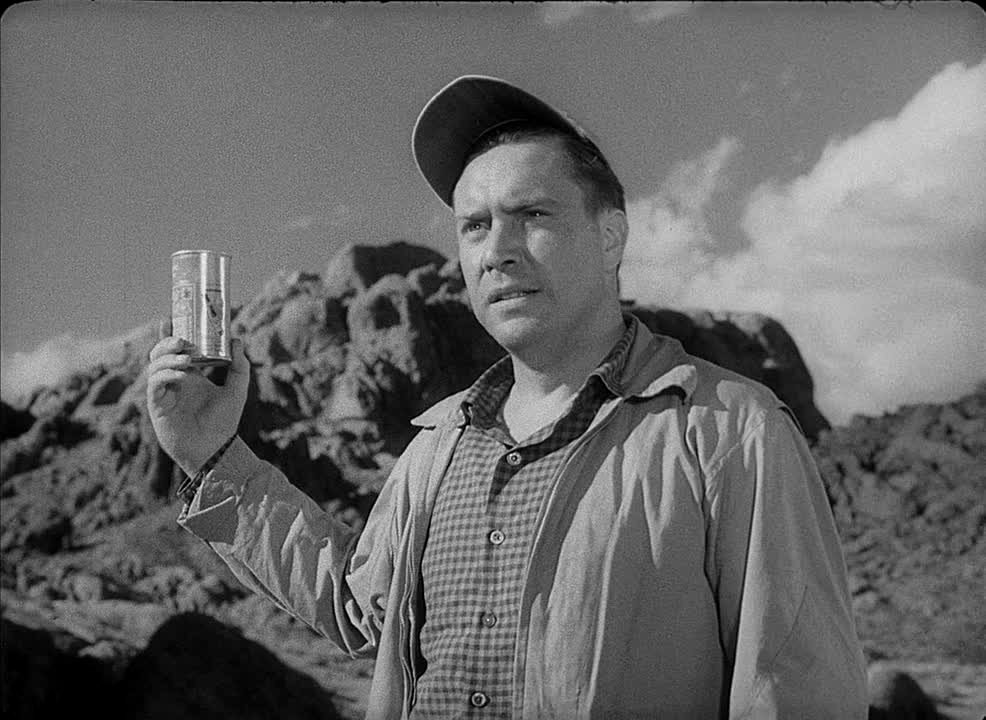
The premise of the film is straightforward. It was based on the killing spree of Billy Cook, a drifter and small-time hood with a deformed eye who gained notoriety for a 22-day rampage that left six people dead on the road from Missouri to California. In the film, Cook is represented by the character Emmett Myers, ably performed by a dead-eyed William Talman in his best role before moving to the small screen on Perry Mason. We meet Myers mid-spree. His M.O. is to hitch a ride, kill the driver, and steal the car, along with the driver’s wallet, before moving onto the next victim. After another grisly killing, Myers sticks out his thumb and hitches a ride with fishermen Roy Collins, played by Edmond O’Brien, and Gilbert Bowen, played by Frank Lovejoy. These two are old friends enjoying a taste of freedom from their domestic lives on a weekend outing to the Gulf of California when they pick up Myers, who proceeds to lead them at gunpoint on a wild odyssey into Mexico, where he plans to kill them and board a ferry to freedom across the Gulf of California. A taut thriller ensues, driven by stark contrasts, interesting inversions, and powerful frustrations, until Myers runs hard into the arms of justice and the fishermen are delivered from their terrible captivity.

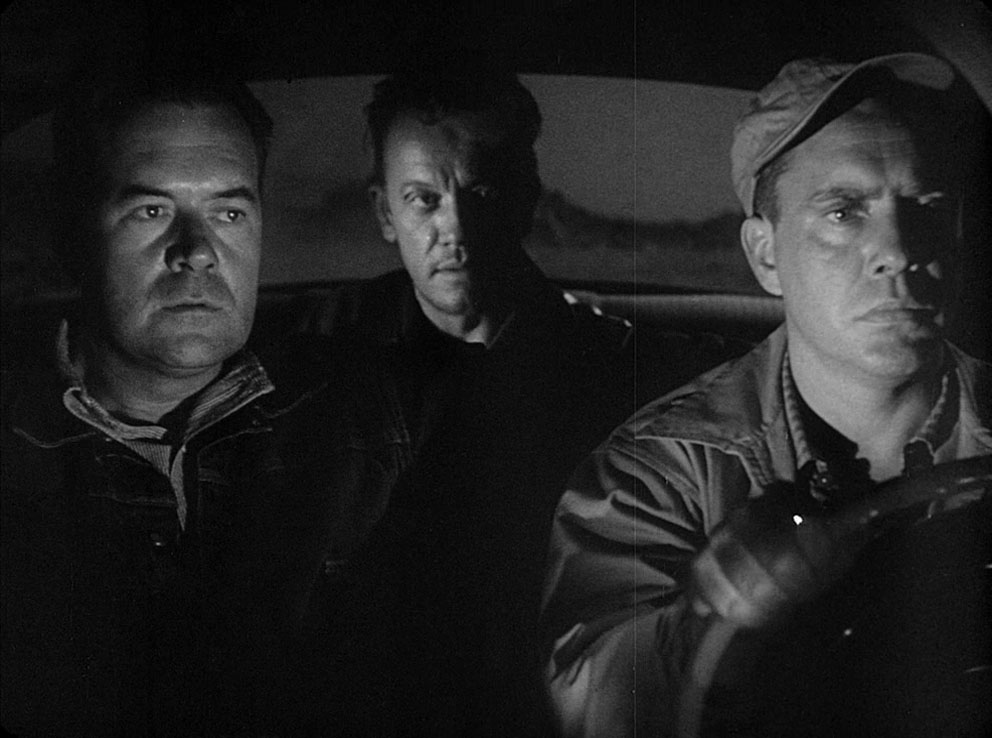
Lupino manages to achieve much in the film’s meagre 71 minute runtime. Most striking to me are the contrasts, both visual and atmospheric, that serve the story. The setting alternates from the hotbox enclosure of Collins’ and Bowen’s car to the wide-open desert spaces through which it is passing. Collins and Bowen are seated in the light up front; Myers is shrouded in darkness in the backseat. Myers is blind in one eye and sharp as a hawk in the other. These contrasts are amplified by inversions, however. Collins is a mechanic and driver. He possesses the most power, therefore, in the most enclosed space. Bowen is the only character who can speak Spanish. Myers holds a gun, then, but Bowen has the power of knowledge when they need to resupply in one of the sleepy Mexican hamlets along the way. Ultimately, the dynamic that emerges between the three characters is a sort of inverted buddy feature. I often found myself wondering whether Bowen and Collins would remain friends when the ordeal was over, or if they would go their separate ways.

The Hitch-Hiker was a B picture for a reason, however. Its weaknesses are plain. There are holes in the plot big enough to drive the fishermen’s Plymouth through. The opportunities for the captives to overpower Myers and run away are seemingly endless, for example. The plot does nothing with the interesting inversions of power represented by the captives’ advantages in mechanical and linguistic knowledge, either. When Bowen speaks with Mexican characters in the film—all of whom are represented in the round, an unexpected breath of fresh air for the time—the opportunities are as tantalizing as his failure to capitalize on them is frustrating. The outcome is predictable, and the film’s short runtime does not allow Lupino to introduce many curves in the road on the way there.

Despite these flaws, The Hitch-Hiker is a must-see noir thriller. Uncluttered and raw, beautifully shot and intelligently optimistic in the shadow of the dark real-world events that shaped its story, the film captures the ambivalence of a moment in American history rich with opportunity but scarred by violence and despair. Imagine watching it in the bench seat up front of an old Chrysler parked in a darkened lot, soundtrack blaring through a speaker hung on the window. After the movie you drop off the speaker on the way out and drive home laughing about your date’s white knuckles when they clutched your knee at the suspenseful parts. You round a bend in the road, straining to see in the weak headlight beams what might be in the dark pavement ahead, and there is a lonesome man in a dark jacket on the side of the road, thumb stuck out, pointing your way. You keep driving.