Chicago in the Rear-View

Well, it’s all over now save for the thinking. Of course, what is anything but thinking? Walking, eating, even breathing, are just thinking in motion. Travel is no different. The sights, sounds, smells, and feelings we seek by traveling are, at bottom, just another way of thinking through the world. The trip I’ve been thinking about for the last four months is finally over and I’m still unpacking it all, but I’m interested today in how we come to think about places in the first place. 

If you played Sim City 2000, you might remember a little easter egg in the game. Here’s how it worked: build a library in your city, click on the building to view details, and then click the button marked “Ruminate.” The game would then open a window containing an essay on cities by Neil Gaiman. I suggest playing the game on DosBox and reading the essay in context, but you can read the short piece here if you don’t have the time. I first read Gaiman’s essay when I was about ten years old, and I’m convinced that it shaped the way I think about cities from the very beginning, because Sim City was the first tool I ever used to think about what a city is, how it works–and Gaiman’s essay tied it all together. Software can move you like that. 

Ruminating in Sim City 2000

“Cities are not people,” Gaiman writes, “but, like people, cities have their own personalities.” When I think of Chicago I imagine a vast, brown machine straddling Lake Michigan, churning incessantly. A pulsating, breathing hybrid being made from people and steel and brick and concrete. On my second night in the city, now 950 miles away, I called it a “grand steamroller of a city… an unstoppable machine looming over the Great Lake,” and at the end of the trip I felt the same way. Of course I’m not alone in this characterization. Carl Sandburg famously described the “City of the Big Shoulders,” the “Hog Butcher for the World,/ Tool Maker, Stacker of Wheat,/ Player with Railroads and the Nation’s Freight Handler.” Anthony Bourdain called Chicago a “completely non-neurotic, ever-moving, big hearted but cold blooded machine with millions of moving parts… that will…roll over you without remorse.” Following Sandburg, we are inclined to see these millions of people, living like anywhere else, as some sort of thing, some lovable but impersonal monster chewing up corn and spitting out steel. Why? Maybe we give each other this idea of what a place is, and we travel to reinforce it. Maybe we travel because of it. Or, maybe Gaiman was right. Maybe Chicago really is a sprawling machine made of people. 

Bathymetric Map of Lake Michigan

On my first day in the city I was riding the Red Line train south into the Loop and it struck me as odd that all of this should be happening just a few thousand feet away from the cold, quiet depths of wild Lake Michigan. While the train raged through a tunnel, an image popped into my head of a Smallmouth Bass, ensconced in silence and ever-so-still, suspended in the water just a few hundred yards away from this roaring, clanging madness. In my imagination, a single little bubble escapes the fish’s slowly opening mouth. It meanders to the surface, where it contributes an immeasurably tiny voice to the symphony of noise swirling in the air around the city. It is amazing that these two things–electric locomotive and smallmouth bass–should exist in such proximity to one another, and it raises the question: is the fish part of the machine, too? Tennyson argued in his way that nature is “red in tooth and claw,” but in this place the traveler cannot help but feel that the order is reversed. The city is wild; the lake civilized. It’s all a matter of perspective, yes, but the frigid calm of the lake’s depths seems to offer a poignant counter-argument to the City for living in this part of the world. The fish does not move unless it must. The people living in the city are always moving, bundled against the killing cold. Maybe this is why the city seems like a thing unnatural: it moves when it should be still.

This image has an empty alt attribute; its file name is kfgwK74qkOQlzevRBOD-PO7o-YSjSz7_UDG-pna3aepbBWDjSEIxcu1UP35FbFWBbSSsC6aEo01tlE1dh21L3-j6KV4UiE6zxpj5qHEfSVH-yaXMHReeAr7-Fx3DMJmvqfDiTjt2
1733 Map of Chicago (Source)

The cold is unmistakable. The wind, infamous. It gets dark at 4:30 in the afternoon during this time of year. When I was there it was foggy and wet, muddy from the first snowfall. As the sun slid beneath the horizon and the long, cold night closed in, I thought too about how miserable Chicago must have been for the people who lived there hundreds of years ago. “Cities exist in location,” Gaiman says, “and they exist in time. Cities accumulate their personalities as time goes by.” Huddled against the cold, counting the days until the spring, Chicago’s early people–Native progenitors and European usurpers alike–must have cultivated a biting sense of humor and a firm work ethic to survive here. Joking to blunt the sharp edges of the cold and shorten winter’s long nights, then working feverishly in the warmer months to survive the cold again. The first Europeans came to know Chicago as a place to cross the river: once, twice, three times you could portage the Rivière Chicagou on this 1733 map. The city, as Gaiman suggests accumulates its character across time and space. You stamp your feet when you’re cold. In Chicago, you cross the river. Over time, millions of people found their way to the portage. They stamp their feet to stay warm. They cross the river. They do it over and over again until they start to look like millions of moving parts and the city takes on a life of its own.

Images like these are the things we use to understand cities. I’m no closer to understanding Chicago today than when I boarded the plane to visit, but neither was Sandburg when he wrote:

“The bronze General Grant riding a bronze horse in Lincoln Park

Shrivels in the sun by day when the motor cars whirr by in long processions going somewhere to

keep appointment for dinner and matineés and buying and selling”

The city is what we project upon it. It is then what we project upon the projections. Add image upon image, time upon place, and the palimpsest can take on a life of its own, like Sandburg’s General Grant in the remainder of the canto:

“Though in the dusk and nightfall when high waves are piling

On the slabs of the promenade along the lake shore near by

I have seen the general dare the combers come closer

And make to ride his bronze horse out into the hoofs and guns of the storm.”

Chicago, I will miss you.
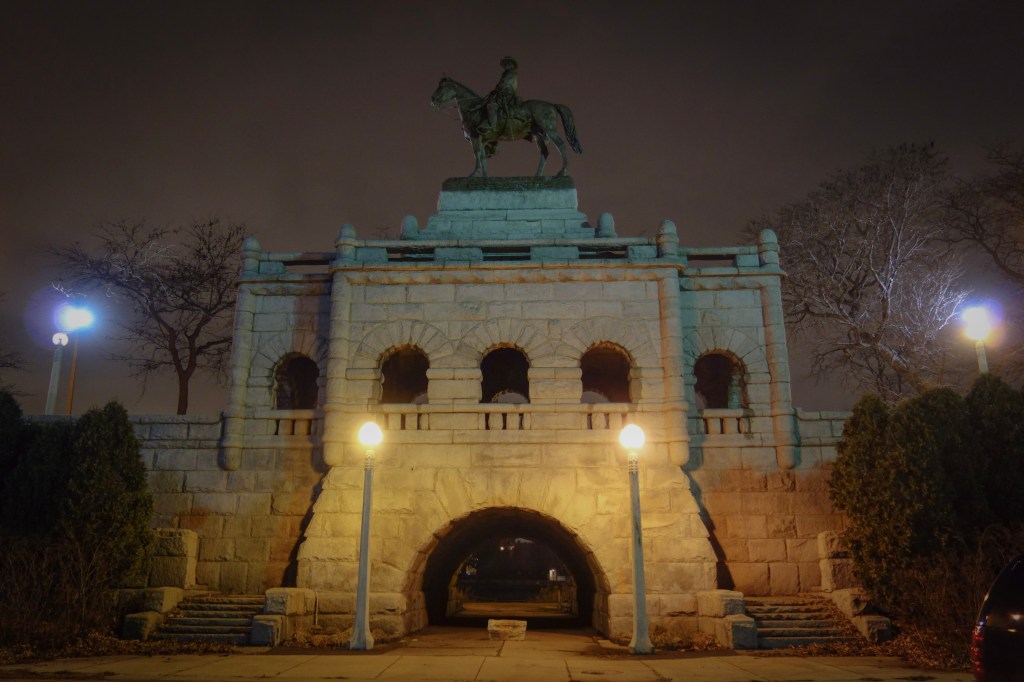
Grant Monument

Punk Postures: Overlooking Punk’s Real Lessons

It didn’t take an advanced degree in the humanities for me to realize that punk rock is a crock of shit. Just a sprained ankle. It wasn’t sour grapes, either, but dedication that broke punk’s fuck-it spirit wide open for me. For years I carried a big Fender bass amp–my only amp at the time, my precious–up and down the stairs to my Dad’s apartment. Every Friday and Sunday in 9th grade when it was time to visit Dad or go back to Mom’s, I dragged the damn thing like an Acme contraption from a Looney Tunes cartoon up those fourteen steep concrete slabs, heaving and cursing the whole way. Later, when I lived in the apartment and played in bands regularly, I lugged that heavy bastard up and down the stairs every other day like a religious ritual. It never got easier, and sometimes it lugged me down instead. But it was a price I had to pay. Asking Dad for a ride, schlepping the giant heavy box, looking like a fool, tumbling down the last three steps and limping for days afterward: far from anarchy, this was work.

fender-bxr-200-175528

Then there were the hours upon hours I had to spend practicing–an even more exhausting worship ritual than the semi-daily ritual of labor. Play the song; try the technique, again and again; pray the muscle memory remains the next day but keep trying anyway; do it over and over.

All of that work is why I can relate to the gracefully aging punks in The Guardian’s recent where-are-they-now profile, “Never Mind the Bus Pass.” 55 year-old former Alien Kulture bassist Aussaf Abbas knew, for example, that punk rock couldn’t pay the bills, so he went to work as an investment banker and has since “met prime ministers and finance ministers and CEOs of major corporations.” “This was unbelievable for an immigrant kid,” he insists, “who grew up in Brixton in a single-parent family.” One-time Au Pairs singer and guitarist Lesley Woods took a similar path to affluence. “After the band folded,” she explains, “my brain was quite scrambled and I needed to get my mind back, so I thought I’d do something really difficult and started studying law.” While she still “mucks about” with music, her work as a barrister is so intense that she only has time for a few recordings and “the odd performance.” Others in the profile tell similar stories.

The standard punk posture insists, outraged: Abbas, Woods, and their peers are sellouts, shills for neoliberalism. But for most people, music offers work—vast, endless vistas of work—with little more than a token spiritual reward at the end of the day. Investment banking may not be the best solution to the problem, but neither is Higher Education, which attracts an army of refugees from dive bars and touring vans every year. Everyone must negotiate neoliberalism on its own terms, and what choice does anyone have? Only those privileged with money or parents with money, a great deal of luck, or generous friends really have a chance to earn anything more than a few dollars and a few Facebook followers at the end of night. Most need all of these simply to live as a musician. Punk’s outrage and anarchy relies on an ocean of privilege, then. For the innumerable devotees whose parents and friends can’t or won’t support years of work without reward, punk rock’s promise of DIY catharsis is merely palliative. The truth beneath the posture gleams like a shiny nickel reflecting the inverse of the American dream: work all you want, kid. It ain’t enough.

To make matters worse, the posture has only ever been clear in retrospect. In an extraordinary piece in The Baffler last winter, “Punk Crock,” Eugenia Williamson wonders: “As punk pushes into its fourth decade, its rules, aesthetic, and parameters are still murky at best. Does punk retain any meaning at all?” Despite the claims of passionate devotees–like the Noisey Facebook commenter she quotes who argues that “the complex ideology of punk goes way beyond the genre of music–it’s also about not giving a fuck and doing exactly what is authentic to you”–punk is hidebound by an inherent logic based on fictions of lost purity and dying scenes. Beneath the aesthetic, her article suggests, punk was never really there. Its earliest adherents lived like the coke-fueled arena rockers they despised; their descendants have “not only voted for Rand Paul but [are] raising children in a McMansion funded by festival dates.” So much for anarchy.

Screen Shot 2016-05-14 at 8.44.43 AM

My own decade-long encounter with cathartic do-it-yourself anarchy was far from revolutionary. I repeated the upstairs and downstairs rituals of labor and repetition later, for example, when I was still a dropout working at Walmart by day and playing the bass by night in a band that pretended it could barely bash out the chords to “Blitzkrieg Bop.” That had been the appeal of the band, actually, when I tried out: their unapologetic badness. They had posted a to-hell-with-it ad for a bassist on Craigslist citing their inability to play but their desire to try anyway. I replied. Everyone was better than they had claimed, of course. They had performed the rituals too. So within a week I was lugging another huge bass amp up three flights of stairs twice a week to the drummer’s apartment across the street from the University of Florida. We called ourselves “Surprise Blowjob”–SBJ for short–and played a few shows over the course of a weltering Gainesville summer before going our separate ways. We joked about “punx” with one breath and rented a practice space with the other; paid for recording with one hand (well, one of us did: Thank you, Ryan, if you read this) and burned our own CDs with the other. We booked shows when we weren’t practicing; drove to Jacksonville to play for 15 people. I designed stickers and merch; stayed up a few nights after work to design a website. And then it was over. A new semester, job hunts, and grad school were looming for the students in the band. They left. Other bands were calling me. Like the individual rituals of labor and repetition, the group ritual of band-building has to be repeated like a rosary. Friends and strangers come and go from the devotee’s life.

SBJ_sticker_page

I packed and unpacked, carried and setup my amplifiers, my gig bags, my cables and pedals in and out, up and down, through every change. I understand now that these rituals of individual dedication and group support were the only authenticity punk rock could offer. Everything else is just an argument about aesthetics.