Today’s Word-of-the-Day is close to our hearts at DEP, I think, because it’s such an important part of the ecosystems we work so hard to protect. Today’s word is commensal.
There are two meanings to commensal, but I want to start with the one we’re most likely to use here.
Commensal. Biology. Applied to animals or plants which live as tenants of others (distinguished from parasitic).
It’s easiest to understand the concept if we apply an –ism to the end. Commensalism is a relationship in which one party benefits while the other is unaffected. It’s different from parasitism, in which one animal benefits at the expense of another; and it’s different from mutualism, in which both parties benefit.
So why is it important to our work at DEP? In two words: Gopher Tortoises.
I’ll let FWC tell the story using their website on the topic. There’s also a great fact sheet there and a neat flickr gallery of photos.
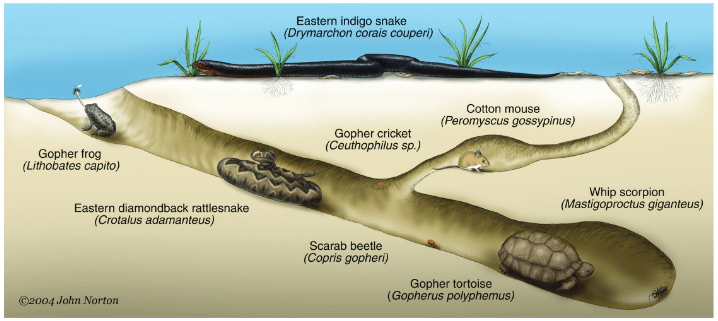
“The gopher tortoise’s presence is important to more than 350 species that benefit from the burrows gopher tortoises dig. Because gopher tortoises alter their environment in a way that benefits other species, they are recognized as a keystone species. Animals that obtain food, refuge, and other benefits from the burrows are known as gopher tortoise commensal species. A healthy and widespread gopher tortoise population is necessary for commensal species populations to exist.”
Some of these commensal species include: burrowing owls, indigo snakes, rattlesnakes, mice, and a host of insects. There’s a lot going on in those burrows!
I didn’t know this before I started writing about commensals this afternoon, but this meaning comes from an earlier definition of commensal.
Commensal. Adjective. Eating at, or pertaining to, the same table.
People used the word this way for over 500 years before the biologists took it over. The first reference in written English comes from a middle-English text called the Testament of Love, in which one of the characters asks another, “O where hast thou bee so long commensal?”
Perhaps that’s what I’ll ask one of the Gopher Tortoise commensals the next time I see one in the woods.
Are you familiar with any other commensals? Does anyone have anything to share about Gopher Tortoises, the 350 species who live with them, or any other Florida commensals?
Thanks for reading and have a great week!

 C.B. Crenshaw