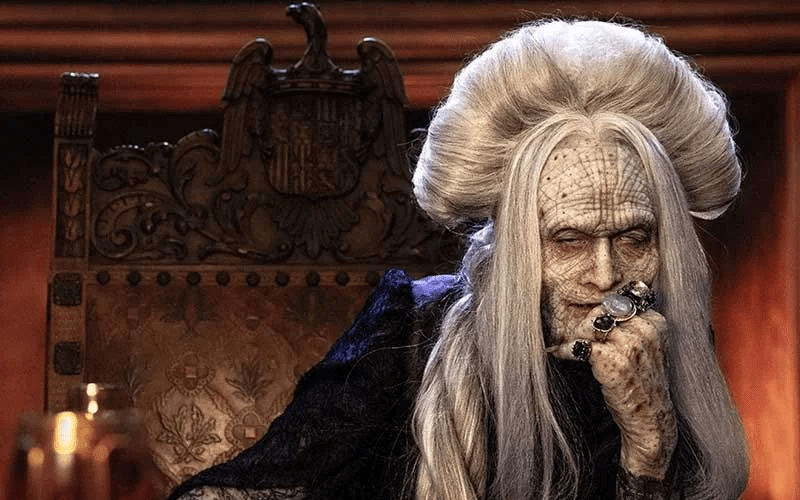
If your mind works anything like mine, at some point during Luc Besson’s Dracula—which is, let’s just get it out of the way, a sumptuous visual feast inspired in equal parts by John Boorman’s Excalibur, Tom Tykwer’s Perfume, and Disney fairy tales—you may find yourself asking: why are we asked to identify with this bloodthirsty creature? Is it actually good and noble to be an undead hematophagous thing, spreading a curse across Eurasia like a dark blot of ink? Should we aspire to be evil legends like this beautiful medieval knight-turned-cryptid fiend?
I think Besson is saying: yes, go for it. Which—without recounting the history of the man here—is not altogether surprising.
And, you know, come to think of it, Dracula and Iron Man and Film Directors have much in common. Iron Man and Dracula are solitary geniuses. Both toil in dark, secret lairs, where they manufacture mysterious and invincible technologies. Iron Man makes a suit of miraculous alloys, rocket-powered shoes, a futuristic computer familiar. Dracula produces mad familiars, enchanted gargoyles, armies of animal allies. Film Directors also like to imagine themselves as genius auteurs. Both Iron Man and Dracula have an inexhaustible supply of money. We see Dracula’s gargoyle minions stacking his dining hall with riches here, and the hellish fiend simply does not care. Film Directors, I like to think, are much the same.
It’s no wonder, then, that we are asked to see Dracula as some sort of hero. In the same way we are asked to see the rogue billionaire Tony Stark as a hero, and we are encouraged to look upon the definitely-not-a-sex-criminal Film Director (all of them, that is) as a singular genius, too.
Another thing you might think about, if you’re like me, is how each generation of films seems to ask us to identify ever more closely with Dracula and other horrifying things. The Count was always steeped in gothic romance, it is true, but it is only since the End of History in the 1990s that we have been asked to properly empathize with the beast as a modern man—to consider his point-of-view and find in it something worthwhile. This is a creature who sinks his teeth into the flesh of the living and either drains their life or damns them to an eternity of dark and vile urges. That the creature also happens to be in love with the memory of a woman who died in the 15th century seems beside the point. Doesn’t it?
Is it because the industry is peopled with monstrous men like Harvey Weinstein, Steve Bannon, and Jeffrey Epstein that we are encouraged to look upon seducing and drinking the blood of nubile young women, plunging cold steel into the hard bodies of young men, or murdering a convent full of nuns as kinda fun things you might want to do on a Friday night? Is it because we are ruled by an unstoppable gang of cheapjack thugs and bone-crunching weirdos that our movie villains refuse to stay dead? Again and again they die. Again and again they come back. Nothing changes. They want more.
Besson, at least, brings Dracula to an end in this film. When Christoph Waltz’s steel spike breaks the fiend’s cold, dead heart, his cursed ashes rise toward the brilliant light of salvation like a murmuration of swallows. Here’s one very bad man, at least, who goes straight to heaven. So that’s something.
(Edit: I’m not the only one thinking about the literal monsters running things. Here’s a blog post about the vampires of Silicon Valley I found linked on Hacker News the morning after I published this review. -CBC)
 C.B. Crenshaw